


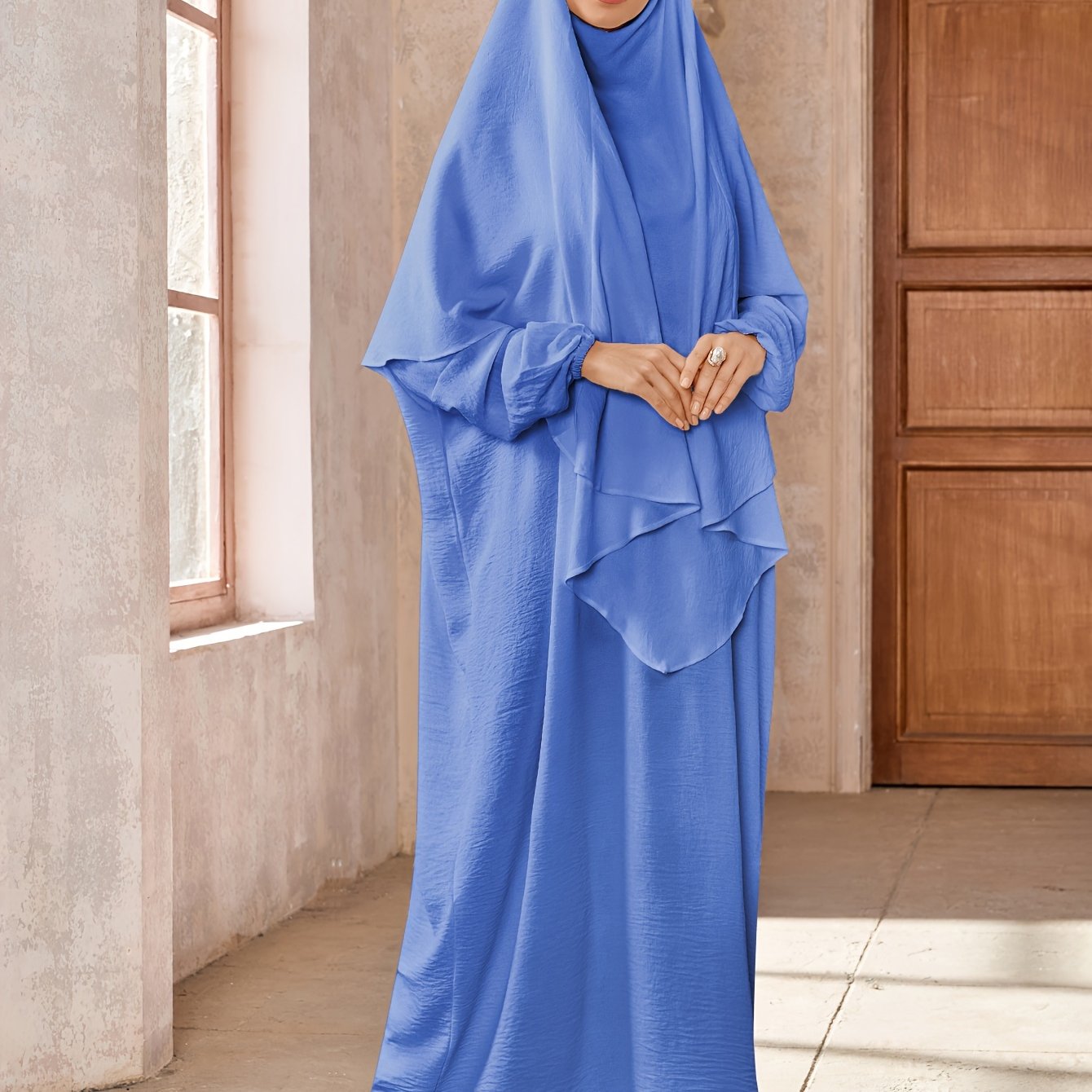
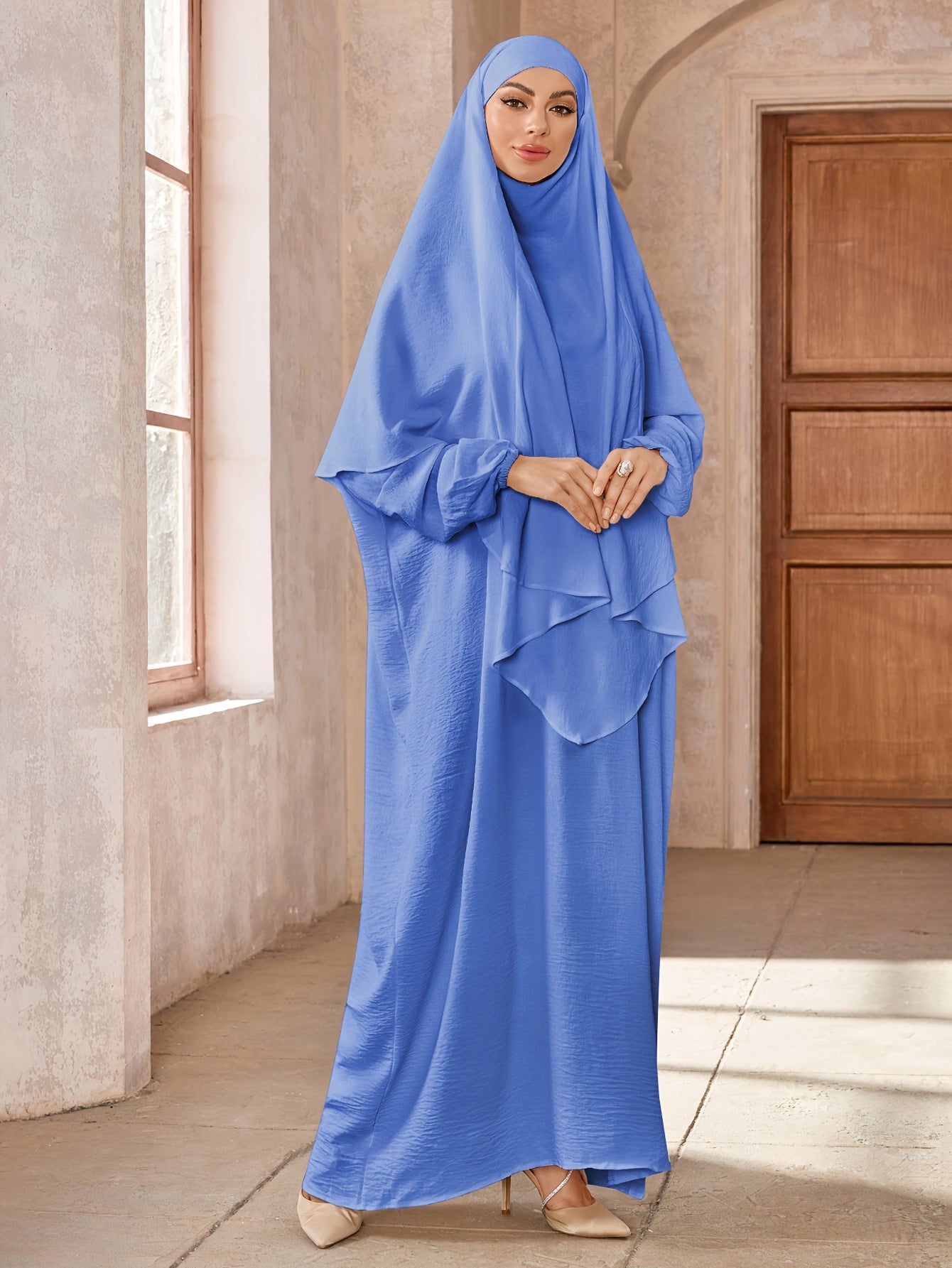
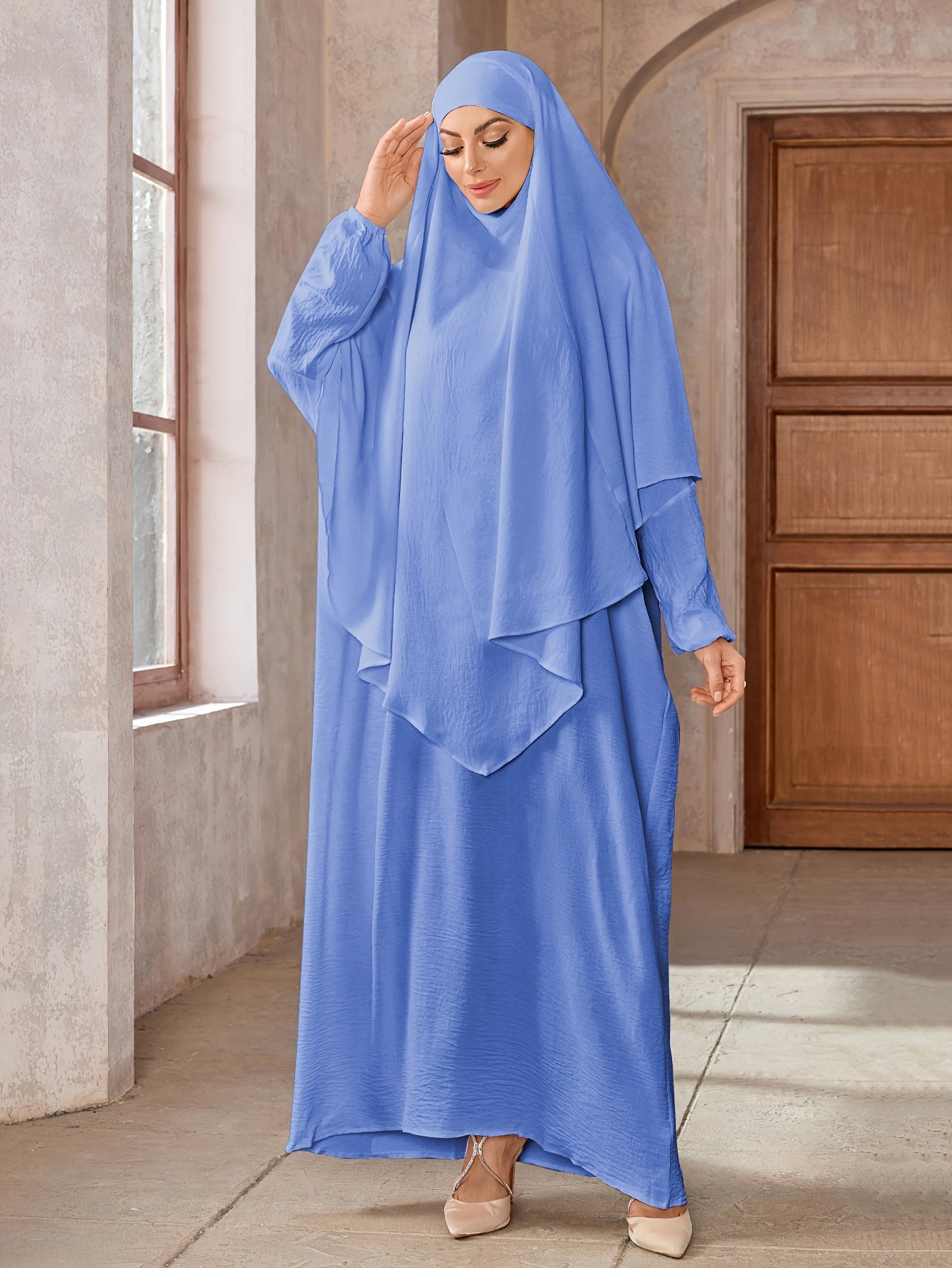
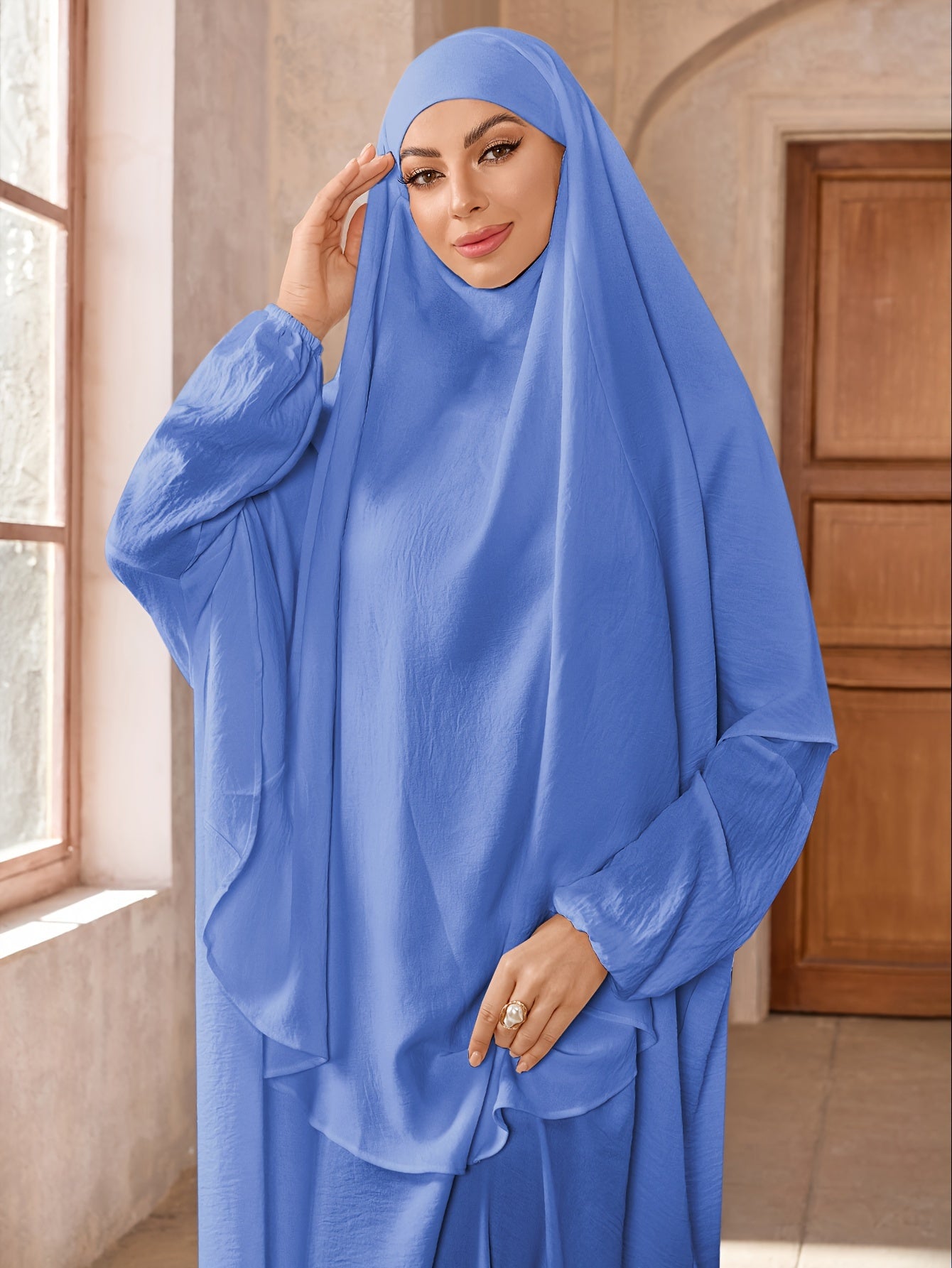
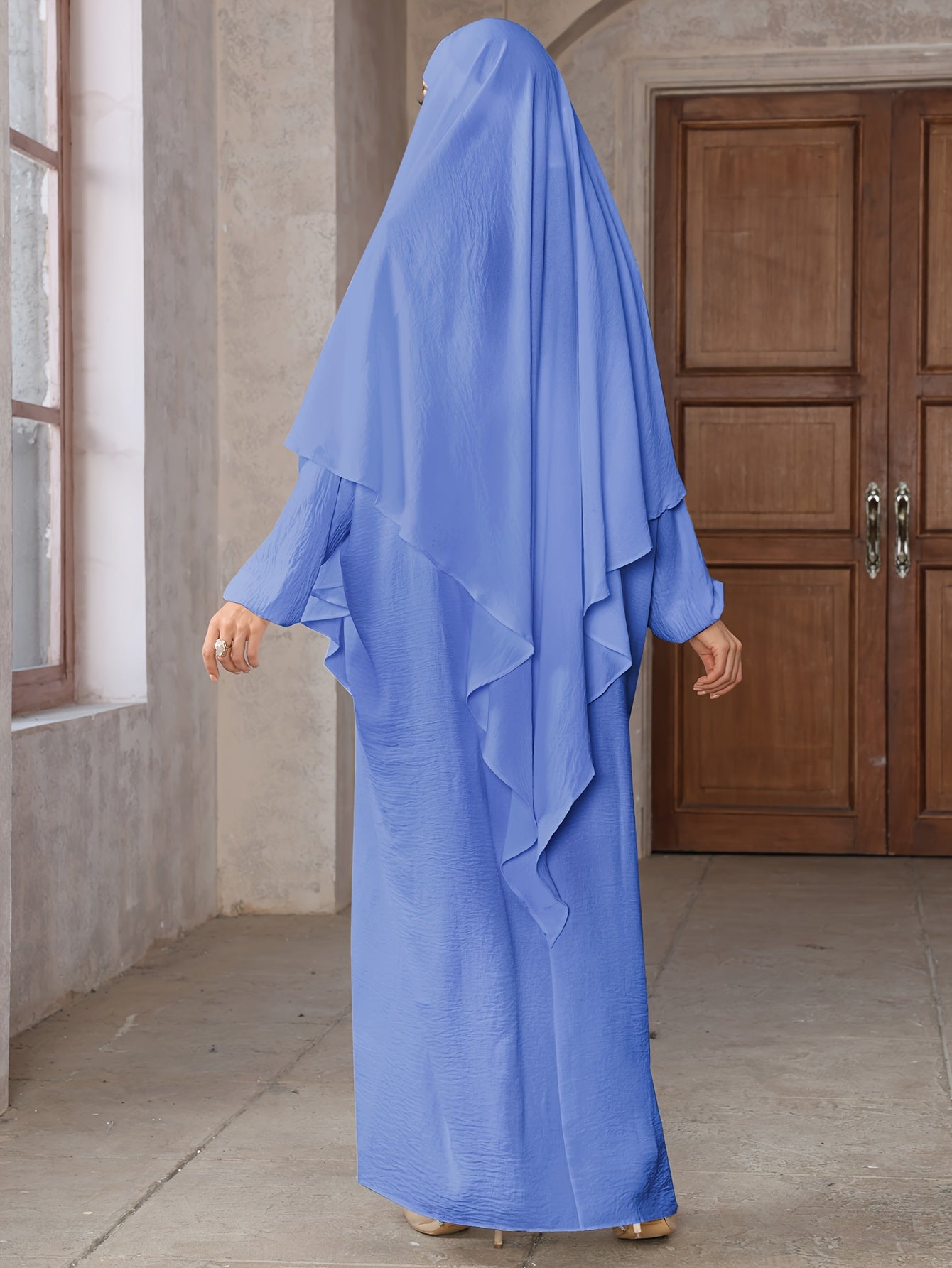
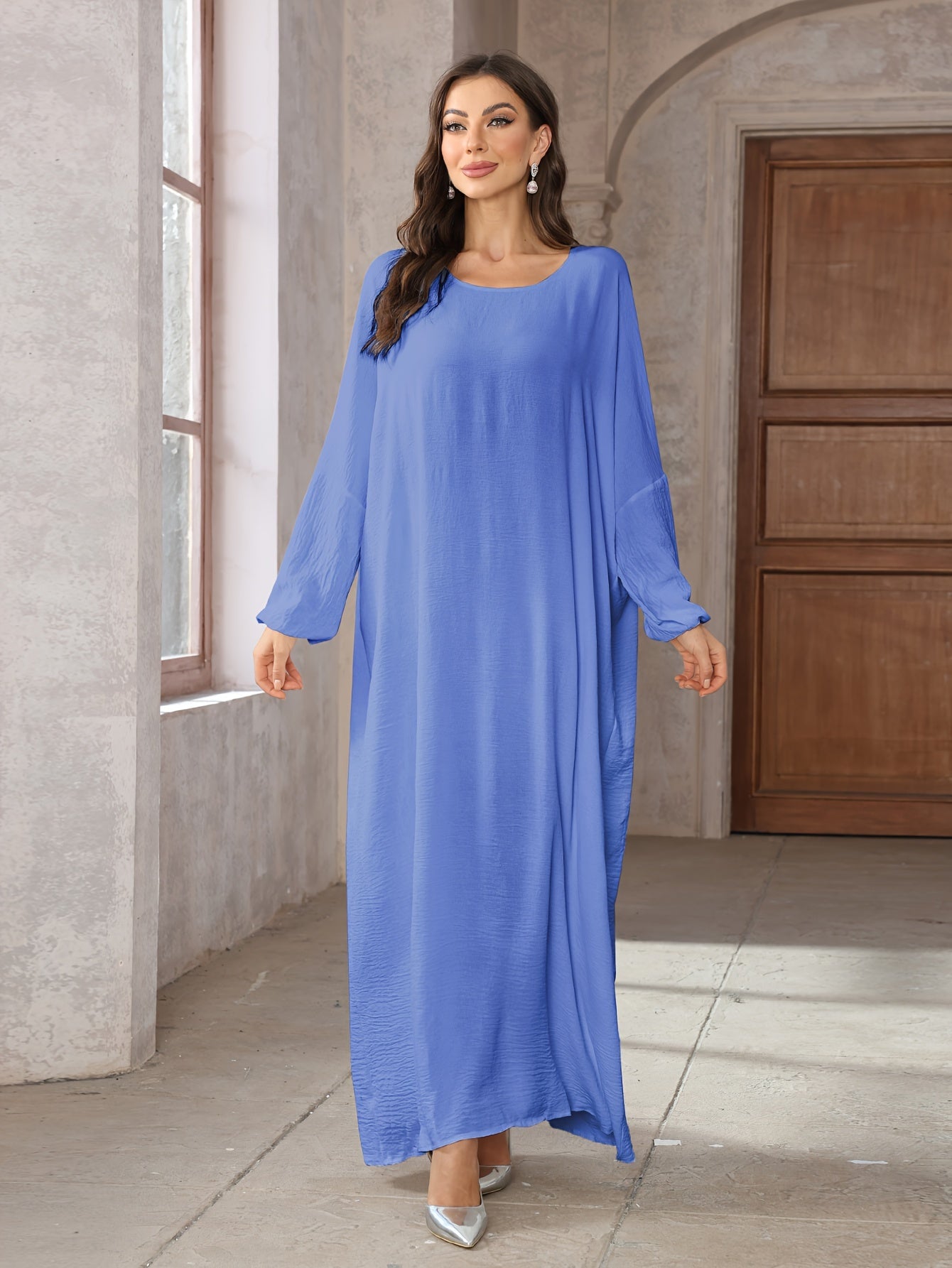
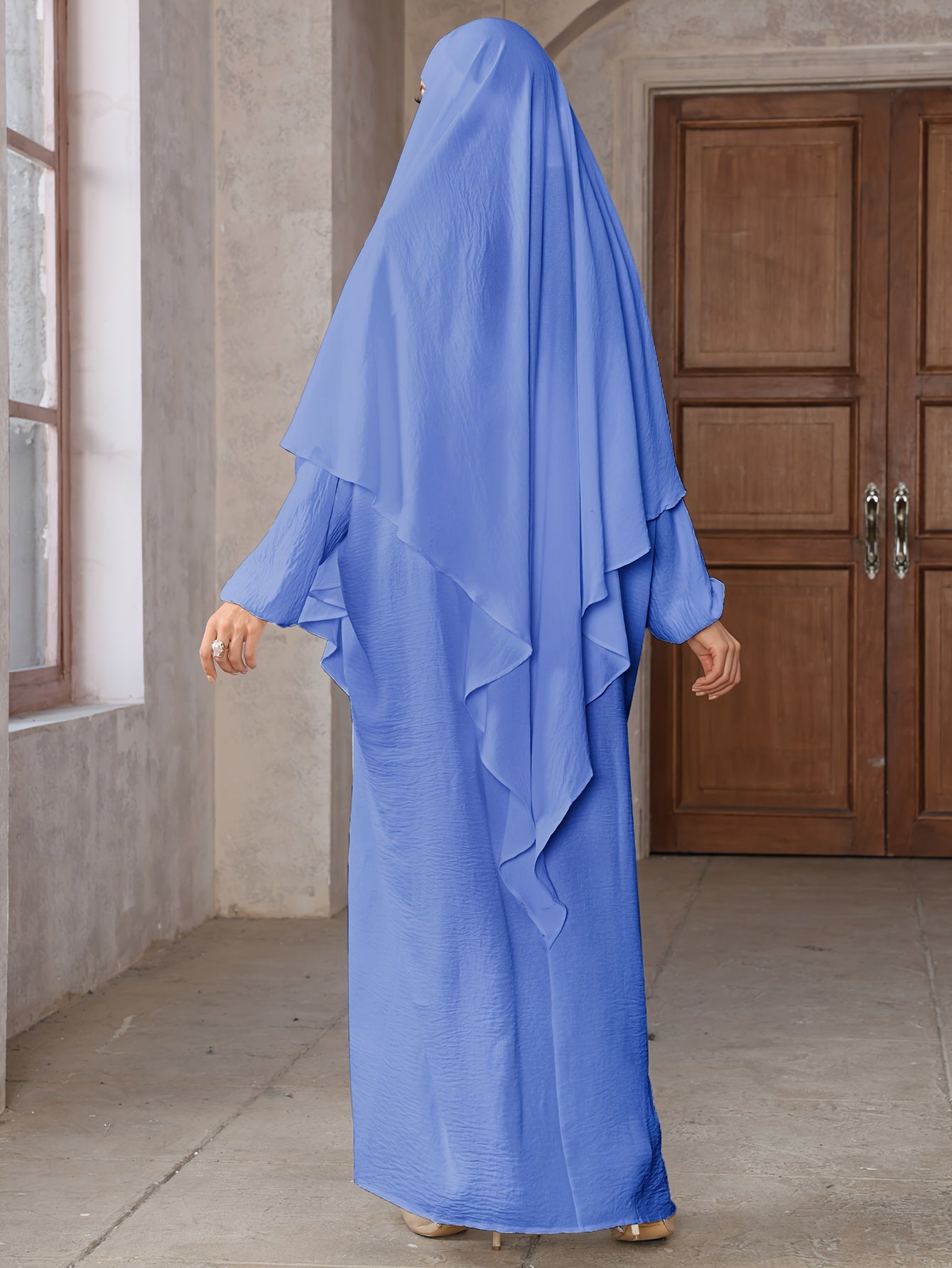
SPECIFICATIONS
Belt: No
Composition: 100% Polyester
Dresses Length: Long length
Fabric: Non-Stretch
Fit Type: H
Length: Long length
Material: Polyester
Occasion: Weekend Casual
Operation Instruction: Machine wash or professional dry clean
Pattern: Solid color
Placket Type: Pullovers
Printing Type: No Printing
Season: All
Sheer: No
Silhouette: Loose
Sleeve Length: Long Sleeve
Sleeve Type: Batwing sleeve
Suitable types: Loose
Type: Kaftan
Weaving Method: Woven
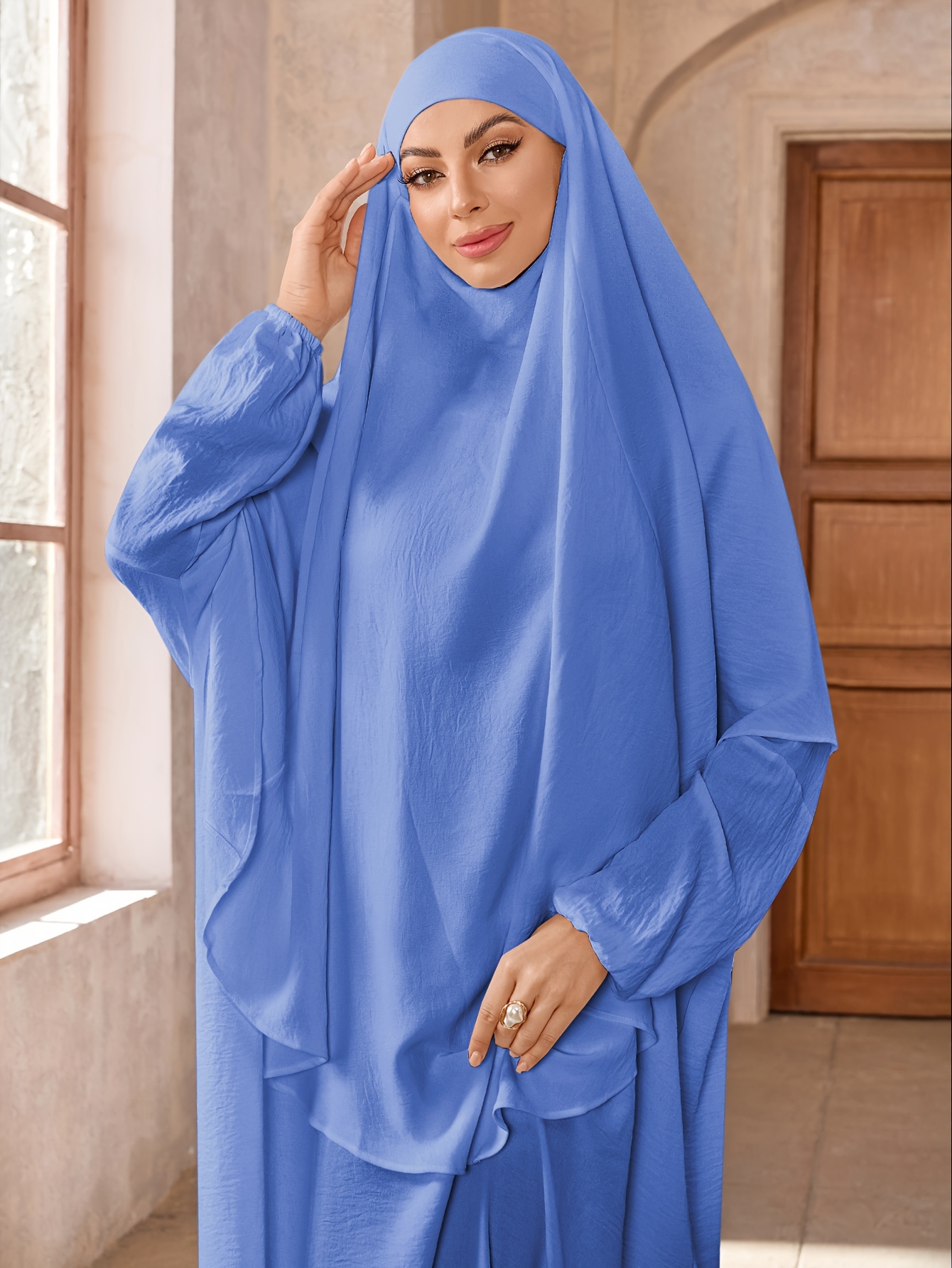
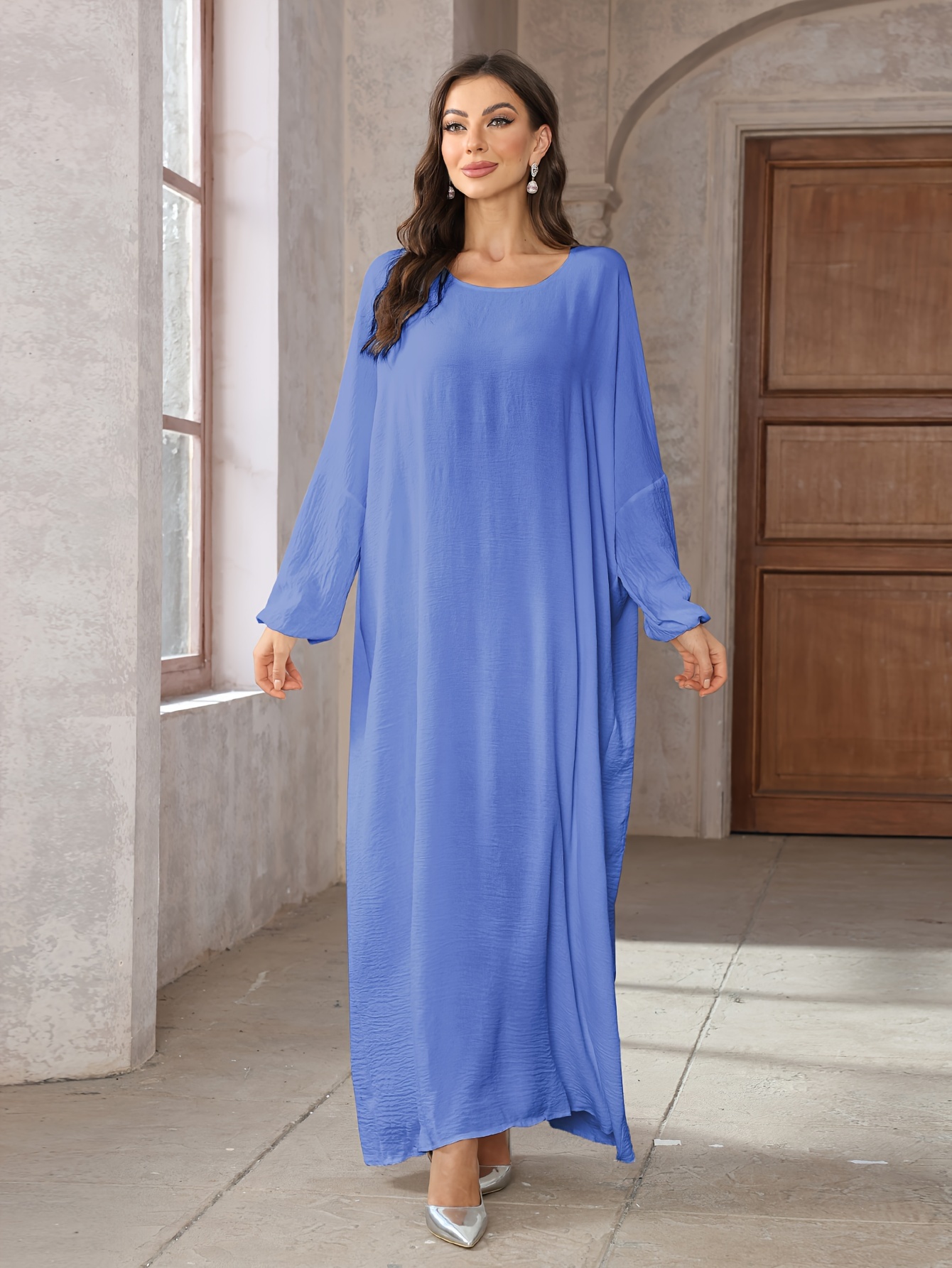
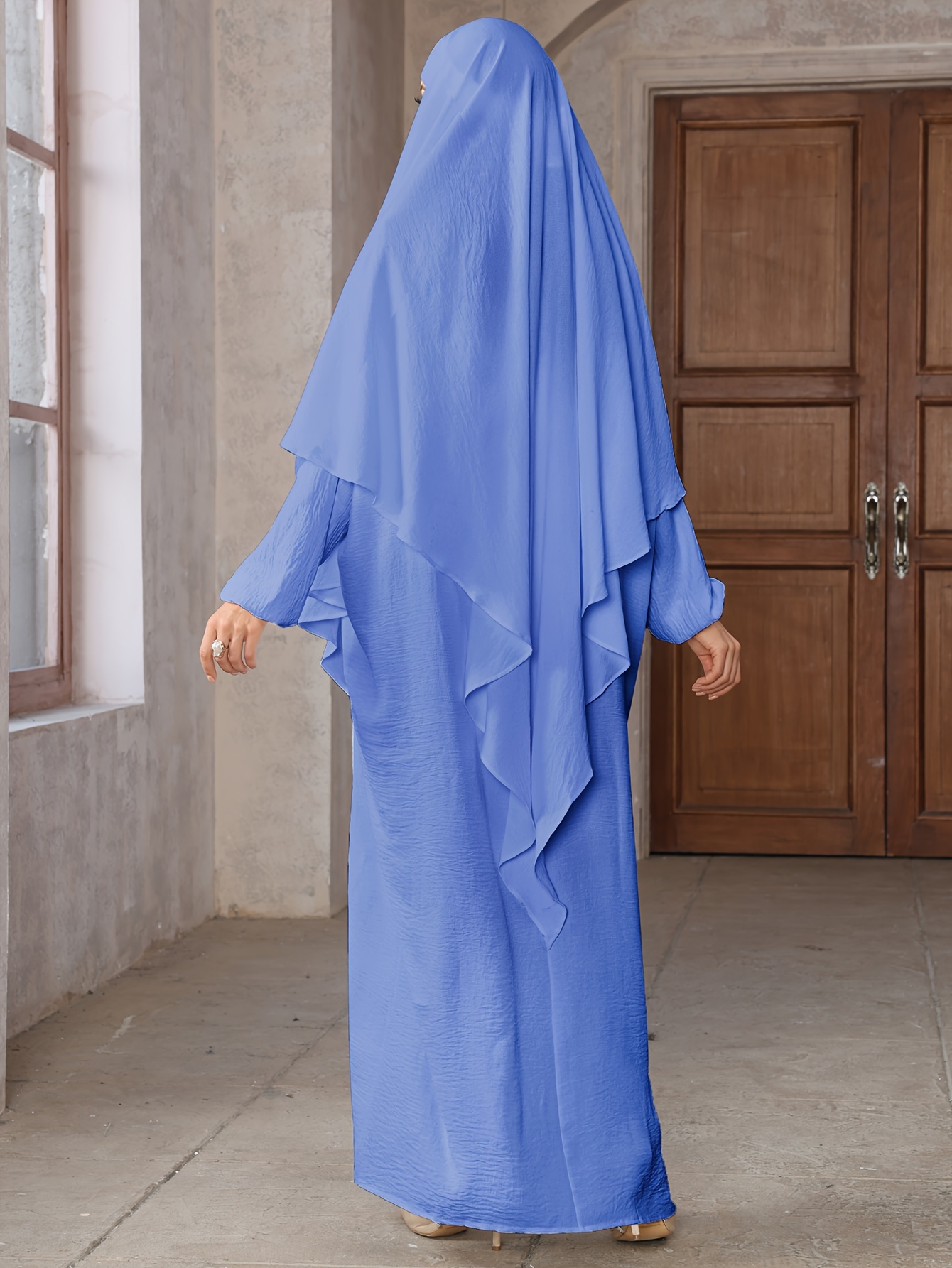
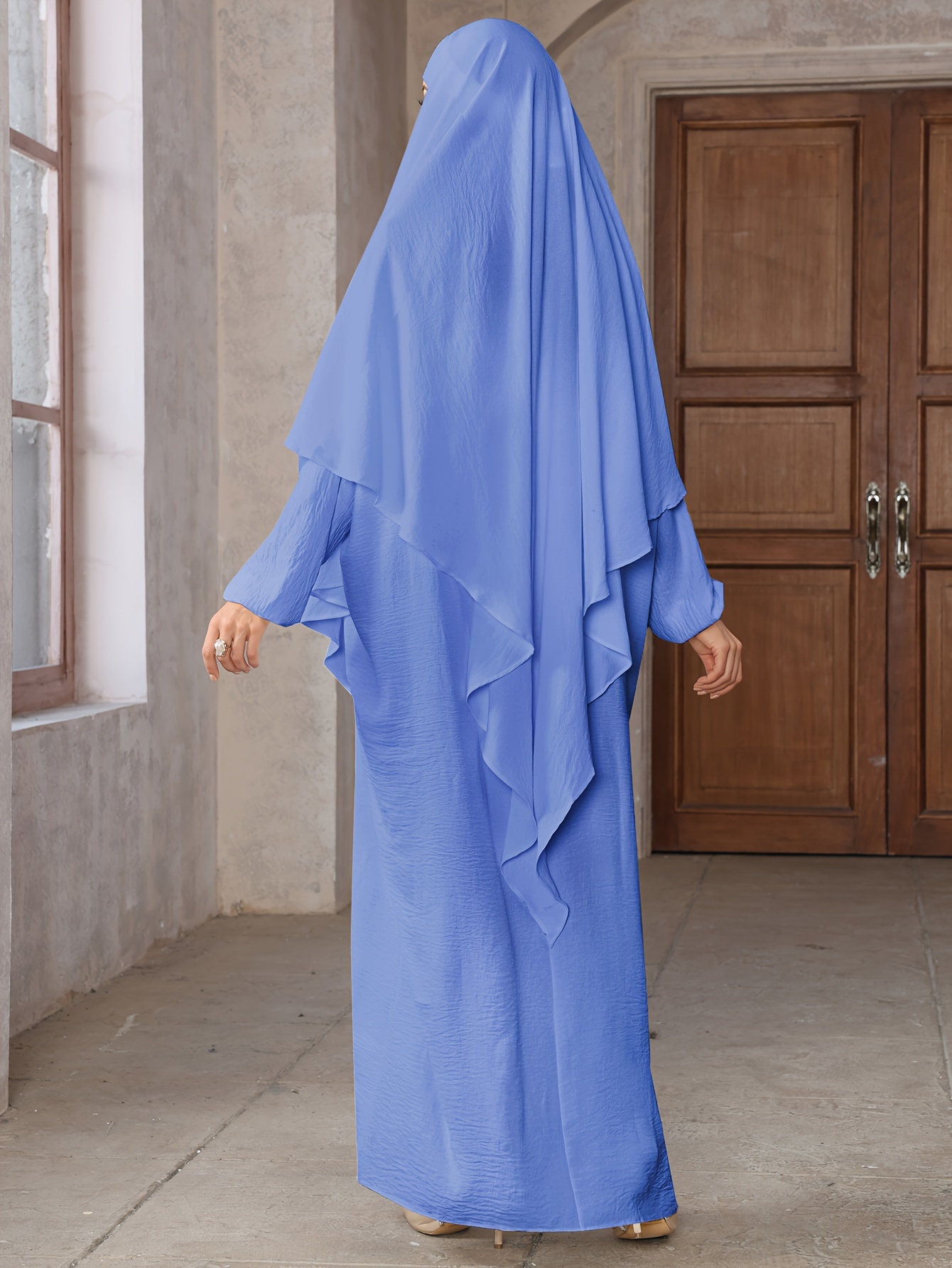
Women’s Plus Size Modest Maxi Jilbab Abaya and Hijab – Elegant Long Sleeve Two-Piece Outfit
To understand the significance of the Plus Size Solid Maxi Jilbab Abaya with Hijab, one must first appreciate the garment’s centuries-long journey. The abaya emerged in the heart of the Arabian Peninsula as a practical yet deeply symbolic cloak. Initially, its purpose was twofold: to shield women from the desert’s harsh elements and to provide a visible representation of modesty. In an environment where the sun’s intensity demanded protective layering, the abaya evolved into a garment that combined necessity with cultural expression.
As Islamic civilization flourished, the abaya expanded in relevance across different geographies. In North Africa, abaya-like robes incorporated looser silhouettes influenced by Berber traditions. Across the Ottoman world, the cloak was adapted with fine textiles and embroidery, representing not only modesty but social prestige. In South Asia, long-flowing garments resembling the abaya became integrated into local clothing traditions, with fabric choices and detailing often symbolizing regional identity. Despite these variations, the essence of the abaya remained unchanged: it was always about dignified coverage paired with understated beauty.
This continuity underscores the abaya’s role as more than just a piece of clothing—it became an emblem of cultural identity and continuity. Even as global fashion shifted through waves of ornamentation, industrialization, and minimalism, the abaya retained its position as one of the world’s most resilient garments, proof of its adaptability and symbolic power.
Cultural Resonance Across Generations
The jilbab abaya has always been more than fabric stitched into form; it is a garment that carries within it the collective memory of generations. It is a piece that does not belong to one individual alone but to families, communities, and civilizations. At its essence, it is a garment that connects the sacred with the everyday, the private with the public, and the historical with the contemporary. To wear an abaya is to step into continuity, to place oneself in a lineage of women who have, for centuries, affirmed their faith, dignity, and cultural pride through this timeless cloak.
Its cultural role extends far beyond the confines of religious practice. While modesty is its foundation, the abaya also exists as a unifying symbol across diverse geographies. From the sands of the Arabian Peninsula to the cosmopolitan streets of global capitals, the abaya speaks a language that is instantly recognizable. It communicates belonging, respect, and shared identity in ways that few garments achieve. For countless women, it is a reminder that style can hold spiritual depth, that clothing can embody values that transcend fashion’s surface appeal.
One of the abaya’s most powerful qualities is its intergenerational significance. Mothers pass them down to daughters not merely as garments but as heirlooms. Each fold carries memories—of prayers whispered in solitude, of family celebrations, of travels undertaken with grace. In these exchanges, the abaya becomes a tangible connection between past and present, allowing younger generations to inherit not just fabric but the wisdom and dignity of their foremothers. Unlike fleeting fashions that dissolve in memory, the abaya strengthens bonds across time. It becomes part of a family’s cultural archive, woven with stories that outlive individual lifetimes.
This intergenerational resonance also reflects the role of artisans. In many regions, abayas were not merely purchased but commissioned, tailored by skilled hands for ceremonial occasions or significant milestones. The fabric, embroidery, and finishing were chosen with intention, ensuring that the garment carried the weight of meaning. Each stitch was an act of devotion, a recognition that clothing could embody values and aspirations. When these garments were preserved and passed on, they carried with them not only the memories of those who wore them but also the artistry of those who created them.
What makes the abaya so enduringly powerful is its capacity to embody multiple meanings simultaneously. For some women, it represents their spiritual practice, a visible reminder of their faith. For others, it is an expression of cultural pride—a way of affirming heritage in a world that often pushes toward uniformity. Still, for many, it is both: a garment that exists at the intersection of devotion and identity. It has the rare ability to shift fluidly between these meanings, accommodating the complexity of women’s lives without contradiction.
Over centuries, this symbolic strength has only deepened. Even as global fashion trends accelerated, bringing forth new silhouettes and aesthetics with each season, the abaya retained its core essence. It did not resist evolution entirely; its fabrics, colors, and detailing adapted to reflect the spirit of each age. Yet these changes never stripped it of identity. The abaya remained recognizably itself, proving that tradition and modernity need not be in opposition but can coexist in harmony.
In today’s interconnected world, the abaya has stepped onto global platforms as a cultural ambassador. Modest fashion shows in Paris, London, and New York frequently feature contemporary interpretations, often styled alongside Western garments or infused with high-fashion embellishments. These adaptations broaden its audience, introducing its elegance to women who may not share the same cultural background but resonate with its dignity and refinement. Despite these reinterpretations, the abaya never loses its essence. It maintains its identity even as it enters new contexts, a rare achievement in a fashion landscape where garments are often stripped of their origins when globalized.
The abaya’s ability to transcend aesthetics speaks to its depth of meaning. It is not merely a garment worn for beauty—it embodies dignity, modesty, and legacy. Fashion at its most powerful does not decorate but communicates, and the abaya communicates across generations, across borders, and across cultures. It is a reminder that clothing can serve as language, articulating values that words may fail to capture.
The resilience of the abaya in a globalized age is itself significant. Many traditional garments have been diluted or relegated to ceremonial use only. The abaya, however, continues to live in both daily and ceremonial contexts. It thrives in contemporary wardrobes without surrendering its symbolic role. Women wear it to prayer and to business meetings, to weddings and to international travel. It is a garment that refuses confinement, instead expanding to meet the varied realities of modern life.
This universality underscores why the abaya remains relevant for younger generations. In an era where many young women feel torn between honoring tradition and embracing modern expression, the abaya provides a solution. It demonstrates that one can participate fully in contemporary fashion while remaining rooted in heritage. It bridges faith and identity with a grace that reassures rather than divides. This is why young designers are increasingly drawn to reinterpret the abaya—not to change its essence, but to celebrate its adaptability and ensure its survival into the future.
The abaya’s resonance also lies in its role as an emblem of empowerment. Where once modesty was dismissed in some circles as restrictive, the abaya now stands as a symbol of agency. Women choose it not out of compulsion but conviction. They wear it as an assertion of values, a declaration that modesty can be powerful, dignified, and beautiful. This transformation of perception is itself generational. Older women may remember times when the abaya was associated narrowly with obligation; younger women increasingly see it as a symbol of pride, choice, and cultural affirmation.
Its significance across generations lies, ultimately, in its continuity. Few garments manage to sustain their symbolic power across centuries without becoming relics. The abaya is not a relic. It is alive, constantly reinterpreted, constantly affirmed by those who wear it. Its resilience testifies to its capacity to hold multiple meanings, to serve multiple roles, and to transcend the limitations of time.
When women wear the jilbab abaya today, whether in a traditional setting or on the runway of a global fashion week, they are participating in this continuum. They are not simply wearing fabric; they are carrying with them the voices of mothers, artisans, ancestors, and communities. Each abaya is part of a story larger than itself, and each wearer contributes her chapter. In this way, the abaya becomes one of fashion’s most profound cultural symbols—an enduring garment that reminds us that clothing, at its best, is never only about the present moment but about the legacies it preserves and the futures it inspires.
Design Philosophy Of The Maxi Jilbab Abaya
The Fabulive Plus Size Simple Solid Maxi Jilbab Abaya with Hijab reflects this deep history while simultaneously addressing modern needs. Its design philosophy is rooted in restraint and elegance, a celebration of simplicity that avoids excess. The flowing silhouette is constructed to allow effortless movement, a practical detail that reflects the abaya’s nomadic desert origins. Yet the cut has been refined for contemporary life, balancing tradition with modern tailoring.
The garment’s two-piece composition—a maxi jilbab paired with a coordinating hijab—creates a unified ensemble that reduces the need for styling guesswork. For women navigating busy routines, this functionality ensures ease without compromising dignity. The inclusion of plus-size dimensions underscores inclusivity, acknowledging that modesty belongs to every woman regardless of size or shape.
Long sleeves provide coverage while contributing to the overall harmony of the design. The robe’s length creates an elongating effect, enhancing elegance while ensuring modest proportions. This measured approach demonstrates why the abaya continues to resonate—it relies on balance, subtlety, and proportion rather than flamboyance.
The Aesthetic Of Simplicity
In contemporary fashion, simplicity is often the highest expression of sophistication. The abaya’s minimal design allows the wearer herself to remain central, not overshadowed by the garment. Solid colors, flowing fabric, and the absence of ornate embellishments ensure that the abaya becomes a timeless investment rather than a seasonal trend.
This aesthetic has resonated with luxury fashion houses that increasingly embrace minimalism. Where once ornamentation dominated high-end fashion, now restraint and quiet elegance are seen as aspirational. The Plus Size Simple Solid Maxi Jilbab Abaya situates itself within this context, offering women a garment that speaks to refinement without ostentation.
Its presence in a wardrobe extends beyond the limits of cultural or religious significance. Women who are not bound to wear modest attire still find in the abaya a garment of remarkable versatility. As a robe, as outerwear, or as a layering piece, its design adapts with graceful ease, demonstrating why minimalism is often considered the ultimate form of luxury.
Evolution Into Modern Modest Fashion
The twenty-first century has seen modest fashion gain international recognition, and the abaya stands at the center of this movement. Global fashion media increasingly highlight the ways in which modest dressing offers alternative narratives of empowerment. Rather than being a symbol of restriction, garments like the jilbab abaya are embraced as choices rooted in personal agency.
Fabulive’s design situates itself at this intersection of tradition and modernity. By offering inclusive sizing, timeless silhouettes, and solid hues, the garment communicates values of dignity and universality. It challenges outdated notions of exclusivity by embracing diversity in size and style preferences. This is why the abaya resonates not only in Middle Eastern markets but among women in Europe, North America, and beyond who admire its elegance.
The contemporary relevance of this piece lies not only in its historical continuity but in its adaptability to today’s fashion language. It functions as both heritage garment and style statement, a rare balance that few pieces in the global fashion archive have achieved.
Symbolism In Contemporary Wardrobes
When a woman selects the Plus Size Maxi Jilbab Abaya with Hijab, she participates in a symbolic act that goes beyond clothing. It is a reaffirmation of values—modesty, dignity, continuity, and intentional living. Unlike fast fashion pieces that are easily discarded, the abaya asserts permanence. Each time it is worn, it reminds the wearer of belonging, cultural affirmation, and timeless beauty.
This symbolic quality has elevated the garment into more than fashion; it has become a cultural artifact. Just as jewelry or heirlooms carry significance, so too does the abaya serve as a vessel of identity. For women navigating global modernity, this offers grounding—an anchor to heritage within a constantly shifting landscape.
The simplicity of its solid design makes it versatile for daily use while retaining ceremonial gravitas. It is as appropriate for family gatherings and religious observances as it is for professional or travel settings. This universality makes the abaya a rare garment that does not limit but expands possibilities for self-expression.
The Philosophy Of Color In Modest Fashion
Color in clothing is never neutral; it carries meanings, moods, and cultural associations. The Plus Size Simple Solid Maxi Jilbab Abaya with Hijab embraces the language of solid tones, an aesthetic choice that signals restraint, elegance, and timeless relevance. Solid colors have long held a place of importance in modest attire because they allow the garment to convey dignity without distraction.
Historically, black became the most recognizable shade for abayas across the Middle East, a color of both modesty and prestige. It provided anonymity while also projecting authority and gravitas. Over centuries, black abayas evolved into cultural icons. Yet alongside this, other shades began to emerge depending on region, season, and personal taste. Earth tones, creams, and deep jewel hues allowed women to express individuality within the boundaries of modest fashion.
In the contemporary interpretation, solid colors also align with global minimalism. Modern luxury often favors monochrome or neutral palettes, as they convey a sense of understated sophistication. This is why the Fabulive jilbab abaya resonates across audiences: it combines traditional modest color philosophy with modern minimalism. Neutral solids such as black, navy, or beige can serve as wardrobe anchors, easily styled for different settings.
The role of color here is not to overpower but to harmonize. It enables the abaya to act as a canvas—ready to be adorned with accessories or left pure in its own simplicity. In either case, the wearer herself remains central, not eclipsed by design excess.
Fabric As A Statement Of Luxury
The material of an abaya determines not only its look but its experience. For centuries, textiles were markers of identity and wealth. Silks, wools, and fine cottons differentiated social strata across regions. The choice of fabric also reflected climate adaptability: heavier weaves for cooler seasons, lighter ones for hot environments.
The Plus Size Simple Solid Maxi Jilbab Abaya uses polyester blends crafted for both elegance and practicality. Polyester, though a modern textile, has earned its place in modest fashion for its durability, lightweight feel, and resistance to wrinkling. It provides a fluid drape that mirrors the flow of traditional abayas, while also supporting modern lifestyles where low-maintenance fabrics are essential.
Unlike delicate silks or high-maintenance linens, polyester maintains color richness over time and requires minimal care. This reflects an important evolution in luxury: no longer defined solely by rarity of materials, but by the balance between beauty, longevity, and convenience. In today’s world, women value garments that can transition between professional, familial, and social settings without excessive upkeep.
The abaya’s fabric is engineered for breathability, allowing airflow during warm months, yet retains sufficient weight to provide comfort in cooler climates. This adaptability reflects centuries of textile innovation across Islamic regions, where versatility was essential for nomadic lifestyles and seasonal shifts. By choosing such a fabric, Fabulive ensures that the garment remains functional across diverse geographies and climates.
Craftsmanship: Minimalism As Precision
Minimalist garments may appear simple, but their execution requires exceptional craftsmanship. The Plus Size Maxi Jilbab Abaya demonstrates this principle through precise tailoring. The long sleeves must strike a balance—providing coverage without restricting movement. The robe’s length must flow elegantly while avoiding unnecessary weight. The hijab’s drape must coordinate seamlessly with the abaya, creating a unified silhouette.
This attention to proportion distinguishes luxury from ordinary production. Every seam contributes to balance, every fold to harmony. The challenge in minimalist fashion is that nothing can be hidden; the absence of ornamentation means that cut and fabric must carry the design entirely. It is here that the jilbab abaya achieves quiet mastery.
The plus-size tailoring adds another layer of complexity. Too often, garments for larger sizes are produced without proper adaptation of proportions. Fabulive’s design recognizes the importance of dignity in fit, ensuring that the robe maintains its elegance regardless of body shape. This inclusivity is not only functional but also philosophical—it communicates that beauty and modesty are not confined to narrow definitions of size.
The craftsmanship extends beyond construction to the integration of the hijab. Matching sets provide both aesthetic harmony and practical convenience. Rather than searching for coordinated accessories, the wearer is offered an ensemble already balanced in tone and proportion. This is luxury in its most thoughtful form: reducing effort while maximizing refinement.
Seasonal Versatility And Global Appeal
A remarkable quality of the Plus Size Maxi Jilbab Abaya is its ability to transcend seasons and borders. Historically, abayas were crafted for the desert climate, providing shade while allowing airflow. Today, this principle translates into garments that function across varied geographies.
In summer, the lightweight polyester ensures comfort, allowing the robe to serve as breathable protection against the sun. Its loose silhouette prevents clinging, maintaining airflow. In winter, it can be layered over thermal undergarments or paired with coats, transforming into a versatile outerwear piece. This duality makes it not only a cultural garment but also a cosmopolitan wardrobe essential.
Travel further highlights its value. Modest women who move across international cities require garments that function in both religious contexts and modern urban environments. The abaya’s solid color and minimalist design enable it to blend seamlessly into global style while retaining cultural identity. It is equally at home in Dubai, London, or Toronto—a true testament to the universality of modest fashion.
The Luxury Of Restraint
In an era where fashion often equates luxury with embellishment, the Plus Size Maxi Jilbab Abaya reminds us of another tradition: luxury as restraint. Historically, some of the world’s most influential garments—such as the Japanese kimono or the Roman toga—were defined by simplicity of cut and purity of fabric. The abaya belongs to this lineage.
Its luxury lies not in excess but in intentionality. Every choice—color, fabric, silhouette—is deliberate. There is no waste of detail, no superfluous adornment. Instead, beauty is achieved through proportion, fluidity, and timelessness. This philosophy aligns with modern values of sustainability, where consumers increasingly seek investment pieces that transcend seasonal trends.
By wearing this abaya, a woman communicates sophistication through understatement. She chooses timeless elegance over trend-driven ephemerality. This subtlety is what makes the garment luxury editorial rather than ordinary retail. It is designed not merely to be worn, but to be experienced—an act of grace in fabric form.
Everyday Functionality: A Garment That Adapts To Modern Life
In contemporary wardrobes, the value of a garment is determined not only by how it looks but by how it adapts to the diverse roles women fulfill each day. The Plus Size Simple Solid Maxi Jilbab Abaya with Hijab is designed with this principle at its core. Its flowing silhouette, full-length coverage, and complementary hijab combine to create a piece that transitions seamlessly across moments of daily life.
Consider a modern woman’s day. She may begin with morning prayer, move into professional engagements, and later participate in social or familial gatherings. This abaya allows her to glide through each setting without the need for constant changes. Its simplicity ensures that it is appropriate for spiritual practice, while its elegance makes it equally fitting for professional or casual environments. The matching hijab removes the styling burden of coordinating accessories, offering a polished appearance in minutes.
Travel adds another dimension to its functionality. For women who navigate different cultural contexts, modest attire can sometimes be challenging to manage. This two-piece set offers a solution: lightweight for packing, crease-resistant for easy maintenance, and versatile enough for both formal visits and relaxed outings. The abaya becomes a reliable companion on journeys, embodying the concept of clothing as both protection and identity.
The garment’s durability enhances its functional value. Polyester blends maintain their shape and color even after repeated wear, ensuring that the abaya continues to look pristine. This reliability supports women who seek clothing that not only meets aesthetic needs but also sustains the demands of daily living.
Inclusivity: Celebrating Plus-Size Modesty
Fashion, for too long, has struggled to offer dignified options for plus-size women. Many designs fail to account for proportion, resulting in garments that either exaggerate volume or restrict comfort. The Plus Size Maxi Jilbab Abaya challenges this narrative by providing a design tailored specifically for inclusivity.
The abaya’s flowing cut celebrates curves rather than concealing them awkwardly. Its proportions are adapted thoughtfully, ensuring that the garment drapes elegantly without overwhelming the wearer’s frame. The inclusion of a hijab in the set further enhances this inclusivity, providing a complete ensemble designed for all body types.
This commitment to inclusivity aligns with a broader cultural shift in fashion. Women are increasingly demanding representation, seeking garments that affirm beauty in every size. Modest fashion, with its emphasis on dignity over exposure, offers a unique lens through which this inclusivity can flourish. By offering plus-size jilbab abayas, Fabulive sends a powerful message: modesty belongs to every woman, regardless of shape.
For plus-size women, this garment does more than provide clothing; it restores agency. It allows them to participate fully in modest fashion without compromise. The long sleeves, full coverage, and proportionate tailoring ensure that modesty is never achieved at the expense of style or comfort. Instead, the abaya becomes a liberating garment—one that empowers women to move confidently in diverse spaces.
Versatility Across Roles And Occasions
The jilbab abaya’s versatility is one of its greatest strengths. Unlike trend-driven garments designed for narrow contexts, this piece is intended to serve across a spectrum of occasions.
In professional settings, its solid color and minimalist design align with contemporary business attire. Paired with structured accessories such as a leather handbag or understated shoes, it projects sophistication and authority without compromising modesty. For community events or religious gatherings, the garment’s full coverage and dignified lines provide the reverence required.
Social occasions further expand its adaptability. With bold jewelry, metallic accents, or embroidered shawls, the abaya transforms into an elegant evening piece. Its neutrality acts as a base upon which countless looks can be built, making it an investment that multiplies possibilities rather than limiting them.
This versatility is not confined to special events. Even in everyday life—errands, family visits, or casual outings—the abaya maintains relevance. It avoids the fragility of garments that require careful handling, offering instead a dependable piece that can endure the pace of modern living.
Styling Relevance In Global Contexts
The abaya, though rooted in Islamic culture, has achieved global resonance. The rise of modest fashion on international runways has introduced the jilbab silhouette to audiences far beyond its origins. What distinguishes the Fabulive abaya is its ability to integrate into diverse fashion narratives without losing authenticity.
In the Middle East, it resonates as a continuation of tradition. In Europe and North America, it is embraced as part of the growing modest fashion movement, where women seek alternatives to revealing clothing without sacrificing elegance. In South Asia and Africa, it aligns with local traditions of long robes and layered attire, adapting naturally into existing cultural wardrobes.
This global relevance is also aesthetic. Minimalist fashion has gained international traction, with monochrome palettes and streamlined silhouettes dominating luxury collections. The abaya fits seamlessly within this landscape, making it as relevant on the streets of Milan as in the souks of Marrakech.
The garment becomes, in effect, a cultural bridge. It demonstrates how modest fashion, far from being a niche, has become part of the international conversation. Women who wear it participate in a style dialogue that honors heritage while engaging with global modernity.
Emotional Functionality: Clothing As Identity
Beyond its practical and stylistic functions, the abaya fulfills a deeper role: it affirms identity. In a world where fashion often pressures women to conform to narrow ideals, the jilbab abaya provides space for authenticity. By choosing modesty, women assert control over how they are perceived.
This emotional functionality transforms the abaya from a garment into an act of empowerment. It allows women to express faith, dignity, and cultural pride on their own terms. The plus-size design extends this empowerment, ensuring that women of all shapes experience the same affirmation.
Every time the abaya is worn, it reinforces the message that clothing can be more than decoration. It can be an expression of values, a connection to history, and a symbol of belonging. The jilbab abaya achieves this without excess—through simplicity, proportion, and continuity.
Maintenance: Care As An Extension Of Elegance
A garment’s value is not determined only by how it looks the day it is purchased but by how it endures. The Plus Size Simple Solid Maxi Jilbab Abaya with Hijab is constructed with this principle in mind, designed to maintain its form, color, and dignity over repeated use. The use of polyester blends ensures that the fabric resists wrinkling, retains color vibrancy, and requires minimal upkeep.
For everyday maintenance, hand washing in cool water with a mild detergent preserves the softness of the fibers while safeguarding the drape of the silhouette. Unlike delicate silks that demand constant professional care, polyester provides the assurance of durability. For women with demanding schedules, this is an invaluable advantage: elegance does not require endless effort.
Drying naturally, away from direct sunlight, protects the richness of the color. Ironing, if needed, can be performed at low temperatures, but the fabric’s natural resilience often eliminates the need. This simplicity of care reflects a modern definition of luxury—where beauty is not burdensome but liberating.
Longevity: A Wardrobe Investment
The abaya’s longevity lies both in its construction and in its timeless design. Trends rise and fade, but solid-colored jilbab abayas retain their relevance across years, even decades. Their simplicity ensures that they are immune to seasonal fashion cycles, making them perennial wardrobe anchors.
Durability is not only physical but also aesthetic. While garments tied to fleeting embellishments may lose their charm, the abaya’s minimalist elegance ensures that it remains desirable year after year. This quality elevates it from a purchase into an investment—an enduring companion through different stages of a woman’s life.
Women who invest in this garment discover that it does not age poorly; rather, it gathers meaning with time. Each occasion on which it is worn adds to its personal history, transforming it from a piece of clothing into a garment of memory. Unlike disposable fashion, which fades into obscurity, the abaya retains significance and continuity.
Sustainability: Conscious Fashion In A Modern Age
In a world where fast fashion dominates, sustainability has become one of the defining values of luxury. The jilbab abaya stands as a quiet act of resistance against disposability. Its durable polyester composition, long lifespan, and timeless silhouette reduce the cycle of constant consumption. By investing in garments that endure, women contribute to reducing environmental impact.
Polyester, when crafted responsibly, offers advantages for sustainable wardrobes. It resists shrinking and fading, reducing the need for premature replacement. Its lightweight properties mean reduced energy in laundering. Most importantly, its longevity ensures that fewer garments need to be purchased, aligning with the philosophy of mindful consumption.
Sustainability here is not confined to material science—it is philosophical. Choosing an abaya that resists the churn of fast-fashion cycles is a conscious rejection of waste. It affirms that clothing should not be consumed thoughtlessly but valued, maintained, and respected. In this sense, wearing the abaya becomes part of a broader environmental ethic: fashion as stewardship.
Long-Term Value: Fashion Beyond Seasons
The true measure of a garment is not in how it dazzles upon first sight but in how it endures. In a fashion world dominated by fleeting trends, the Plus Size Maxi Jilbab Abaya distinguishes itself as an emblem of continuity. Its long-term value lies not only in its physical durability but in its ability to remain relevant, dignified, and meaningful across years, cultures, and life stages. Unlike garments tethered to novelty, the abaya resists obsolescence, proving itself as fashion beyond seasons.
At the most practical level, its adaptability is unmatched. One robe seamlessly fulfills the demands of professional life, religious observance, social gatherings, and international travel. For a woman navigating these different spheres, the abaya becomes a unifying garment, a piece that allows her to move fluidly without the constant need for outfit changes. This adaptability is both efficient and liberating. It reduces wardrobe clutter, minimizes expense, and affirms the idea that true style requires fewer pieces of higher value rather than endless acquisitions. The abaya demonstrates that less can indeed be more—more meaningful, more intentional, more elegant.
The timelessness of its design guarantees that it is not bound to the transient moods of fashion. Where many garments are condemned to irrelevance by the next seasonal catalog, the jilbab abaya remains unchallenged in its dignity. Its flowing silhouette and solid tones are archetypal forms of elegance—always appropriate, always refined. A woman may invest in this garment today and find it equally fitting ten years from now, for it embodies principles that do not change: modesty, proportion, and grace. This is the essence of longevity in fashion: a garment that transcends decades because its design is rooted in values rather than trends.
The inclusivity of this abaya elevates its long-term value to a more profound level. For too long, plus-size women have been offered clothing that feels compromised, garments that are adapted as an afterthought rather than crafted with dignity in mind. This jilbab abaya reverses that pattern. It affirms that modest fashion belongs to every body, that elegance is not confined to narrow sizes. This inclusivity gives the garment emotional value beyond its material form. It becomes a statement of representation, a garment that not only clothes the body but validates it. In a world where representation is deeply tied to identity, this makes the abaya more than fabric; it transforms it into cultural affirmation.
Its heritage dimension extends this value across generations. Fashion that endures is fashion that carries memory. When an abaya is passed down, it ceases to be a mere garment and becomes a vessel of continuity. It holds the imprint of occasions, prayers, journeys, and milestones. A daughter receiving her mother’s abaya inherits not only a piece of clothing but a fragment of history, a tangible connection to her lineage. This is a value that no mass-produced, disposable garment can provide. It is intergenerational relevance—proof that the abaya is not only a garment of the present but also of the past and future.
The long-term value of the jilbab abaya also rests in its ability to anchor wardrobes within the philosophy of intentional fashion. Fast fashion thrives on the illusion of constant novelty, encouraging consumers to buy endlessly yet retain nothing of true significance. The abaya disrupts this cycle. It offers permanence in a world obsessed with the temporary. It reassures the wearer that her investment is safe, that her choice will not be outdated by next season’s dictates. This intentionality creates freedom, allowing women to invest not in quantity but in quality, not in spectacle but in meaning.
Beyond personal utility, the long-term value of the abaya extends to sustainability. Every garment that endures reduces the need for replacement. Every abaya that is worn for years offsets the waste generated by disposable fashion. In this sense, the jilbab abaya becomes part of an ecological ethic. By choosing garments that last, women contribute to environmental responsibility, demonstrating that luxury and sustainability are not opposites but allies. This intersection between personal elegance and global responsibility is rare in fashion, but it is precisely what defines the abaya’s enduring worth.
Its universality adds another dimension. The abaya is equally at home in Riyadh and Paris, Dubai and New York. It crosses borders with ease, adapting to cultures while retaining its identity. This global adaptability ensures that it remains relevant regardless of geography. A woman who wears the abaya in one context can carry it confidently into another, knowing that its elegance speaks universally. This global language of modesty and sophistication further solidifies its long-term value.
There is also a psychological dimension to its worth. Garments that last become more than clothing—they become companions. Women form emotional bonds with pieces that accompany them through milestones. Each wear adds memory, deepening attachment. Over time, the jilbab abaya ceases to be anonymous fabric; it becomes her abaya, with stories woven into its folds. This emotional continuity is part of its investment value, creating a garment that grows richer with time rather than diminishing.
Ultimately, the long-term value of the Plus Size Maxi Jilbab Abaya is an interplay of practicality, timelessness, inclusivity, heritage, sustainability, universality, and emotional resonance. It proves that fashion can be more than seasonal consumption—it can be continuity, identity, and legacy. In this way, the abaya teaches a lesson urgently needed in modern fashion: that true luxury is not found in excess but in endurance, not in novelty but in meaning.
The Deeper Dimension Of Sustainability
To appreciate the sustainability of the abaya is to reflect not only on fabric or construction but on the broader philosophy of fashion itself. For centuries, clothing has served two essential purposes: to shield the body from its environment and to signify belonging, identity, and cultural expression. These two functions were once inseparable, woven together in the way garments were designed, produced, and worn. Modern consumerism, however, often fractures this balance. The rise of fast fashion has reduced clothing to a cycle of consumption and disposal, transforming garments into commodities devoid of memory or meaning. Against this backdrop, the jilbab abaya emerges as a garment of restoration, reminding women of fashion’s true purpose.
The sustainability of the abaya lies not only in its physical qualities but in the values it represents. When a woman chooses this garment, she is making a conscious decision to embrace continuity over ephemerality. The abaya is not a dress designed for one season or a fleeting moment; it is a garment that exists across time. Its simplicity ensures that it is never tethered to the whims of temporary trends. Its durability ensures that it resists the waste that comes from clothing that quickly fades or falls apart. In this sense, every wear becomes a quiet act of stewardship—an affirmation that elegance can be lived responsibly.
Luxury, when stripped of excess, finds its truest form in meaning. In the past, extravagance was often equated with wealth and status, but today’s definition of luxury is shifting. The modern woman seeks not garments that loudly proclaim cost but pieces that carry resonance, endurance, and responsibility. Sustainability is no longer a peripheral issue but central to how we understand refinement. The jilbab abaya reflects this redefinition: it stands as both a cultural symbol rooted in history and a contemporary necessity aligned with ecological awareness.
The durability of its fabric amplifies this message. Polyester blends may appear ordinary compared to silks or brocades, yet their resilience ensures longevity. They withstand the wear of daily life, retaining shape and richness of color even after years of use. This longevity is itself a sustainable practice. It challenges the culture of disposability, where garments are purchased, worn briefly, and discarded. Instead, the abaya remains, evolving with the wearer, gathering significance as it accompanies her through seasons of life. A single garment, preserved and cherished, does more for sustainability than dozens of cheaply produced alternatives.
Equally important is the ethic of restraint embodied in its design. Modern fashion often seeks to dazzle with embellishment, to capture attention through excess. But the jilbab abaya teaches a different lesson: beauty resides in simplicity, in proportion, in quiet dignity. Restraint is itself sustainable, for it avoids the waste of overproduction, unnecessary decoration, and seasonal obsolescence. Each abaya becomes a meditation on essentials—coverage, elegance, modesty—nothing more, nothing less.
The cultural dimension of sustainability is rarely discussed but profoundly important. Fashion does not exist in a vacuum; it interacts with heritage, identity, and continuity. When women wear the abaya, they are not merely dressing themselves—they are participating in a lineage of modest fashion that spans centuries and continents. They become part of a narrative that values tradition, faith, and belonging. This continuity resists the erosion of identity that can come from globalized fashion trends, which often pressure individuals to conform to homogenized aesthetics. Sustainability here means cultural preservation: ensuring that garments of heritage remain relevant in the modern age.
There is also an emotional sustainability at play. In a world saturated with novelty, the jilbab abaya offers stability. Its timeless design reassures the wearer that her investment will not be undermined by shifting fads. Each time she wears it, she is reminded that true style is not dictated by fashion weeks or seasonal catalogues but by enduring values. This creates an emotional bond with the garment, one that encourages long-term ownership and care. Emotional sustainability, though intangible, is powerful—it ensures that garments are not discarded carelessly but cherished, maintained, and even passed on to future generations.
The environmental conversation around fashion often focuses on the technical: fabrics, supply chains, emissions. These are vital, but the abaya expands the conversation by linking sustainability with philosophy. It asks us to reconsider what clothing is for. Is it merely for decoration, or is it also for expression of values? The jilbab abaya answers with clarity: it is both. It covers the body while affirming identity. It protects against the elements while symbolizing modesty. It is practical yet profoundly meaningful. In this duality lies its sustainability, because garments that serve multiple roles with elegance are those that endure.
The abaya also speaks to global audiences about intentional ownership. In societies where wardrobes are filled with clothes worn only once, the jilbab abaya stands apart. It demands no spectacle yet offers infinite versatility. Worn at prayer, in professional settings, at social gatherings, or during travel, it adapts effortlessly. One garment replaces many, reducing the need for constant consumption. This intentional ownership is both ecological and spiritual—a way of honoring resources, respecting the environment, and cultivating mindfulness in fashion choices.
Perhaps the most profound contribution of the jilbab abaya to sustainability is its role in redefining aspiration. Young women growing up in a world dominated by images of excess may come to believe that fashion is about accumulation and extravagance. The abaya tells another story. It shows that aspiration can be grounded in dignity, in choosing garments that respect the body, the environment, and tradition. It reorients fashion toward meaning rather than spectacle, a lesson urgently needed in an age of ecological crisis.
In the end, the deeper dimension of sustainability is about more than recycling fabrics or reducing waste. It is about rethinking our relationship with clothing altogether. The jilbab abaya, with its modest silhouette, durable fabric, and timeless design, invites women to participate in this rethinking. Each wear is not just an act of dressing but a declaration: fashion can be responsible, it can affirm values, it can protect both identity and environment. This is what makes the abaya not only a garment of the past but a necessity for the future.
Styling Guidance: How To Elevate The Maxi Jilbab Abaya
The Plus Size Simple Solid Maxi Jilbab Abaya with Hijab is not simply a garment; it is a versatile canvas upon which women can project their individuality. Its solid color and flowing silhouette invite creativity, allowing it to be styled differently depending on occasion, season, and personal preference.
For professional environments, restraint defines elegance. Minimal jewelry, structured handbags, and neutral-toned shoes complement the abaya without disrupting its balance. The monochrome palette aligns with contemporary corporate aesthetics while preserving modest dignity.
In social settings, the garment lends itself to ornamentation. A statement necklace, metallic clutch, or embroidered shawl can transform the robe into evening wear. Because the abaya’s design is understated, it allows accessories to shine without clashing, offering endless possibilities for customization.
Seasonal styling further enhances its versatility. In summer, lightweight sandals and pastel-toned hijab pins create freshness. In winter, layering with coats or pairing with boots provides warmth without diminishing elegance. Each adjustment underscores the abaya’s ability to serve as a perennial wardrobe foundation, always relevant and always adaptable.
Spring And Summer Ease In Modest Fashion
The arrival of spring transforms wardrobes into expressions of freshness and lightness. For women who wear the maxi jilbab abaya, this season highlights the garment’s ability to provide both comfort and refinement. The silhouette allows air to circulate freely, preventing heat from overwhelming the body while still ensuring dignified coverage. When paired with light-toned hijabs in soft pastels or muted neutrals, the abaya takes on a new identity that feels attuned to the season’s optimism.
Summer intensifies the importance of this adaptability. The origins of the abaya in the desert are a reminder that modest wear was first and foremost practical, engineered to protect women from sunlight while enabling them to remain active in a hot environment. Today, that principle remains. The fabric’s breathability ensures that it shields against the harshness of sun without suffocating the wearer. Accessories become an important seasonal accent. Open sandals, delicate jewelry, and sheer shawls add touches of lightness that keep the overall appearance in harmony with summer’s rhythms.
The summer abaya also demonstrates cultural versatility. In some regions, lighter shades like beige or ivory may replace the classic black for a cooler feel, while in others, bold jewel tones signal festive energy. What remains constant is the sense of balance: the garment adapts to warmth without surrendering to it, preserving modesty and sophistication in equal measure. In this way, spring and summer do not present challenges to the jilbab abaya but instead allow it to showcase its resilience and timeless relevance.
Autumnal Transitions And The Elegance Of Layers
As autumn arrives, a new palette emerges in both nature and fashion. The jilbab abaya enters this season as an ideal garment for transition. Its solid tones provide a canvas upon which the warm colors of fall—deep burgundy, forest green, and earthy brown—can be introduced through scarves, shoes, or handbags. The flowing cut, which in summer kept the body cool, now becomes a graceful foundation for layering.
Layering with an abaya requires an appreciation of proportion. A textured wool shawl draped loosely adds warmth while maintaining the fluid silhouette. Leather accessories, whether belts or handbags, introduce contrast and depth without compromising the garment’s minimalism. Even subtle details, such as autumn-toned hijab pins or patterned scarves, transform the abaya into a piece that feels seasonally grounded.
The true strength of the abaya in autumn lies in its adaptability. Women navigating between warm afternoons and cooler evenings find that the garment transitions with them. Unlike seasonal clothing that must be exchanged completely, the abaya continues to serve while embracing new combinations. This makes it more than a seasonal outfit; it is a perennial wardrobe base that only requires thoughtful adaptation. Autumn is also a reflective season, and the abaya mirrors this tone. Its modest silhouette encourages introspection and dignity, aligning with the season’s slower rhythms and emphasis on quiet gatherings.
Winter Grace And The Power Of Modesty In Cold Climates
Winter introduces challenges that demand warmth without sacrificing style. For women who wear the jilbab abaya, this season reveals the garment’s hidden versatility. Solid colors, particularly darker shades, serve as elegant backdrops for winter textures. A wool coat layered over the abaya creates a commanding silhouette that conveys both modesty and sophistication. Scarves in heavier weaves add protection against cold winds, while leather boots complete the look with both practicality and refinement.
The abaya’s length proves particularly advantageous in winter. It provides additional warmth while avoiding the exposure that shorter garments may bring. The sleeves, while originally designed for modesty, function equally as protection against the cold. This convergence of modesty and practicality is where the garment demonstrates its enduring wisdom—designed centuries ago for desert life, yet fully capable of serving women in cold European winters or snowy North American landscapes.
Winter also introduces opportunities for luxury styling. Velvet shawls, metallic accents, or embroidered gloves elevate the abaya into festive attire suitable for formal gatherings during the season. Its simplicity ensures that these elements do not feel excessive but rather intentional. The abaya, therefore, becomes a bridge between daily practicality and evening refinement, proving once again its universality.
What is most remarkable about the abaya in winter is how it shifts perceptions of modest fashion. Where some assume modesty to be limiting, the abaya demonstrates expansion. It shows that modesty can withstand extremes, that it can be at once culturally rooted and globally relevant. In this sense, winter is not an obstacle but an opportunity for the garment to display its full potential.
Universality Across Climates And Cultures
The jilbab abaya’s ability to serve across climates underscores its position as one of the most versatile garments in global fashion. Few pieces can claim relevance in both the arid summers of the Middle East and the icy winters of Europe. Yet this garment does so with dignity, proving that timeless design is not confined by geography. Its universal function reflects deeper truths about clothing as cultural expression.
At its heart, the abaya is about protection, modesty, and elegance. These qualities are not seasonal; they are enduring human needs. By adapting across climates, the garment reveals its timeless design logic. Its flowing cut, breathable fabric, and solid tones are not arbitrary but intentional choices that transcend centuries and borders.
This universality also positions the abaya as a cultural bridge. Women across continents may wear it for different reasons—faith, tradition, or simple appreciation of elegance—but they are united by its symbolism. It affirms identity without excluding others, presenting modest fashion not as a niche but as part of global style conversations.
For modern women, this universality translates into long-term value. The abaya does not demand constant replacement with the seasons. Instead, it demonstrates continuity, providing one garment that adapts to many contexts. This is why it is increasingly recognized not only as modest attire but as luxury editorial fashion: it embodies restraint, intentionality, and meaning in ways few garments achieve.
Frequently Asked Questions
Is the abaya suitable for both casual and formal occasions?
Yes. Its minimalist design allows it to adapt seamlessly. With understated accessories, it serves casual needs. With bold accents, it transitions into formal wear.
How should the garment be cared for?
Hand washing in cool water with mild detergent preserves the fibers. Dry naturally and avoid harsh heat when ironing. The polyester blend is wrinkle-resistant, reducing maintenance effort.
Does the set include both the jilbab abaya and the hijab?
Yes. The two-piece composition ensures a unified look, eliminating the need for accessory coordination.
Is the abaya appropriate for all seasons?
Absolutely. Its breathable fabric ensures comfort in summer, while its long sleeves and adaptable layering potential make it suitable for colder climates.
What sizes are available for plus-size women?
The design specifically accommodates plus-size figures with proportionate tailoring that ensures drape and dignity across body types.
Can the abaya be styled with outerwear?
Yes. It pairs elegantly with coats, jackets, or shawls without disrupting its silhouette. This makes it especially useful for winter wardrobes.
How does the fabric feel against the skin?
The polyester blend is lightweight, soft, and fluid, ensuring both comfort and durability. Its smooth texture avoids stiffness while maintaining resilience.
Will the color fade after repeated washing?
No. Polyester fibers are colorfast, ensuring that the garment retains its richness over time when cared for as recommended.
Is the abaya suitable for travel?
Yes. Its wrinkle resistance, lightweight quality, and versatile styling make it an ideal companion for journeys.
What makes this abaya different from other modest garments?
Its inclusive sizing, minimalist luxury, and combination of timeless tradition with modern practicality distinguish it. It is both a cultural symbol and a versatile contemporary garment.
Customer Reviews
Amina – UAE
I purchased this abaya for Ramadan, and it has quickly become my most worn piece. The fabric is breathable in the heat, yet it still drapes beautifully. The matching hijab makes dressing effortless. ⭐⭐⭐⭐⭐
Samira – UK
As a plus-size woman, I often struggle with finding modest wear that feels tailored for me rather than adapted from smaller sizes. This abaya was clearly designed with inclusivity in mind. It flows elegantly and gives me confidence in every setting. ⭐⭐⭐⭐⭐
Layla – Canada
I wore this jilbab abaya for my sister’s wedding festivities, pairing it with gold jewelry and a silk scarf. The simplicity of the design allowed my accessories to shine while keeping my look modest and refined. ⭐⭐⭐⭐
Fatimah – USA
The quality exceeded my expectations. Even after several washes, the fabric retains its shape and color. It’s rare to find a garment that feels this durable and still so graceful. ⭐⭐⭐⭐⭐
Nura – Saudi Arabia
I travel frequently between Riyadh and London, and this abaya is a true lifesaver. It adapts perfectly to both climates and packs easily without creasing. An indispensable piece in my wardrobe. ⭐⭐⭐⭐⭐
Hafsa – Germany
The restraint in design is what makes it stand out. I don’t feel overpowered by embellishment. Instead, I feel elegant in the purest way possible. ⭐⭐⭐⭐
Maryam – South Africa
I appreciate that Fabulive designed this specifically with plus-size women in mind. The tailoring respects my shape without feeling restrictive. This is modesty with dignity. ⭐⭐⭐⭐⭐
Khadija – France
I layered the abaya under a wool coat for winter, and it created such a graceful silhouette. It works equally well with heels or flats, proving its versatility across occasions. ⭐⭐⭐⭐
Zainab – Pakistan
The matching hijab was what convinced me to purchase. Styling often feels stressful, but this set removes that worry. I feel polished every time I wear it. ⭐⭐⭐⭐⭐
Salma – Qatar
A timeless piece. I believe I’ll still be wearing this abaya years from now, and it will remain relevant. That is the definition of long-term value in fashion. ⭐⭐⭐⭐⭐