


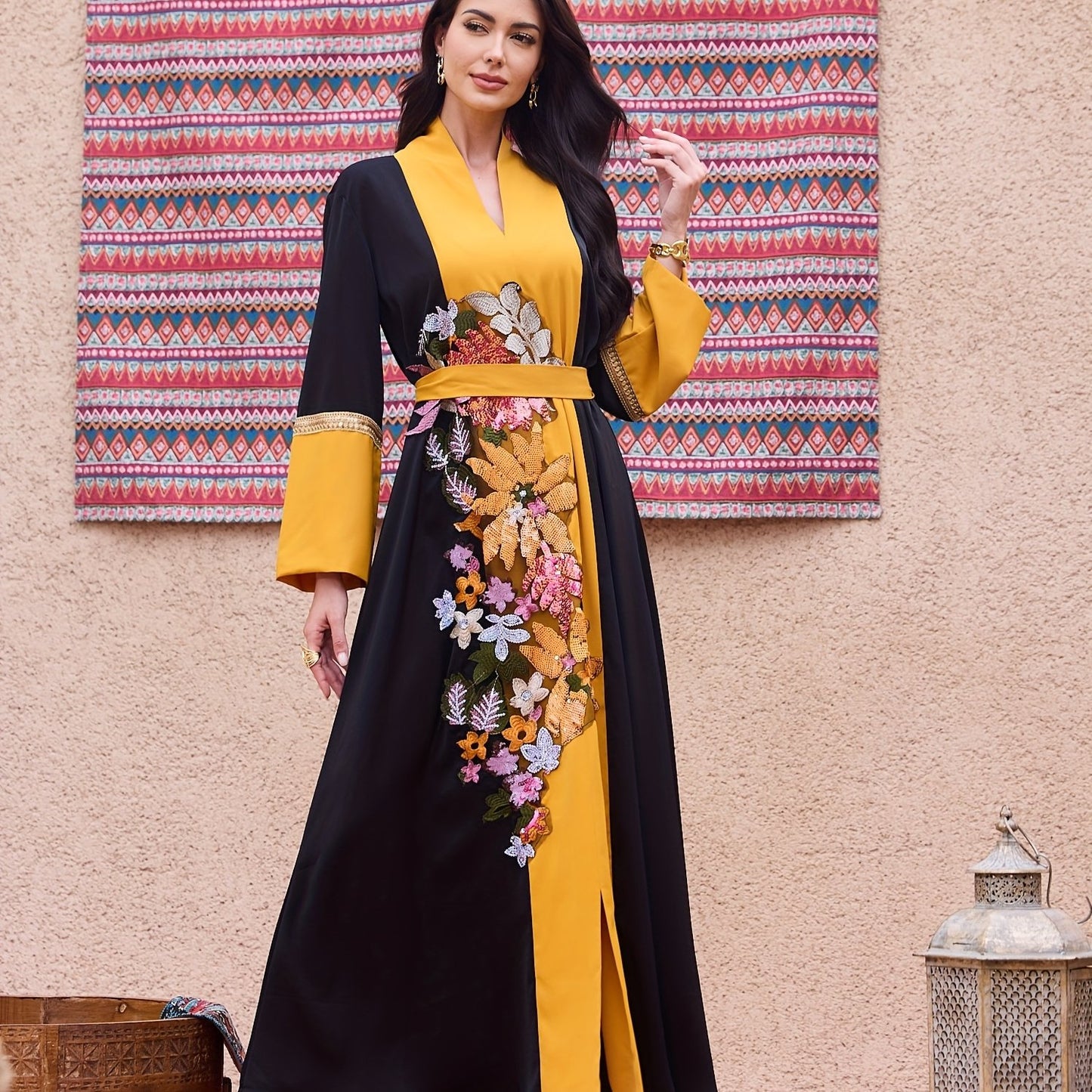
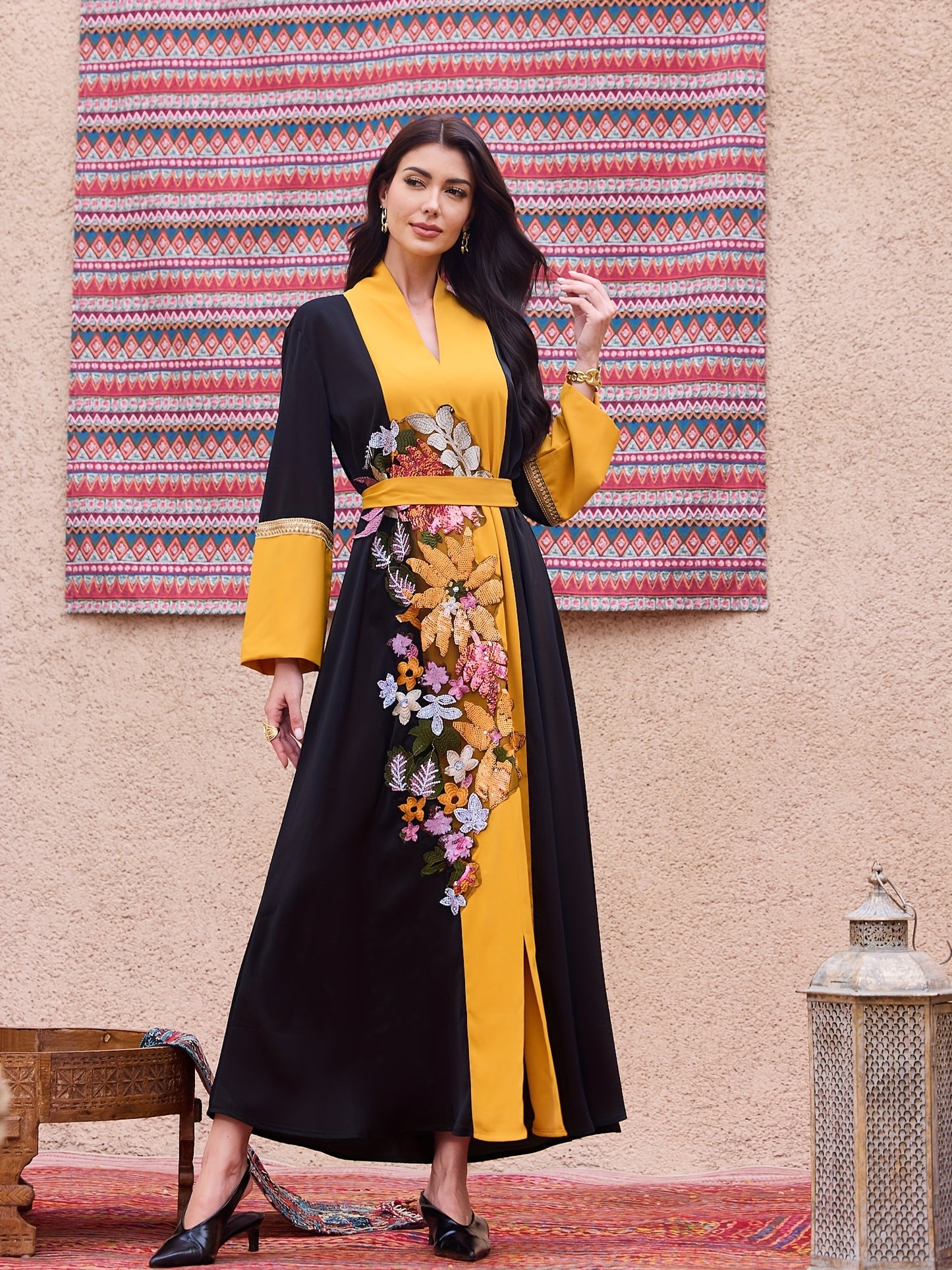
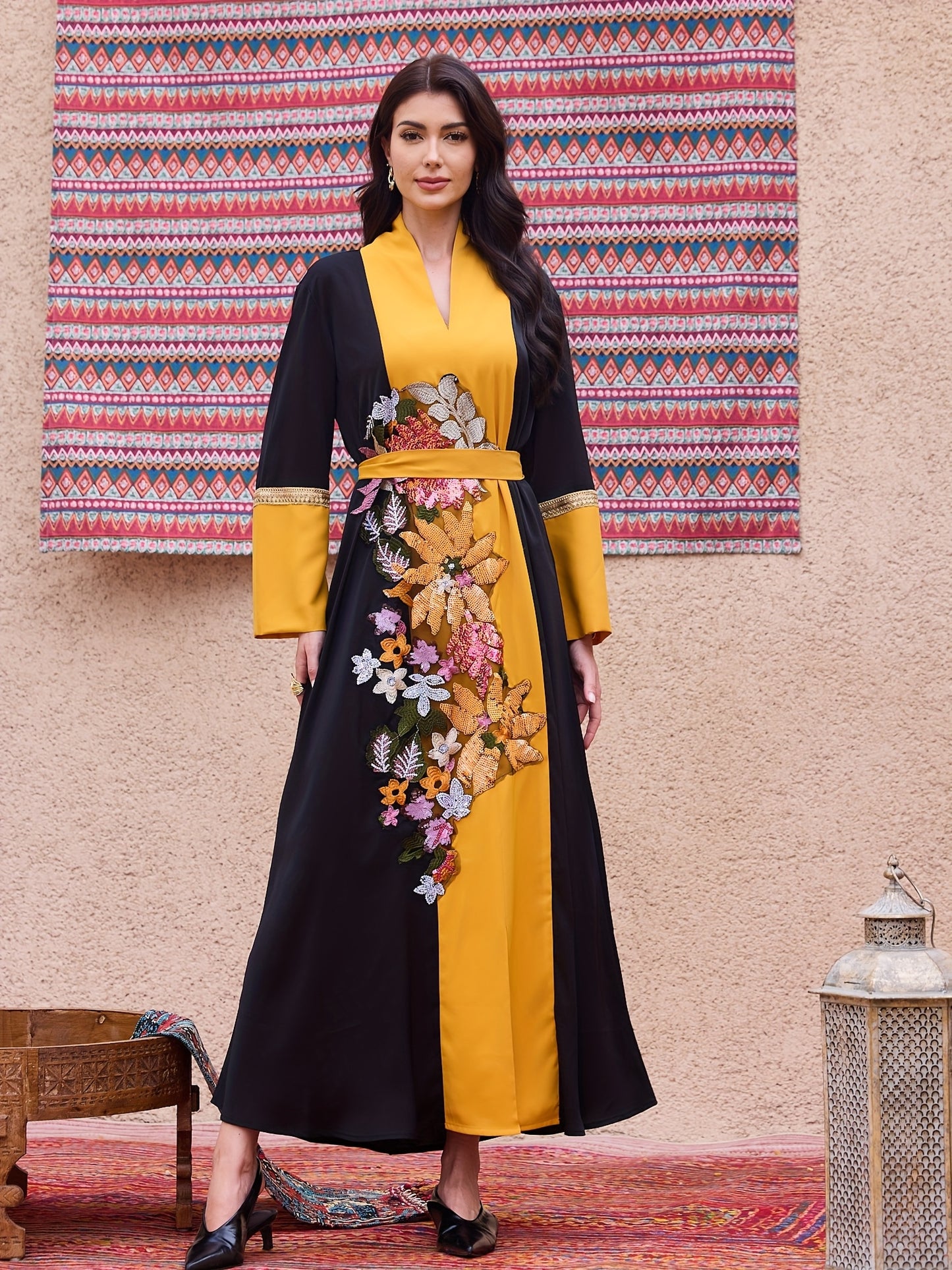
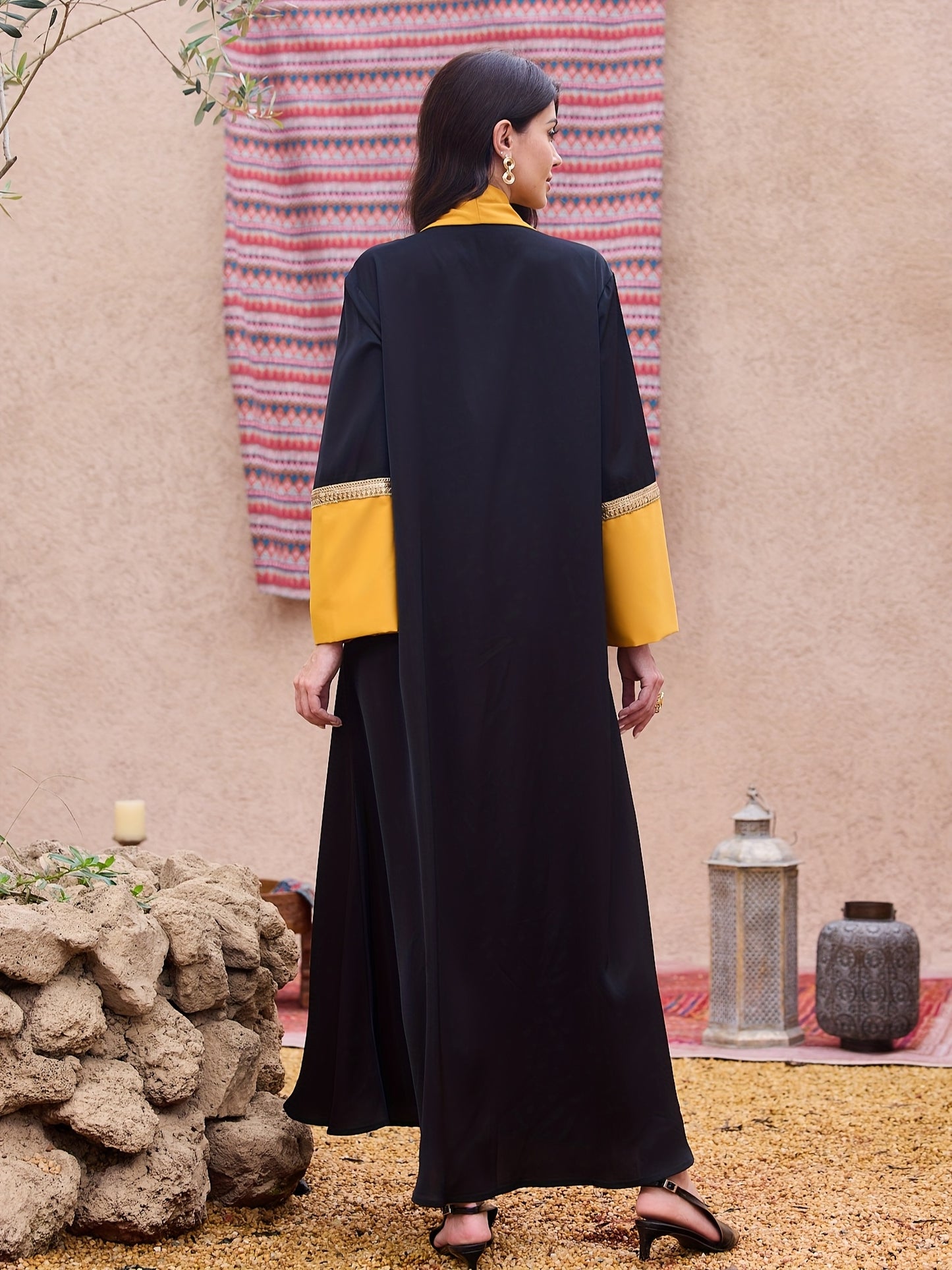
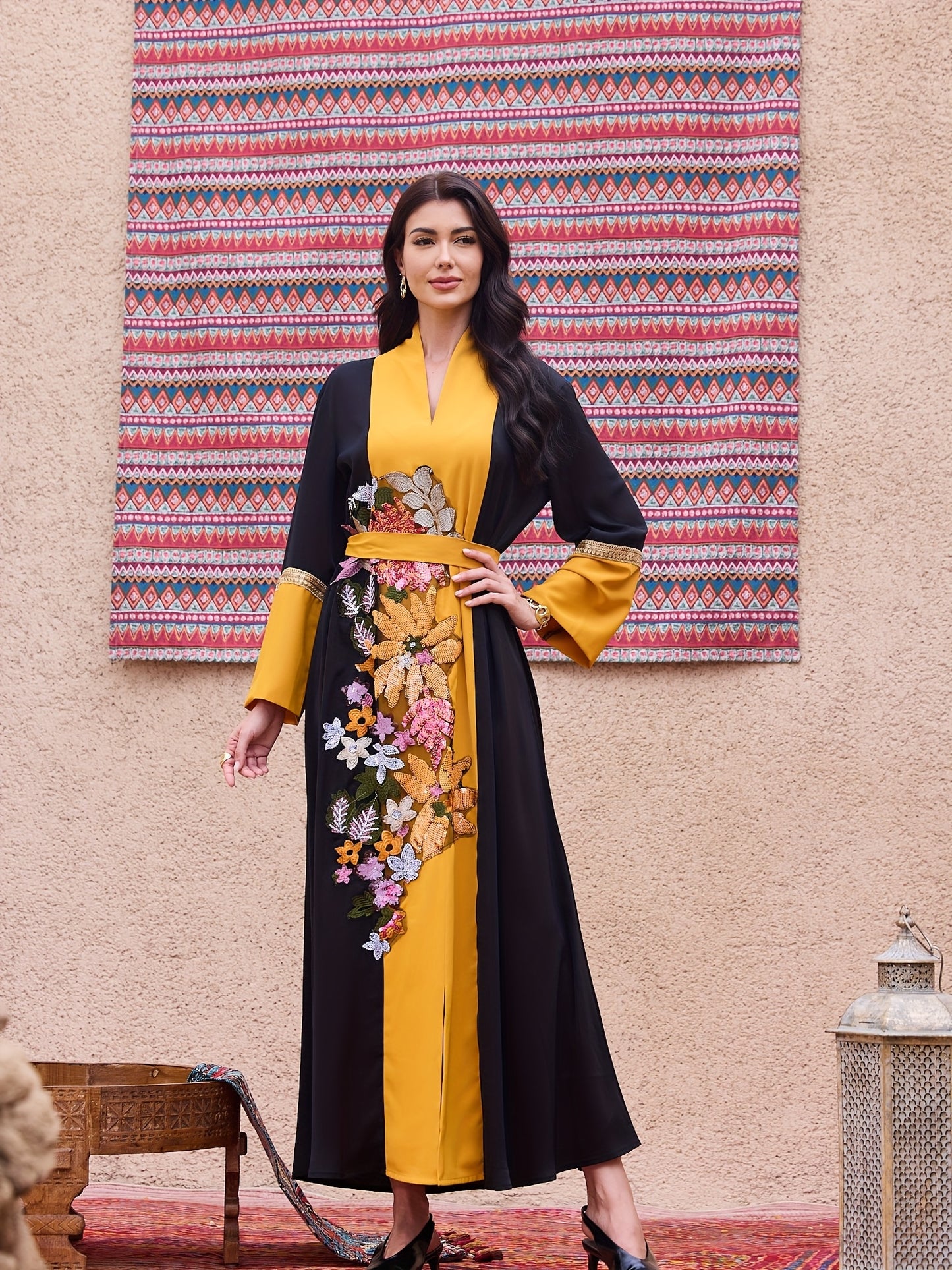
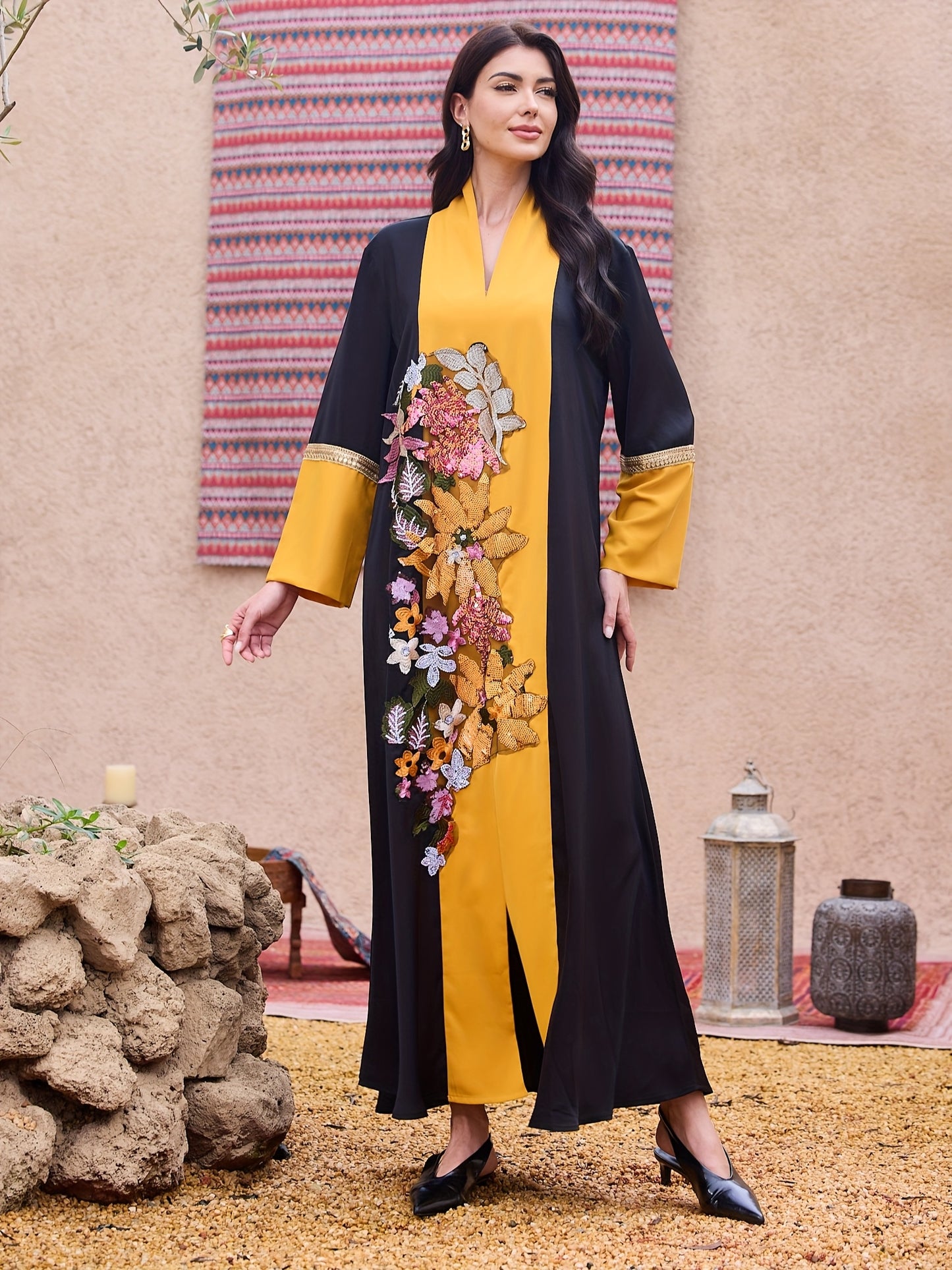
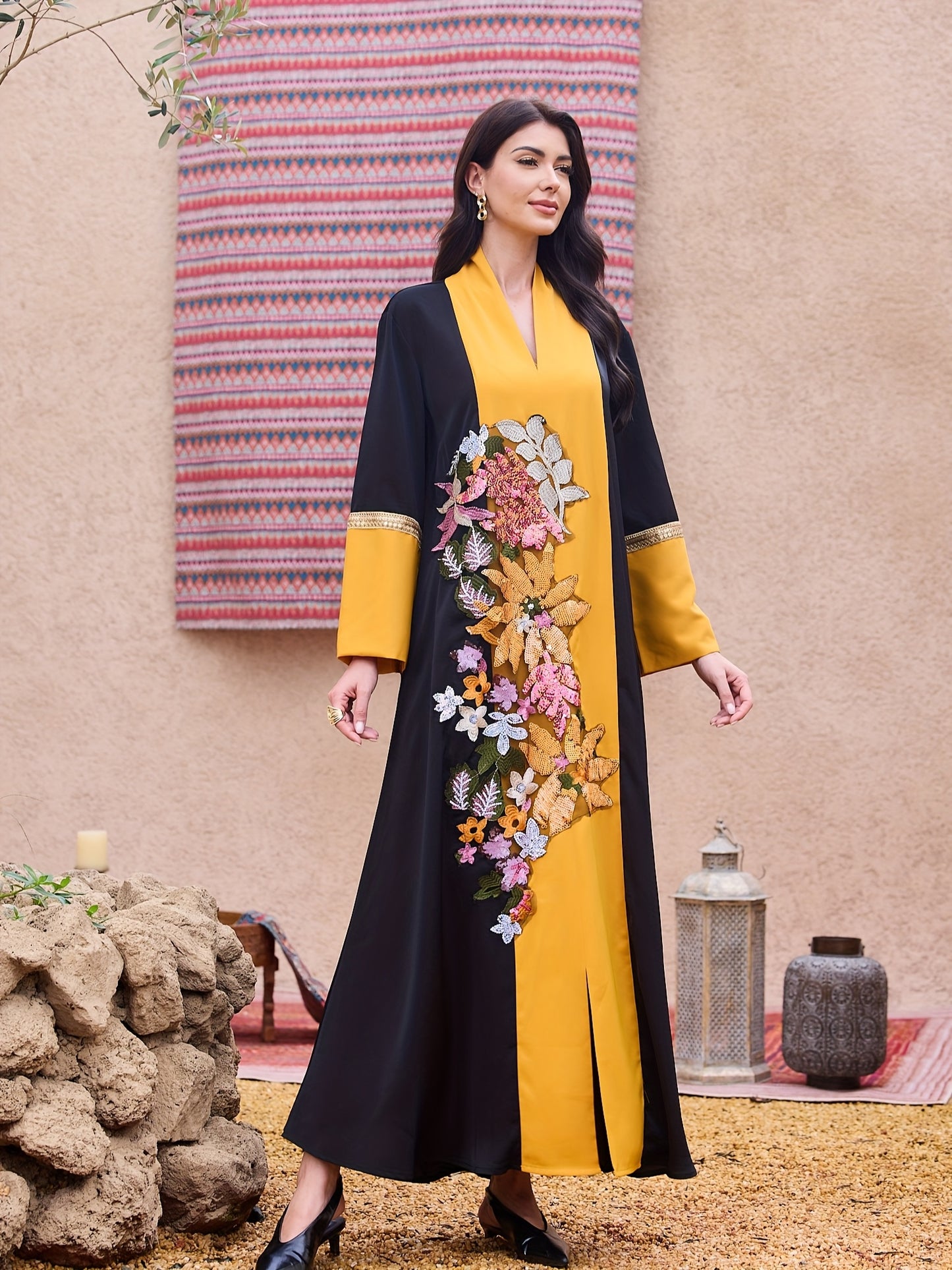
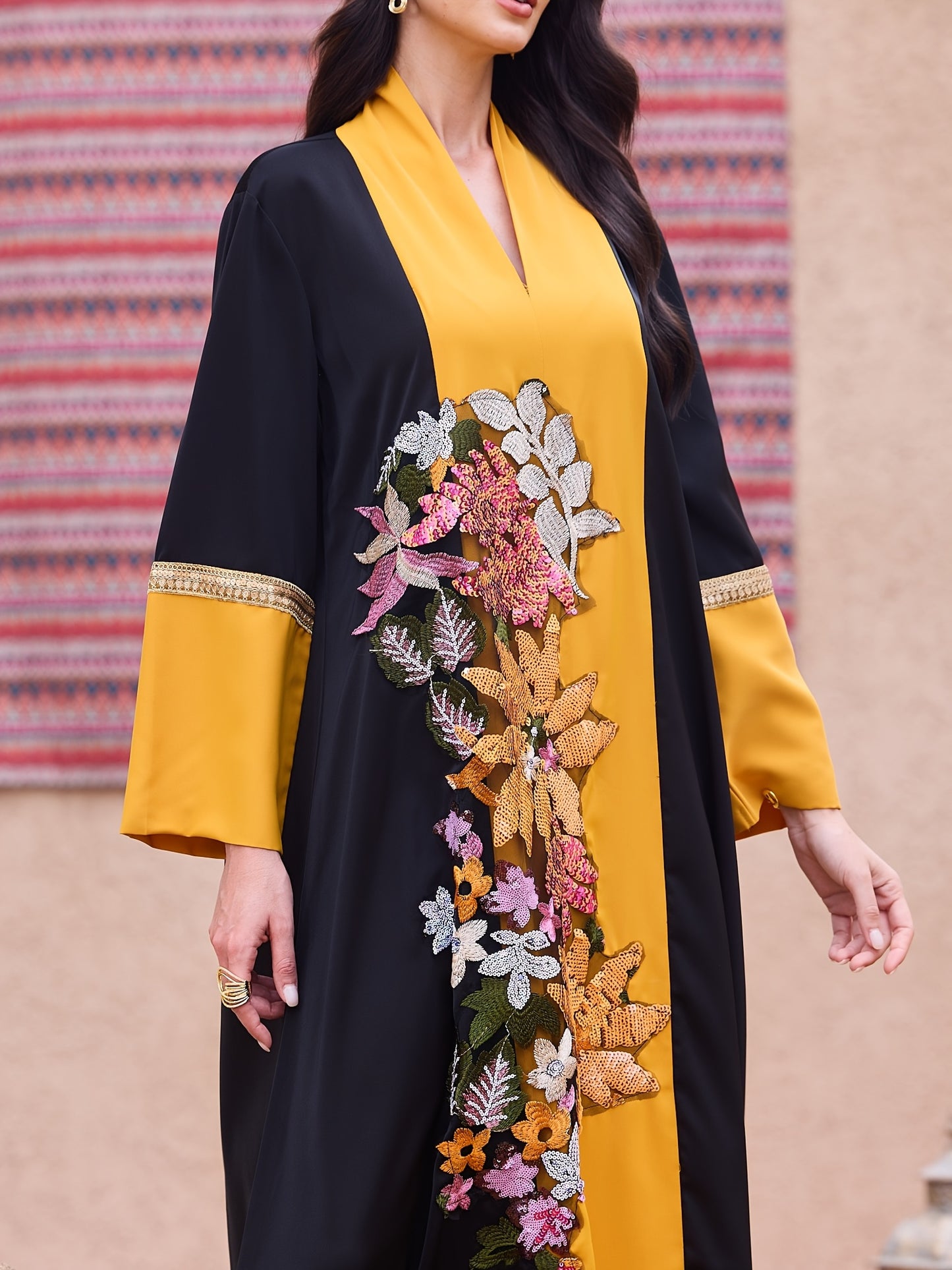
SPECIFICATIONS
Collar Style: V-neck
Composition: 100% Polyester
Details: Applique
Fabric Elasticity: No Elasticity
Material: Polyester
Operation Instruction: Machine wash or professional dry clean
Pattern: Solid color
Printing Type: No Printing
Season: All-season
Sheer: No
Style: Elegant
Type: A Pendulum
Weaving Method: Woven
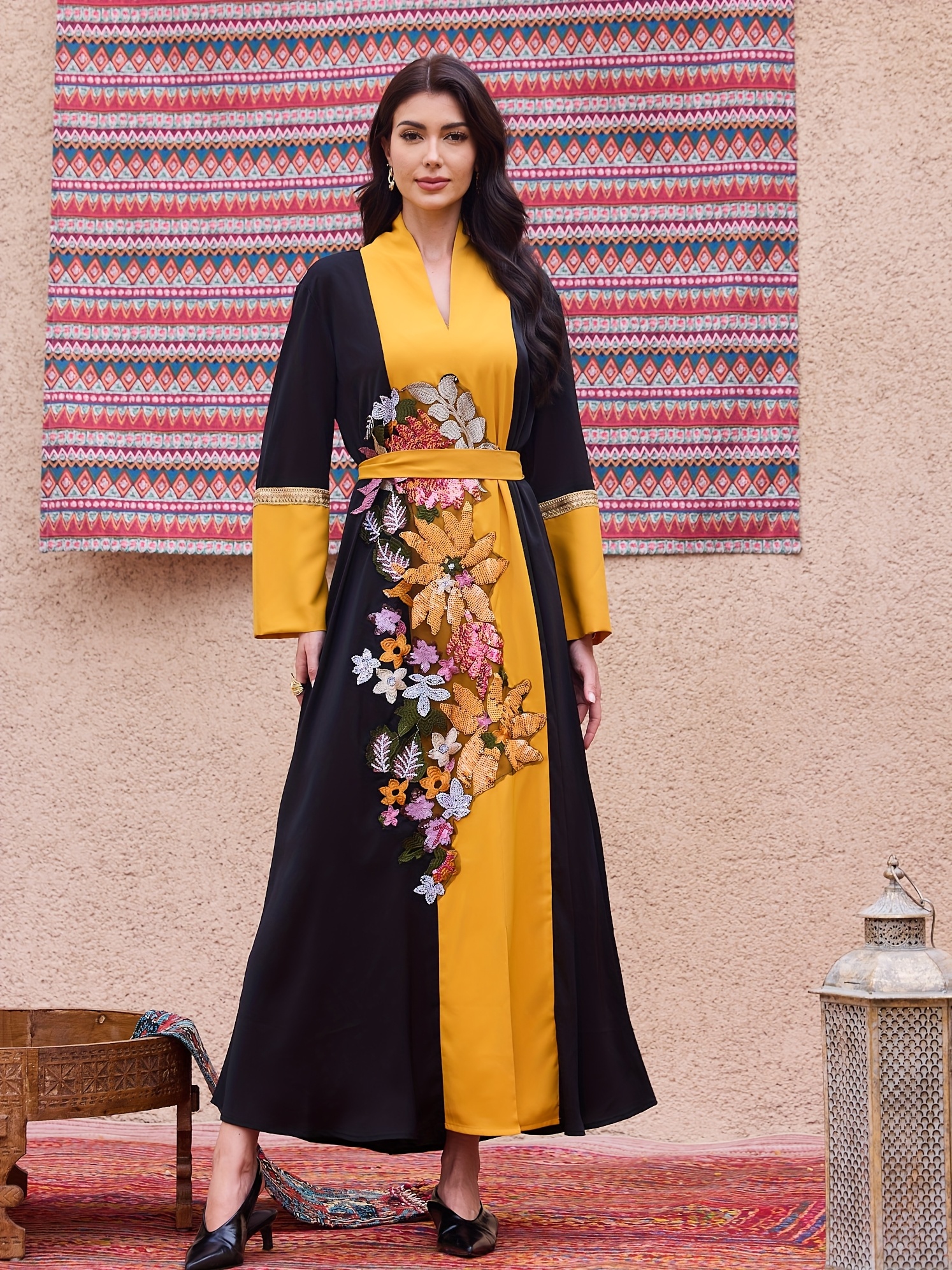
Black Beaded Spliced Abaya Dress – An Elegant Statement for Special Occasions
The black spliced fashion beaded Turkish Arab elegant holiday abaya dress represents more than a garment; it is the articulation of an aesthetic philosophy where modest fashion meets the codes of luxury tailoring. At its conceptual foundation, this abaya is built upon centuries of refinement in Middle Eastern dress culture, where silhouettes were developed not only for modesty but for grandeur. The design language draws upon a long lineage of Arab and Turkish inspiration, channeling elements that evoke flowing motion, understated elegance, and subtle ornamentation. The use of spliced paneling is not simply decorative—it signifies a deliberate design choice to break the uniformity of the silhouette while enhancing movement and structure. This architectural quality of the garment allows it to drape with a sculptural presence, transforming the abaya into an object of art as much as an article of clothing.
At its core, the abaya is a garment of contrasts. It balances minimalism with embellishment, tradition with modernity, and function with spectacle. The black base grounds the design in timeless restraint, offering a canvas upon which intricate beadwork can flourish. By placing beadwork strategically along the spliced segments, the designer ensures that the embellishments are not overwhelming but become highlights that elevate the overall silhouette. This marriage of stark black fabric and luminous beadwork mirrors the historical interplay of light and shadow in Islamic art and architecture, suggesting continuity between cultural heritage and present-day style. Such careful balance reveals the depth of thought behind the creation of the piece, demonstrating that every seam and every bead has purpose.
In addition, the abaya reflects a philosophy of inclusivity through its design. The cut is designed to accommodate different body types while maintaining a flattering form. The loose silhouette honors the traditional ethos of modesty, yet the careful tailoring and paneling ensure that it does not appear shapeless. The garment maintains a fluid line that elongates the body, giving the wearer a commanding presence while preserving comfort. This ability to merge the aesthetic with the practical is a hallmark of refined craftsmanship and demonstrates why such a garment transcends ordinary fashion into the sphere of collectible luxury.
Technical Excellence And Craftsmanship
The craftsmanship of the abaya becomes apparent not only in its visual appeal but in the precision of its construction. Creating an abaya that incorporates spliced panels requires exceptional mastery in pattern cutting and sewing techniques. Each panel must align perfectly with the next, ensuring that the drape of the fabric remains seamless despite the structural interruptions. This technical expertise demonstrates a workshop culture in which artisans apply a near-architectural approach to fabric, understanding that even minor inaccuracies could distort the garment’s symmetry. The finished result is a flowing silhouette that gives the illusion of effortless simplicity, concealing the complexity of its making.
Equally demanding is the integration of beadwork. Beading is not merely applied decoration but a discipline in itself, requiring patience, dexterity, and an eye for proportion. The beads in this abaya are meticulously hand-placed to emphasize the spliced design rather than obscure it. This selective placement allows the embellishments to shimmer discreetly, adding depth to the garment without overshadowing its structure. In luxury editorial terms, this demonstrates an understanding of restraint—true sophistication lies not in excess but in precision. The beading interacts with light in subtle ways, catching glimmers as the wearer moves, turning every step into an exhibition of controlled luminosity.
The labor invested in such details reflects a devotion to craft that cannot be replicated in mass-produced garments. Each abaya becomes a testament to the artisan’s discipline, where hundreds of hours might be required to perfect a single piece. This commitment to quality ensures durability as well. The stitching is reinforced at stress points, the beadwork is secured with double threads, and the fabric is cut in a way that resists fraying. The garment, therefore, is not only an object of beauty but one engineered to endure repeated wear. In a world dominated by disposable fashion, the abaya embodies the principle that true luxury lies in longevity.
Innovation Within Tradition
While rooted in heritage, the abaya demonstrates innovation through its interpretation of classic forms. The spliced structure is an unconventional design choice that redefines how the abaya silhouette can be understood. Where traditional abayas rely on continuous panels of fabric, this version introduces segmentation that offers both aesthetic and functional advantages. Aesthetic, because it allows designers to experiment with texture and embellishment; functional, because it enhances flexibility and airflow, making the garment more comfortable during long hours of wear. This balance between form and function represents the evolution of traditional garments in response to contemporary lifestyles.
The decision to combine Turkish and Arab stylistic influences is itself an act of innovation. Turkish fashion history often celebrates ornate detailing, textiles with rich textures, and intricate embroidery. Arab influences, on the other hand, emphasize graceful flow, darker palettes, and symbolic modesty. By fusing these traditions, the abaya becomes a cultural hybrid—one that honors multiple lineages while addressing the cosmopolitan reality of today’s wearer. This capacity for hybridization makes the abaya adaptable across cultures and occasions. It becomes a bridge garment that can be worn in Middle Eastern settings, in international fashion contexts, or in private celebrations, each time expressing a different facet of its identity.
Innovation also emerges through material selection. The fabric is chosen for its dual performance in drape and durability. The designer’s decision to prioritize both fluidity and strength demonstrates awareness of the modern consumer’s needs: garments must be practical as well as beautiful. The beadwork, while traditional in technique, is arranged in contemporary motifs that feel fresh without straying from cultural resonance. This ensures the abaya remains relevant in current fashion dialogues without losing its heritage anchor. Such subtle design decisions indicate a forward-thinking approach where tradition is not abandoned but reinterpreted for new generations.
The Abaya As A Work Of Art
Ultimately, to discuss design and craftsmanship in this context is to recognize the abaya not merely as clothing but as a wearable artwork. Every line, every bead, every fold of fabric contributes to a composition that resonates on both aesthetic and emotional levels. The black color is not incidental but intentional: it creates a stark backdrop against which the play of beadwork is intensified, much like ink on a parchment or stars against a night sky. The spliced design introduces rhythm into the garment, a cadence of fabric that suggests both motion and harmony. The beadwork acts as punctuation, drawing attention to specific areas while maintaining overall cohesion. Together, these elements construct a narrative of refinement and elegance.
The abaya also functions symbolically. As a holiday garment, it is designed to carry the gravitas of celebration, embodying dignity while exuding beauty. The craftsmanship ensures that the wearer does not merely wear the garment but inhabits it, experiencing the weight of cultural continuity and the lightness of aesthetic pleasure simultaneously. This duality transforms the abaya into something greater than fashion. It becomes an heirloom piece, a reminder of artistry that connects the individual to collective traditions while projecting them into contemporary spaces. In this way, the abaya acquires timeless value, transcending the ephemeral cycles of seasonal trends.
The work of art, however, is not static. It interacts dynamically with the wearer. Each movement activates the beadwork, each gesture reveals the thought behind the cut, and each occasion adds new layers of meaning to the garment. In this sense, the craftsmanship does not end in the workshop but continues in the lives of those who wear it. The abaya is a performance piece as much as an object, and it is in this ongoing dialogue between design and wearer that its true artistry is realized.
The Symbolism Of Black In Abaya Tradition
Color in clothing is never a simple matter of aesthetic preference; it is always charged with layers of symbolism and cultural meaning. In the case of the black spliced beaded Turkish Arab elegant holiday abaya dress, the choice of black is deliberate and multifaceted. Black has historically represented dignity, authority, and timeless restraint. Within the abaya tradition, it also speaks to continuity, modesty, and the unbroken chain of cultural identity. The richness of black is that it serves as both absence and presence. It is absence in the sense that it absorbs light, allowing the wearer to project serenity and humility. It is presence in that it enhances every decorative accent placed upon it, magnifying the shimmer of beads and the rhythm of the garment’s spliced structure.
Unlike bright colors that may date themselves with seasonal trends, black maintains permanence. It has endured centuries as the most dominant palette in modest fashion because it transcends momentary shifts in taste. Yet black is not static. Its interaction with light produces subtleties of tone, depth, and shadow. The same abaya may appear deep and matte in soft candlelight, yet radiantly lustrous under evening lanterns or daylight. This capacity for transformation is why black has always been considered the ultimate color of elegance. The wearer gains versatility without sacrificing gravitas, making it suitable for celebrations, formal gatherings, or spiritual holidays alike.
The symbolism of black in this abaya also extends to its psychological dimension. Black is known to empower the wearer with presence, authority, and self-assurance. For centuries, figures of importance across cultures chose black attire to assert status and solemnity. In this abaya, the tradition continues, yet with a contemporary refinement that ensures it is not austere but celebratory. When paired with beadwork, the color becomes a theatrical stage, turning embellishments into constellations that invite admiration. The garment thus reveals the enduring ability of black to balance reverence and glamour, a quality that continues to ensure its dominance in luxury abaya design.
The Role Of Spliced Design In Material Expression
The spliced structure of this abaya adds a crucial layer of complexity to how color and material are expressed. Where a continuous expanse of fabric would produce uniformity, splicing introduces visual rhythm and texture. Each splice acts as a deliberate interruption that highlights the garment’s construction. This architectural gesture allows designers to experiment with contrasts in fabric finish, such as matte against sheen, or different densities of weave. In the context of this particular abaya, the splicing becomes a canvas upon which beadwork can be applied with calculated precision, drawing attention to specific areas without overwhelming the garment’s balance.
The technique of splicing is demanding because it requires mastery over fabric manipulation. Each splice must integrate seamlessly into the garment, preserving fluidity while offering structural variation. The reward of this technique is significant: it allows the abaya to capture light and motion in ways a single-panel design cannot. As the wearer moves, the splices create subtle shifts in drape, producing an interplay of shadow and highlight across the black canvas. This dynamic quality ensures the abaya never appears static; it becomes animated by the environment and by the gestures of the body. In luxury terms, it transforms the garment into a performance piece rather than a mere covering.
Material expression within splicing also has symbolic implications. It reflects a design philosophy that acknowledges the value of contrast. Just as life balances solemnity with joy, the abaya balances dark fabric with glimmers of beadwork. The splice becomes the threshold where opposites meet—solid against delicate, monochrome against sparkle, restraint against flourish. This creates a visual metaphor of balance and unity. Such design sophistication elevates the garment from functional attire to cultural artifact, embodying a narrative of harmony between diverse influences.
Beadwork As Material Poetry
Beadwork is not an afterthought in this abaya but an integral material language that enriches its narrative. Historically, beads have symbolized wealth, spirituality, and artistic refinement. They have been used across civilizations as talismans, currencies, and decorations that speak to human desire for beauty and permanence. On this abaya, beadwork plays a dual role: it decorates and it articulates. The beads are strategically positioned along spliced seams and accent areas, where they catch and reflect light. This turns the garment into a kinetic canvas, animated by the shimmer of ornamentation whenever the wearer moves.
The selection of beads is crucial. In luxury abayas, beads are not chosen for volume but for precision. Each bead is handpicked to ensure consistency in luster and durability. The artisans apply them with painstaking care, securing them in patterns that enhance the fabric’s natural flow. Unlike sequins, which may overwhelm a garment with excessive shine, beadwork offers a subtler and more tactile expression of embellishment. The beads become textural punctuation, inviting closer inspection and tactile appreciation. They add weight in just the right measure, creating a gentle sway that enhances the fluidity of the abaya without compromising comfort.
From a symbolic perspective, beadwork transforms the abaya into a garment of celebration. In many cultures, beads are associated with holidays, rituals, and rites of passage. Their sparkle signifies festivity, while their permanence signals continuity. To wear an abaya adorned with beadwork is to carry both joy and heritage upon the body. It makes the garment an heirloom in spirit, a reminder that special occasions deserve attire that reflects their significance. Beadwork, therefore, becomes material poetry—each bead a syllable in a larger verse of elegance, cultural pride, and timeless design.
Material Integrity And Luxury Standards
No discussion of materials in this abaya would be complete without addressing the quality of the fabric itself. The choice of base fabric in luxury abayas is critical because it determines drape, durability, and comfort. This abaya employs fabric that is simultaneously lightweight and resilient, ensuring fluid motion without vulnerability to wear. Such balance is difficult to achieve, requiring textiles that are woven with high thread counts for smoothness yet reinforced for strength. The result is a garment that feels delicate to the touch yet can endure repeated use without losing its elegance.
Material integrity also extends to how the fabric interacts with the body. It must allow breathability, particularly in climates where abayas are worn daily. At the same time, it must provide modest coverage without transparency. This dual demand is met through fabric innovation, where advanced weaving techniques create textiles that balance opacity with air circulation. The wearer benefits from a garment that feels luxurious while also practical, a union of aesthetic and functional demands that defines true luxury.
Luxury standards are further confirmed by the garment’s finishing. Seams are reinforced, hems are meticulously aligned, and beadwork is double-stitched for longevity. These elements may appear minor, yet they distinguish high-quality production from mass-market imitations. In editorial terms, they signify respect for both the garment and its wearer. By investing in such standards, the designers affirm that the abaya is not a fleeting purchase but a long-term companion. This aligns with the modern consumer’s desire for sustainability—choosing fewer garments of higher quality that endure over time. In this sense, material integrity becomes not only a technical achievement but also an ethical statement, reinforcing the abaya’s place in a world increasingly attentive to responsible fashion choices.
Cultural Lineage And Symbolic Identity
The abaya is more than an aesthetic garment; it is a vessel of cultural lineage and symbolic identity. Within Arab and Turkish traditions, clothing has always carried profound meaning, reflecting values of modesty, dignity, and spiritual consciousness. The black spliced beaded abaya resonates with these layers of history, presenting a garment that both acknowledges centuries of custom and adapts them to the rhythms of modern life. It carries the solemnity of the abaya’s original function while introducing design flourishes that align with contemporary sensibilities.
To understand the cultural weight of this abaya, one must view it not merely as fabric but as a cultural artifact. The very act of wearing it is a form of cultural continuity, an acknowledgment of heritage passed down through generations. Its flowing silhouette honors the principle of modesty that has always defined abaya culture, while the embellishments pay homage to centuries of craftsmanship and artistic devotion. By retaining black as its foundational color and integrating beadwork with architectural splicing, the garment reflects a community’s reverence for tradition while simultaneously celebrating its evolution.
This duality makes the abaya an emblem of identity. For women across the Middle East and beyond, the garment becomes a declaration of belonging and pride. Its design reflects values deeply rooted in cultural ethos: respect for privacy, the beauty of restraint, and the grace of understated power. Yet it also communicates openness to global influence, evident in the fusion of Turkish ornamentation and Arab form. This balance between continuity and adaptation reveals the abaya’s unique role as both protector of heritage and harbinger of style innovation.
Contemporary Versatility Across Occasions
One of the abaya’s enduring strengths lies in its versatility across occasions. This particular piece, designed for holidays and celebratory moments, demonstrates how a garment rooted in modest fashion can transition seamlessly between settings. The black base imbues it with formality, ensuring appropriateness for ceremonial gatherings, while the beadwork and spliced design elevate it to festive grandeur suitable for weddings, banquets, or seasonal festivities. It does not merely serve as attire for one event; it adapts to multiple contexts with elegance.
In a contemporary world where fashion is increasingly defined by adaptability, the abaya positions itself as an indispensable wardrobe element. It can be worn as evening attire, its beadwork catching light in the glow of chandeliers or lanterns, commanding attention without ostentation. It can equally serve as refined daywear when paired with understated accessories, allowing the spliced design to provide architectural interest without overwhelming simplicity. For international travel, the abaya becomes a cultural ambassador, offering the wearer both comfort and sophistication while reflecting heritage in cosmopolitan settings.
This versatility also extends to generational appeal. Younger wearers may style it with contemporary accessories—minimalist handbags, modern footwear, or sleek hijab fabrics—while older generations may emphasize its traditional associations with heritage jewelry or ceremonial adornments. This multi-generational relevance demonstrates the abaya’s extraordinary adaptability. It is not constrained by age or occasion but expands to meet the needs of diverse lifestyles. The garment, therefore, positions itself as both timeless and modern, fulfilling the desires of women who seek attire that respects tradition while embracing change.
Styling Possibilities And Personal Expression
While cultural conventions often emphasize uniformity in abaya design, this particular garment opens a wide spectrum of styling possibilities. The spliced structure itself invites experimentation. It can be highlighted with accessories that draw attention to its architectural lines or softened with flowing scarves that amplify its fluidity. Beadwork adds another dimension, enabling the wearer to pair it with metallic jewelry that resonates with its shimmer or with matte textures that allow the beadwork to take center stage.
Styling the abaya also becomes an act of personal narrative. For the woman who wears it, the garment offers the chance to express individuality within the framework of modest fashion. It can be accessorized for grandeur or pared down for subtle elegance. When layered with contrasting textures—such as silk hijabs, velvet shawls, or fine leather footwear—the abaya transforms into an ensemble that communicates both taste and intention. The wearer is not confined by the garment but empowered by it, able to construct a look that aligns with personal mood, context, and cultural dialogue.
In professional settings, the abaya’s sophistication makes it an appropriate alternative to formal suits or dresses. Its tailored silhouette and restrained color allow it to project authority while the beadwork introduces refinement. In leisure contexts, the same garment may be styled with lighter accessories, shifting its function toward relaxed elegance. This fluidity across contexts is what distinguishes luxury abayas from ordinary attire. They are not single-use garments but transformative pieces capable of reshaping themselves according to the desires of the wearer.
The act of styling also situates the abaya within the broader global fashion conversation. As modest fashion continues to gain recognition worldwide, garments like this abaya demonstrate how cultural clothing can compete with couture in terms of creativity and refinement. Styling becomes a dialogue between heritage and global trends, allowing wearers to assert their identity while participating in a universal language of elegance.
The Abaya As A Cultural Bridge In Global Fashion
In an era where fashion transcends borders, the abaya occupies a critical role as a cultural bridge. This black spliced beaded design embodies the spirit of global modest fashion, appealing not only to women in the Middle East but to an international audience increasingly intrigued by the aesthetics of restraint and elegance. Its Turkish Arab influences expand its cultural vocabulary, situating it at the crossroads of civilizations that have historically defined luxury.
The abaya’s global relevance lies in its ability to communicate values that resonate universally. Modesty, dignity, and grace are not limited to one cultural sphere; they are aspirations shared across societies. By embodying these values in a garment that is simultaneously modern and traditional, the abaya introduces international audiences to a fashion ethos rooted in depth rather than surface. It offers an alternative to the rapid cycles of trend-driven fashion, presenting clothing as heritage, as narrative, and as identity.
In high fashion contexts, the abaya challenges conventional definitions of luxury. While Western couture often emphasizes exposure and spectacle, the abaya demonstrates that concealment can be equally powerful. Its spliced structure, beadwork, and commanding black silhouette provide sophistication without excess, proving that elegance does not require flamboyance. This positions the abaya within the dialogue of global luxury fashion, where it asserts its place not as a derivative form but as an origin of innovation.
Furthermore, the abaya operates as a diplomatic garment in cross-cultural contexts. When worn internationally, it becomes both a personal statement and a cultural ambassador. It introduces audiences unfamiliar with modest fashion to its beauty and complexity, reshaping perceptions of Middle Eastern dress traditions. Through its refinement, it encourages appreciation rather than exoticization, demonstrating that abayas are not relics of tradition but evolving works of fashion art. In this way, the abaya becomes more than attire—it becomes a bridge, a conversation, and an invitation to understand fashion as a universal language enriched by cultural diversity.
Preserving The Integrity Of Craftsmanship
A garment of this magnitude deserves attentive care, for it is not merely clothing but an investment in artistry and tradition. The black spliced beaded abaya embodies meticulous construction, and its longevity is directly tied to how it is maintained. Preserving such a piece requires more than routine cleaning; it requires a philosophy of respect for the garment’s integrity. Each seam, splice, and bead has been arranged with intention, and maintaining this arrangement ensures that the garment will continue to serve its wearer with the same elegance year after year.
Proper storage plays an essential role. The abaya must be kept away from direct sunlight to prevent fading of the rich black tone, and it should be stored in breathable garment bags to protect the delicate beadwork from dust or accidental snagging. When hung, padded hangers are recommended to support the shoulders and maintain the fluidity of the silhouette. Such practices are not burdensome but are an extension of the garment’s ethos of dignity—care mirrors respect, and respect ensures continuity.
When it comes to cleaning, the abaya requires sensitivity. Harsh detergents, abrasive scrubbing, or careless machine washing can compromise both the beadwork and the splice detailing. Gentle hand washing or professional dry cleaning ensures that the materials retain their structural integrity and their visual refinement. True luxury garments demand such consideration, not as inconvenience but as recognition of their elevated status. The act of care becomes part of the garment’s narrative, a ritual that connects the wearer more deeply to the artistry embodied in the piece.
Sustainability Through Longevity
In an age dominated by fast fashion, the black spliced beaded abaya stands as a counter-narrative. Its very construction resists the disposability that characterizes mass-market garments. Each element, from reinforced stitching to carefully secured beadwork, is designed to endure, not for a single season but for years of wear. This inherent durability transforms the garment into a sustainable choice, as it minimizes the need for frequent replacement. The philosophy here is not to purchase more but to purchase wisely—to invest in garments that accompany one through life rather than clutter it with short-lived trends.
Sustainability is also expressed through timeless design. The use of black ensures the abaya never appears outdated, while the spliced silhouette and beadwork remain contemporary without being fleeting. In fashion, longevity is often measured not only by physical durability but by aesthetic relevance. A garment that remains desirable across years resists the cycles of obsolescence that fuel waste. By creating pieces that retain beauty and cultural significance, designers contribute to a model of sustainability that privileges quality over quantity.
Equally important is the ethical dimension of sustainability. A garment created with respect for craft and designed for endurance reduces pressure on the environment. Rather than encouraging overproduction and rapid disposal, it supports an ethos of careful consumption. For wearers conscious of their ecological footprint, choosing such an abaya becomes more than a fashion decision—it becomes an ethical stance. It represents alignment with values of stewardship, preservation, and responsibility, both to culture and to the planet.
Economic And Emotional Value Over Time
The worth of this abaya extends far beyond its initial purchase price. Economically, its durability ensures that the cost per wear decreases with every occasion it is donned. Where inexpensive garments demand replacement after limited use, a well-crafted abaya retains its elegance for years, making it a practical investment. The wearer is not merely acquiring fabric and beadwork; she is securing a long-term wardrobe companion that continually proves its value.
Yet the true measure of long-term value is not solely economic but emotional. Over time, the abaya accumulates memories. It may be worn to weddings, family gatherings, or festive celebrations, each event layering the garment with personal meaning. Beadwork that once shimmered for strangers now glimmers with recollections of cherished moments. This accumulation of emotional value cannot be quantified, yet it becomes one of the most powerful reasons why such garments endure in wardrobes and hearts. Unlike disposable clothing, which carries no lasting significance, this abaya becomes part of personal history, a tactile reminder of life’s milestones.
Such emotional resonance also underscores the intergenerational value of the abaya. Its durability allows it to be passed down, becoming an heirloom that bridges generations. For daughters or granddaughters, inheriting an abaya is more than receiving clothing—it is inheriting stories, traditions, and the refinement of an earlier era. This transfer ensures that the garment’s value continues beyond its original owner, magnifying its cultural and personal significance. In this way, long-term value becomes perpetual, sustained not only by fabric and beadwork but by the narratives it carries.
Aligning With The Future Of Responsible Fashion
The black spliced beaded abaya is emblematic of the direction luxury fashion must take to remain relevant in the twenty-first century. The future of fashion lies not in producing ever more garments but in producing garments of enduring quality, garments that respect both the wearer and the world in which she lives. This abaya, by virtue of its craftsmanship, durability, and timeless design, anticipates this shift. It affirms that luxury is not defined by abundance but by refinement, and that true elegance aligns with responsibility.
In an era where fast fashion dominates the global marketplace, we see an alarming shift toward excessive consumption and rapid disposal of garments, fueling a cycle of waste. However, brands like Fabulive are charting a new course, where the emphasis is placed on long-lasting pieces that transcend fleeting trends. The very nature of luxury fashion is evolving to prioritize sustainability, and the abaya stands at the forefront of this movement, demonstrating that enduring beauty and responsible production are not mutually exclusive.
This abaya represents a future where fashion is a reflection of our values, a medium for expressing consciousness and commitment to sustainability. With each bead delicately stitched into place, the garment tells a story of mindful creation—one that respects nature, cherishes craftsmanship, and values the artistry that goes into making something lasting. By choosing a piece like this, consumers are not merely investing in clothing but in a philosophy that challenges the overconsumption that has characterized the fashion industry for decades.
The Philosophy of Responsible Fashion
Responsible fashion is not only about materials but about philosophy. It is about designing with foresight, ensuring that a garment maintains relevance across years and remains beautiful with careful maintenance. It is about producing in ways that honor artisanship rather than exploit it, creating pieces that elevate rather than diminish. This abaya demonstrates all these principles. It does not ask to be discarded at the season’s end; it invites the wearer to weave it into the fabric of her life. The enduring appeal of this piece is a direct reflection of a deliberate design philosophy aimed at creating garments that are not just fashionable for the moment but remain significant across generations.
Fashion, at its most conscious, addresses a deeper cultural need. It challenges us to think more critically about what we wear and why. This abaya embodies a shift from the short-term gratification that often accompanies the consumption of fast fashion toward a long-term investment that speaks to both individual style and broader ethical considerations. The garment encourages a relationship between wearer and clothing that transcends the immediate moment, encouraging its owner to care for, appreciate, and pass down the piece over time. This mentality is integral to responsible fashion—moving away from “disposable” culture and fostering a mindset of thoughtful consumption.
Furthermore, responsible fashion involves embracing transparency and understanding the origins of the materials used. When considering the production of this abaya, one recognizes the intricate interplay between ethically sourced materials, sustainable production processes, and the respect for artisanal labor. By choosing high-quality fabrics and working closely with skilled artisans, this abaya does more than just serve as clothing—it carries the story of its creation. Every stitch, every bead, and every cut is infused with the knowledge that it will endure, both in terms of physical wear and cultural relevance.
The Shift Toward Longevity and Timeless Elegance
The concept of longevity in fashion is not just a matter of durability; it speaks to the cultural narrative that fashion should evolve with us, not be replaced with every new season. By investing in clothing that is designed to last, consumers are making a statement about their values. They are choosing to break away from the cycle of disposable clothing that has led to both environmental damage and a depletion of the cultural significance of fashion. The black spliced beaded abaya, with its timeless design and impeccable craftsmanship, exemplifies the shift toward purchasing fewer but better pieces—luxury garments that are cherished for their beauty, functionality, and longevity.
A garment like this abaya elevates its wearer because it represents more than personal style; it represents a commitment to responsible consumption. As the fashion industry embraces sustainability, this abaya serves as a beacon of a future where luxury is no longer synonymous with excess but is instead defined by thoughtfulness. True elegance, as embodied in this piece, is not reliant on novelty or trends. It is found in the care taken to craft something with lasting value, both in material and in cultural relevance.
Such garments challenge the traditional cycle of fashion, which encourages constant acquisition and the rapid replacement of garments. Instead, the focus shifts toward pieces that remain desirable, relevant, and stylish throughout the years. When consumers choose to invest in a black spliced beaded abaya, they are making a conscious decision to embrace a future where fashion is defined not by what is new but by what is meaningful. In doing so, they are contributing to a movement that values longevity, quality, and timeless beauty over fast fashion’s fleeting moments of glamour.
Changing Consumer Habits and Mindful Consumption
In aligning with the future of responsible fashion, the black spliced beaded abaya plays a pivotal role in reshaping how consumers approach their wardrobes. It encourages women to consider their clothing choices not as fleeting items that are discarded after a single season but as meaningful investments. This shift towards valuing depth over breadth, longevity over immediacy, and thoughtfulness over trends, places the wearer at the forefront of a movement that recognizes the profound impact fashion has on both the individual and the planet. As part of this movement, the abaya stands as a testament to the importance of curating a wardrobe based on enduring beauty, cultural richness, and environmental consciousness.
Fashion, for too long, has been driven by an obsession with novelty and constant consumption. Trends rise and fall rapidly, with each passing season bringing a new wave of garments, accessories, and styles that demand attention. This cycle encourages people to buy more, often discarding what was once cherished in favor of what is new and perceived as trendy. In contrast, the black spliced beaded abaya rejects this idea of disposable fashion. It embodies timeless elegance and craftsmanship, inviting wearers to slow down and make thoughtful decisions about what they choose to add to their closets. The abaya’s design, rooted in cultural heritage yet embracing modern aesthetics, becomes an heirloom piece—one that is not only appreciated for its beauty but also valued for its lasting impact.
The modern consumer is increasingly becoming aware of the effects that fast fashion has on the environment. From the exploitation of natural resources to the pollution caused by textile production and the significant carbon footprint left by global supply chains, the fashion industry is one of the largest polluting sectors in the world. In addition to environmental concerns, there is also growing awareness of the social implications of fast fashion, which often relies on cheap labor in developing countries, subjecting workers to poor conditions and unfair wages. These realities are forcing consumers to rethink their purchasing habits and align themselves with brands that share their values of responsibility and sustainability.
The shift towards mindful consumption is not just about avoiding certain brands or trends; it’s about actively choosing products that are made with care, attention to detail, and respect for both the environment and the people involved in the creation process. The black spliced beaded abaya exemplifies this type of conscious luxury. It is not merely about the garment’s aesthetics or its status as a high-end product; it also reflects the dedication of the artisans who created it, the sustainable practices employed in its production, and the philosophy behind its design. For those who choose this abaya, it is an expression of their personal commitment to making choices that prioritize quality and integrity over mass consumption.
The Rise of Slow Fashion
This evolving consumer mindset is closely tied to the rise of the slow fashion movement, a paradigm that prioritizes thoughtful production, longevity, and ethical practices over the rapid cycles of fast fashion. Slow fashion emphasizes the importance of creating garments that are built to last—pieces that are not just designed to be worn once or twice but are intended to become staples in a wardrobe for years to come. The black spliced beaded abaya is a perfect example of slow fashion in practice. Its design is not dictated by short-term trends but is rooted in a philosophy of creating something timeless and enduring. The choice of high-quality materials, combined with meticulous craftsmanship, ensures that this abaya will stand the test of time, remaining as relevant and stylish decades from now as it is today.
The slow fashion movement also encourages consumers to rethink their relationship with their clothing. Instead of seeing clothes as disposable items to be worn and discarded, slow fashion advocates for a more meaningful connection to what we wear. By investing in fewer but higher-quality garments, consumers are able to build a wardrobe that tells a story—one that reflects their personal style and values rather than the transient whims of fashion. This shift towards a more intentional approach to consumption not only elevates personal style but also encourages a more sustainable and responsible fashion industry. As consumers begin to demand more from the brands they support, the fashion industry is forced to respond by creating garments that prioritize ethics and sustainability, just as the black spliced beaded abaya does.
The Importance of Investing in Quality Over Quantity
One of the central tenets of slow fashion is the idea of investing in quality over quantity. Rather than filling one’s closet with cheap, mass-produced items that wear out quickly or fall out of style, slow fashion advocates for investing in pieces that are built to last—garments that are both aesthetically pleasing and durable. This concept is not just about the physical construction of the garment but also about the emotional value it carries. A piece like the black spliced beaded abaya holds a deeper significance than a fleeting trend. It becomes part of the wearer’s personal narrative, a piece of clothing that can be passed down through generations, carrying with it the stories and memories of its owner.
By purchasing fewer, higher-quality items, consumers not only reduce the overall impact of their wardrobes on the environment but also cultivate a more intentional and curated collection of clothing. The process of curating a wardrobe based on longevity and quality fosters a deeper appreciation for the garments one owns. Each piece becomes a cherished investment, one that is worn with pride and respect. This mindful approach to consumption aligns with a broader cultural shift towards valuing craftsmanship, sustainability, and the preservation of heritage. Instead of contributing to the overproduction and waste that defines fast fashion, wearers of this abaya participate in a cycle of mindful consumption that promotes a deeper connection to their clothing.
Changing the Narrative Around Fashion Consumption
The shift toward more mindful consumption also challenges the prevailing narrative around fashion. Traditionally, fashion has been seen as a way to display wealth, status, and social standing, with the emphasis on purchasing new garments to keep up with the latest trends. However, in a world that is becoming increasingly aware of the environmental and social consequences of such consumption, this narrative is being reevaluated. The value of a garment is no longer solely determined by its price tag or its ability to follow the latest trends. Instead, it is being defined by its longevity, craftsmanship, and ethical production practices.
The black spliced beaded abaya plays a key role in reshaping this narrative. It is not about being part of the fast-fashion race or keeping up with ever-changing trends. Rather, it encourages its wearer to adopt a more thoughtful approach to fashion, one that values quality, sustainability, and personal meaning over the fleeting nature of mass-produced clothing. By choosing garments like this abaya, consumers are making a statement that transcends surface-level fashion and embraces a philosophy of elegance that respects both culture and sustainability. This paradigm shift is not just a trend; it is a movement towards a more responsible, meaningful, and sustainable future in fashion.
Curating a Meaningful Wardrobe
This thoughtful approach to consumption is changing the way people view their wardrobes. Instead of continuously adding new pieces to their closets, consumers are focusing on curating a collection of clothing that reflects their personal style and values. Each piece is chosen with care and consideration, ensuring that it is not only stylish but also practical and long-lasting. The black spliced beaded abaya is an ideal example of this approach. It is a piece that can be worn for many years, transcending trends and remaining relevant through its timeless design and craftsmanship.
Curating a wardrobe based on quality and meaning also encourages consumers to think more carefully about their purchasing decisions. Instead of mindlessly following trends or buying items on impulse, they are considering the long-term value of each piece. This intentional approach to fashion empowers consumers to make choices that align with their values, whether that means supporting ethical production practices, choosing sustainable materials, or investing in garments that are built to last. The result is a wardrobe that is not only more stylish but also more meaningful, where each piece tells a story and contributes to a more sustainable fashion ecosystem.
The Future of Fashion: Elegance With Responsibility
The movement toward responsible fashion is not just a trend; it is a fundamental shift in how we think about and engage with clothing. The black spliced beaded abaya, with its combination of sustainable design, exceptional craftsmanship, and timeless elegance, represents the future of luxury fashion. It demonstrates that true luxury lies not in excess but in the careful creation of beautiful, durable garments that respect both the wearer and the world at large.
As we move forward into a future where sustainability becomes paramount, the fashion industry must continue to evolve. The black spliced beaded abaya shows us that luxury can be aligned with responsibility, that fashion can be both beautiful and mindful. It is a garment that invites its wearer to think critically about consumption, to choose quality over quantity, and to embrace a more conscious approach to style. In doing so, it sets the stage for a future where fashion is not just a reflection of personal identity but a force for good—one that values craftsmanship, sustainability, and cultural heritage.
By embracing this abaya, wearers are not only choosing a garment that exudes elegance but are also making a powerful statement about their commitment to the future of fashion—one where beauty and responsibility are no longer mutually exclusive but are woven together to create a more sustainable and ethical industry. This future is one where fashion is not defined by the speed at which it is produced but by the lasting impact it leaves on the world.
Frequently Asked Questions
What is the significance of the beadwork on this abaya?
The beadwork on the black spliced beaded Turkish Arab elegant holiday abaya is not only a decorative feature but also a key element of its artistry. Each bead is meticulously placed to highlight the spliced segments, creating a shimmering effect that adds dimension and movement to the garment. The beadwork represents the sophistication of traditional craftsmanship, where each piece contributes to the overall design narrative. The beads offer subtle illumination without overpowering the garment’s restrained elegance. This carefully considered placement ensures the abaya remains timeless while still embracing modern design aesthetics.
How do I care for the beadwork and fabric?
The abaya requires special care to maintain its elegance and craftsmanship. For the fabric, hand washing is recommended with a mild detergent, ensuring that the delicate material does not suffer from the wear and tear of machine washing. The beadwork should be handled with care, either spot-cleaned gently or professionally dry cleaned to avoid damaging the intricate details. When storing the abaya, ensure it is placed in a breathable garment bag, away from direct sunlight, to prevent fading. By following these steps, the abaya will maintain its visual appeal and structural integrity over the years.
Can the abaya be worn on multiple occasions?
Absolutely. The black spliced beaded abaya is designed with versatility in mind, making it suitable for various occasions. Whether for a formal event, a festive celebration, or even a high-profile wedding, this abaya will transition seamlessly. Its ability to adapt to different occasions is one of its most celebrated features. The subtle sheen from the beadwork adds an air of sophistication for evening wear, while the sleek silhouette remains elegant for daytime events. Its timeless design ensures that it can be worn repeatedly without losing its charm.
What makes this abaya different from other holiday abayas?
What sets this abaya apart is the combination of traditional design and modern craftsmanship. The fusion of Turkish and Arab design influences brings together rich cultural histories, resulting in a garment that is both familiar and fresh. The spliced structure introduces dynamic visual interest, while the intricate beadwork adds a layer of texture and depth not commonly found in standard abaya designs. These design choices make the abaya unique, elevating it from simple attire to a piece of wearable art.
How does the abaya contribute to sustainable fashion?
This abaya aligns with sustainable fashion principles by emphasizing longevity and timeless appeal. It is crafted with materials that are durable and resilient, ensuring it remains in excellent condition for years. Rather than following the transient trends of fast fashion, this abaya is designed to transcend seasons, offering both cultural significance and modern styling. By choosing to invest in such a garment, wearers are making a conscious decision to support responsible fashion practices—purchasing quality pieces that outlast fast fashion’s fleeting cycles.
What should I pair the abaya with for a complete look?
The versatility of the black spliced beaded abaya allows for a wide range of styling possibilities. For a formal, sophisticated look, pair it with metallic accessories, such as gold or silver jewelry, to complement the shimmer of the beadwork. A luxurious clutch and elegant heels will add to the ensemble's refinement. For a more relaxed styling, opt for neutral-toned footwear and a simple, minimalistic hijab to let the abaya's design stand as the focal point. Whether dressing it up or down, the abaya offers the flexibility to suit various personal styles and occasions.
Is the abaya suitable for different body types?
Yes, the black spliced beaded abaya is designed with inclusivity in mind. Its flowy silhouette accommodates various body shapes, offering comfort and a flattering fit. The spliced design also contributes to creating a visually elongated shape, which enhances the overall silhouette without compromising modesty. The adjustable fit ensures that the abaya looks graceful on all figures, whether worn loose or slightly cinched at the waist with a belt or tie, making it a versatile piece for women of all sizes.
How can I incorporate this abaya into everyday wear?
Though initially designed as a holiday and event-specific garment, the black spliced beaded abaya can be adapted to everyday wear. By pairing it with casual footwear and a more relaxed scarf, the abaya can become a statement piece for a more subdued outing. The elegance of the design ensures that it still maintains a sense of sophistication, even when worn in less formal settings. With the right styling, this abaya proves its versatility as both a celebratory garment and a chic, everyday attire.
What is the significance of the black color in the abaya?
The black color of the abaya is a timeless choice that speaks to the essence of sophistication and elegance. Historically, black has been a symbol of modesty, power, and grace in many cultures, particularly in Arab and Turkish traditions. It is a color that has remained relevant for centuries, transcending passing trends. For women who wear this abaya, black becomes a symbol of strength and dignity, while also offering the freedom to experiment with accessories and styling options, without being limited by color.
How does this abaya compare to other luxury abayas in terms of craftsmanship?
This abaya stands out in terms of craftsmanship due to its combination of hand-selected materials, intricate beadwork, and the skilled application of traditional techniques. The spliced design, which is both an aesthetic and functional feature, demonstrates the designer’s commitment to creating something that is visually captivating yet practical. The beadwork is applied with such precision and care that it enhances the overall design rather than detracts from it. These elements, coupled with the quality of the fabric, make this abaya a rare and luxurious piece, setting it apart from mass-produced alternatives.
Customer Reviews
Amira H., Saudi Arabia: "I wore this abaya to a wedding, and it was the perfect choice. The rhinestones added just the right amount of sparkle without being too much. I received so many compliments. It’s also incredibly comfortable and flattering." ⭐⭐⭐⭐⭐
Layla K., UAE: "The craftsmanship is impeccable. I love the batwing sleeves—they’re so unique and elegant. The fabric feels luxurious, and I can tell it will last for years. Worth every penny!" ⭐⭐⭐⭐⭐
Zahra M., Egypt: "I love how versatile this abaya is. I wear it for both formal and more casual occasions, and it works perfectly for both. The rhinestones are subtle but add a beautiful touch. Definitely one of my best purchases!" ⭐⭐⭐⭐⭐
Fatimah S., Kuwait: "The abaya is stunning! The black color makes it easy to pair with anything, and I love how it drapes over my body. It’s perfect for both special occasions and everyday wear. So happy with my purchase!" ⭐⭐⭐⭐⭐
Mariam T., Jordan: "I’m so impressed with the quality. The fabric is soft yet durable, and it fits beautifully. I’ve worn it multiple times already, and each time, it still feels as luxurious as the first." ⭐⭐⭐⭐⭐
Amina R., Qatar: "This abaya is simply exquisite. The design is so elegant, and the beads really catch the light in such a subtle way. It’s perfect for holiday events, and I’ve already planned to wear it for another celebration!" ⭐⭐⭐⭐⭐
Nadia F., Lebanon: "I adore how lightweight this abaya is. The material is breathable, which is great for warm weather. Despite being lightweight, it never feels cheap—quite the opposite. It’s a timeless piece I’ll cherish for years." ⭐⭐⭐⭐⭐
Yasmin L., Bahrain: "Wearing this abaya makes me feel so special. The spliced design is really flattering, and I can tell it was made with so much attention to detail. The beads are just the right touch. Definitely worth the investment." ⭐⭐⭐⭐⭐
Samira J., Oman: "What sets this abaya apart is how it combines tradition with modern style. I wore it to a formal dinner, and it turned heads without being flashy. It’s understated luxury at its finest." ⭐⭐⭐⭐⭐
Ranya P., Tunisia: "I was looking for a unique abaya for a special occasion, and this one was exactly what I needed. The design is elegant, and I love how it stays comfortable while still looking incredibly chic." ⭐⭐⭐⭐⭐