


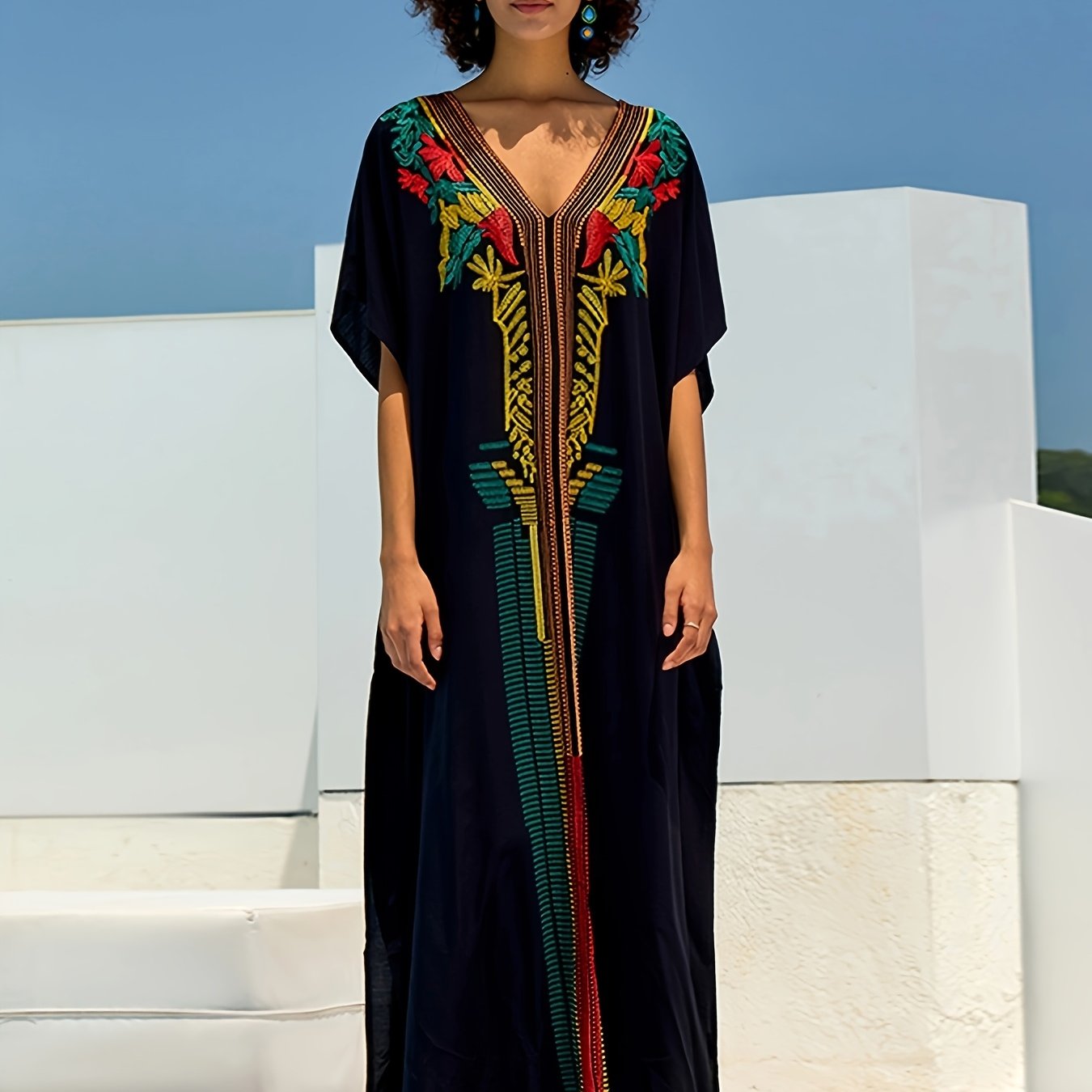
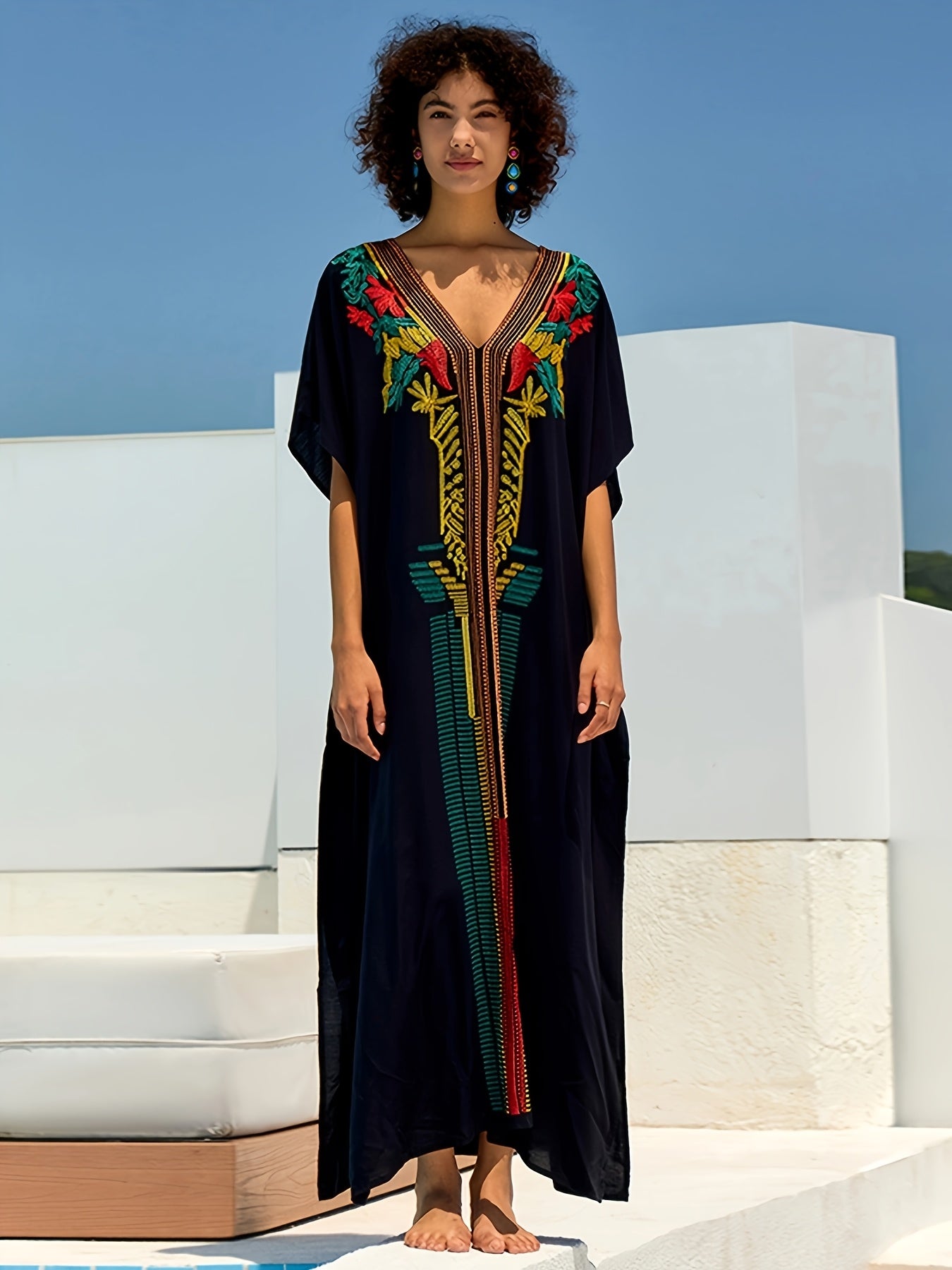
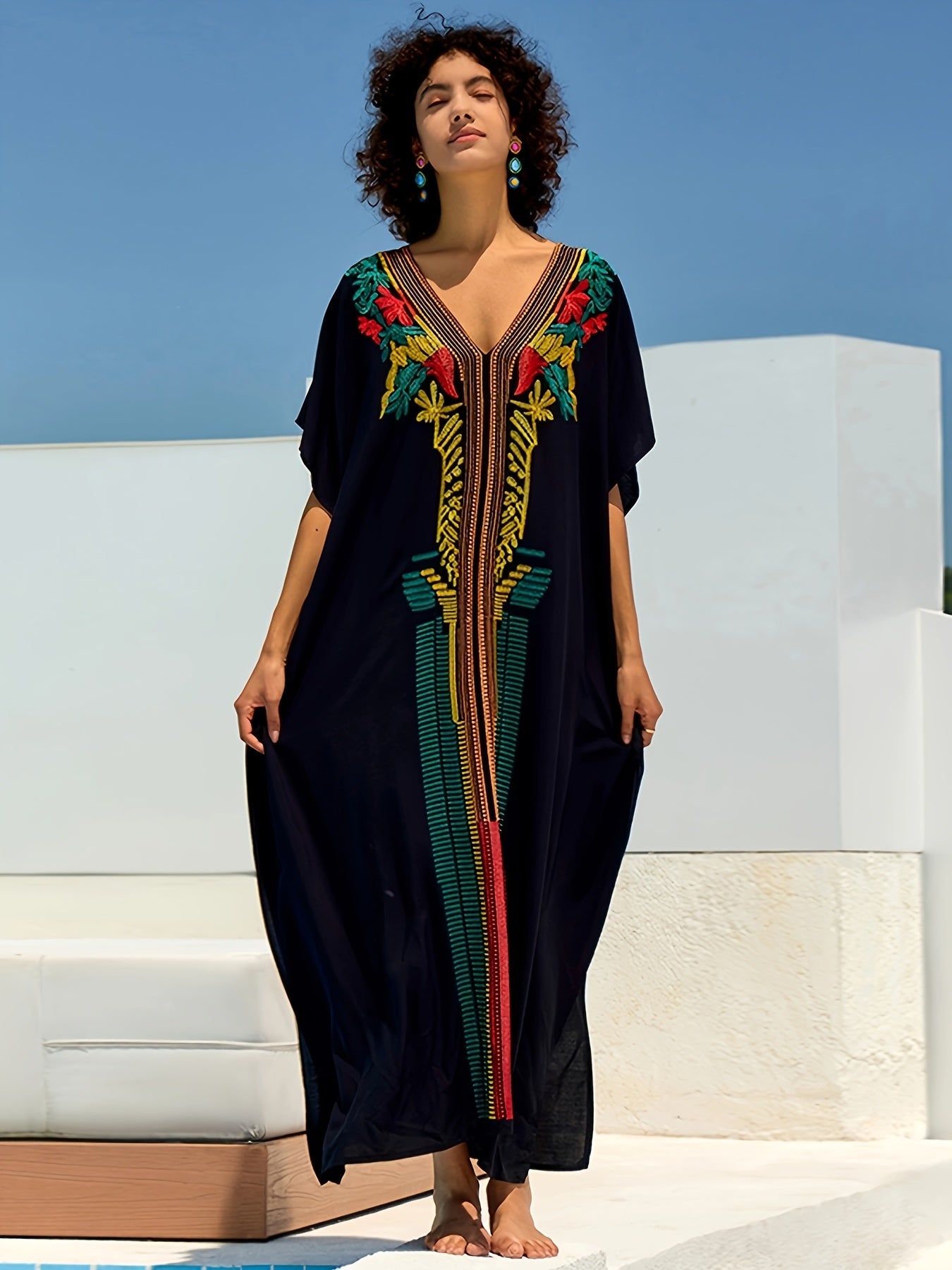
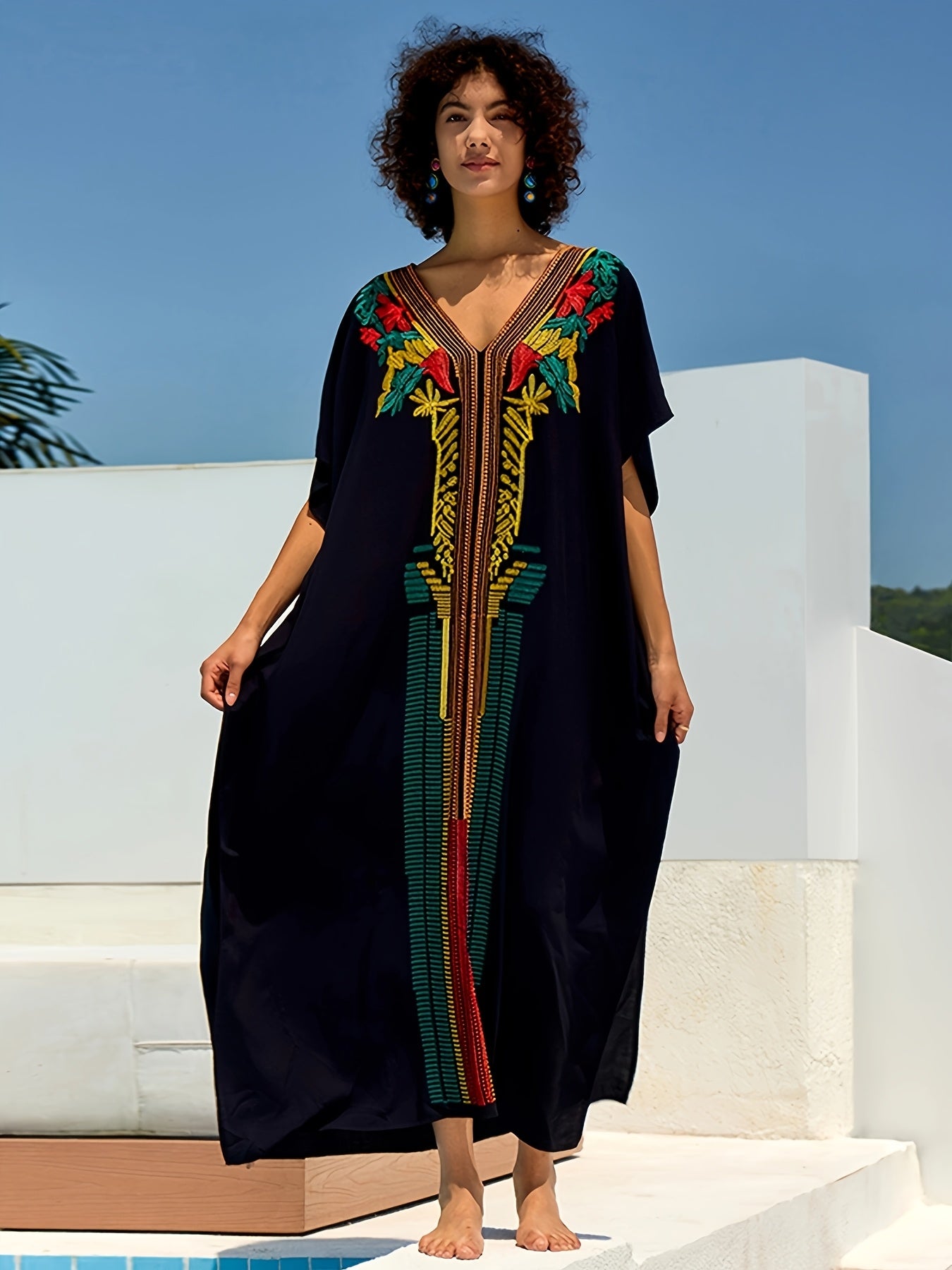
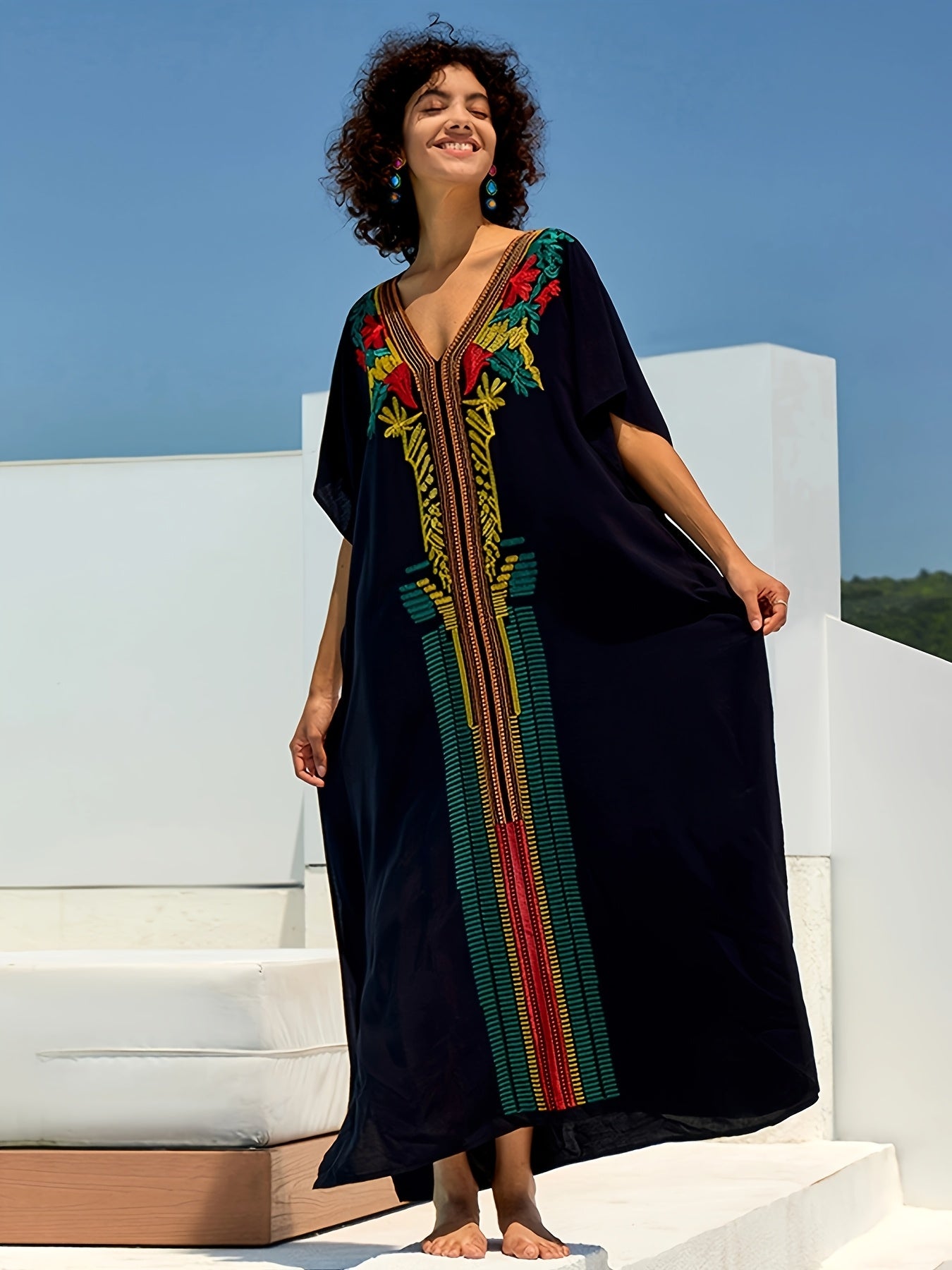
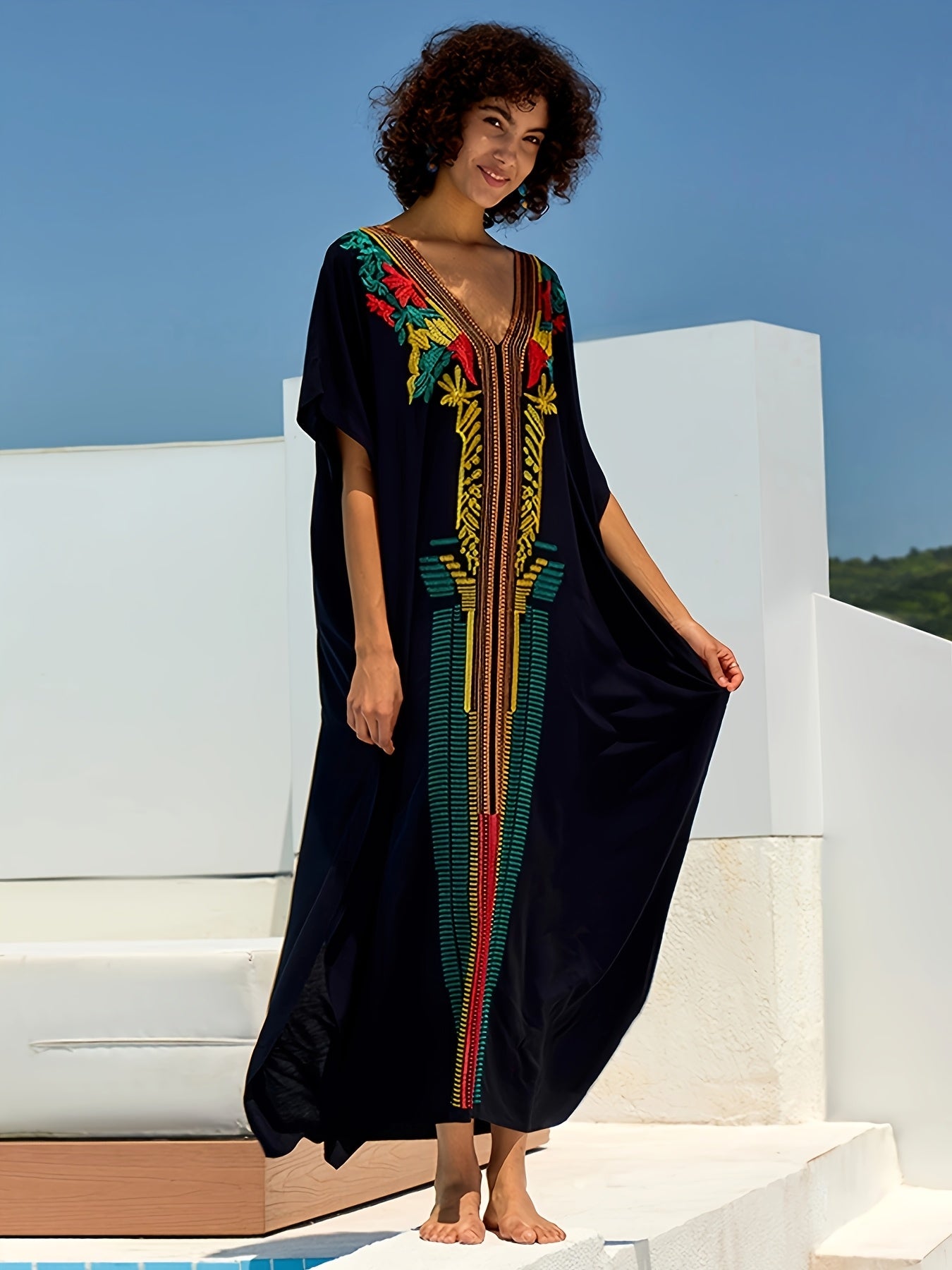
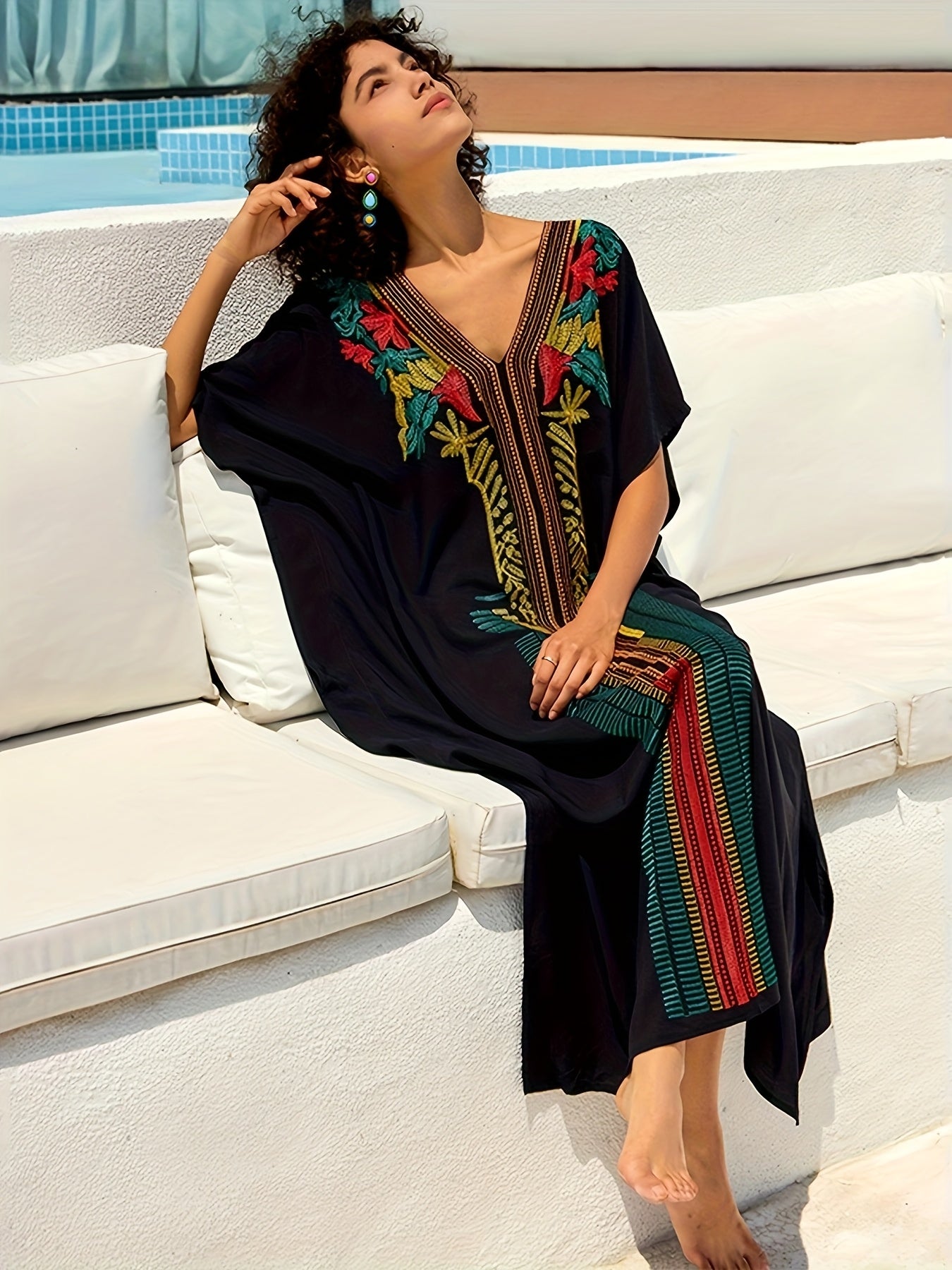
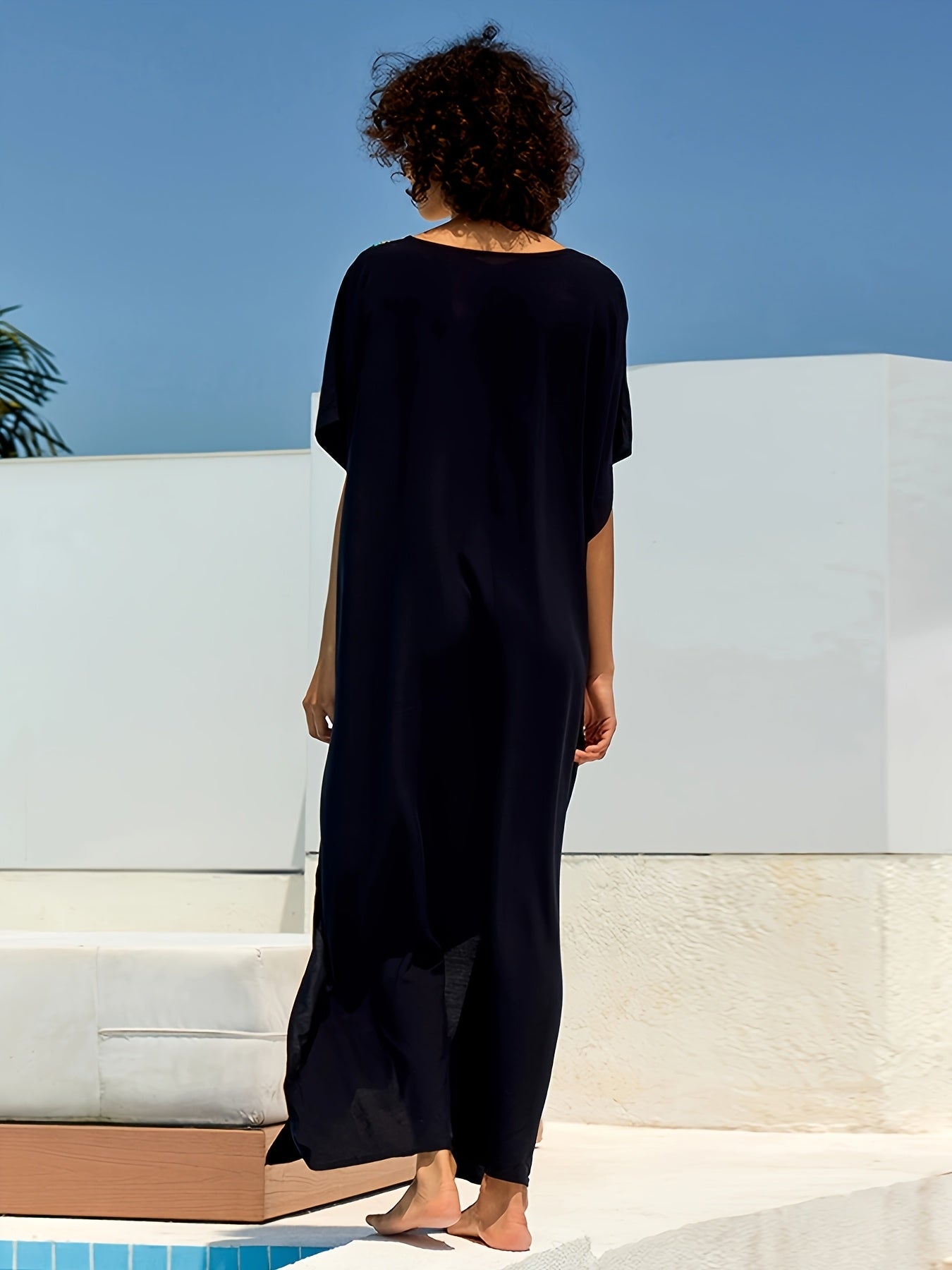
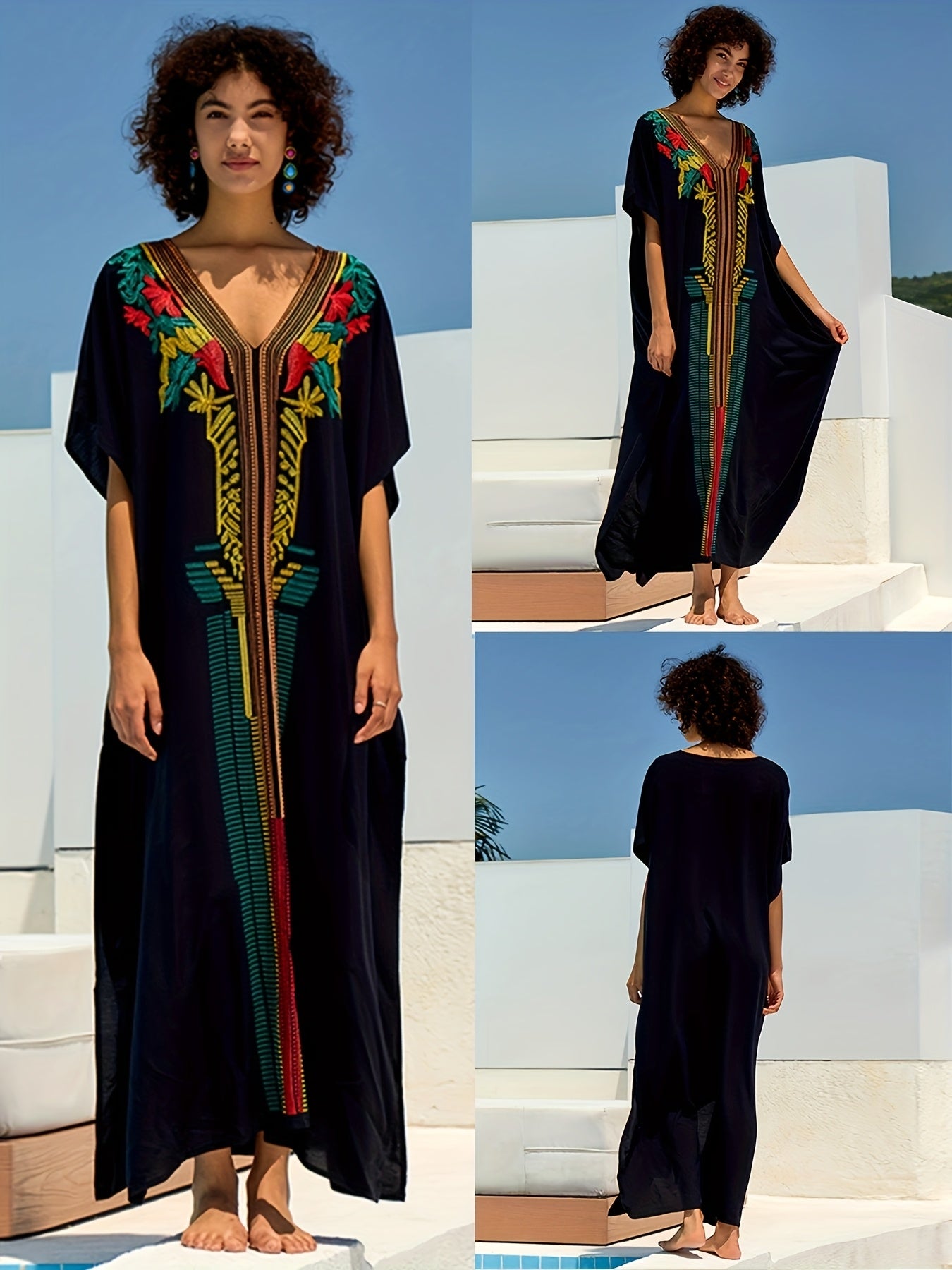
SPECIFICATIONS
Closure Type: Hedging
Collar Style: V-neck
Composition: 100% Rayon
Details: Embroidered
Fabric: Non-Stretch
Fit Type: Loose
Material: Rayon
Operation Instruction: Hand wash,do not dry clean
Pattern: Solid color
Placket Type: Pullovers
Printing Type: No Printing
Scene: Daily & Casual
Season: All
Sheer: No
Sleeve Length: Half Sleeve
Sleeve Type: Drop Shoulder
Style: Boho
Weaving Method: Woven
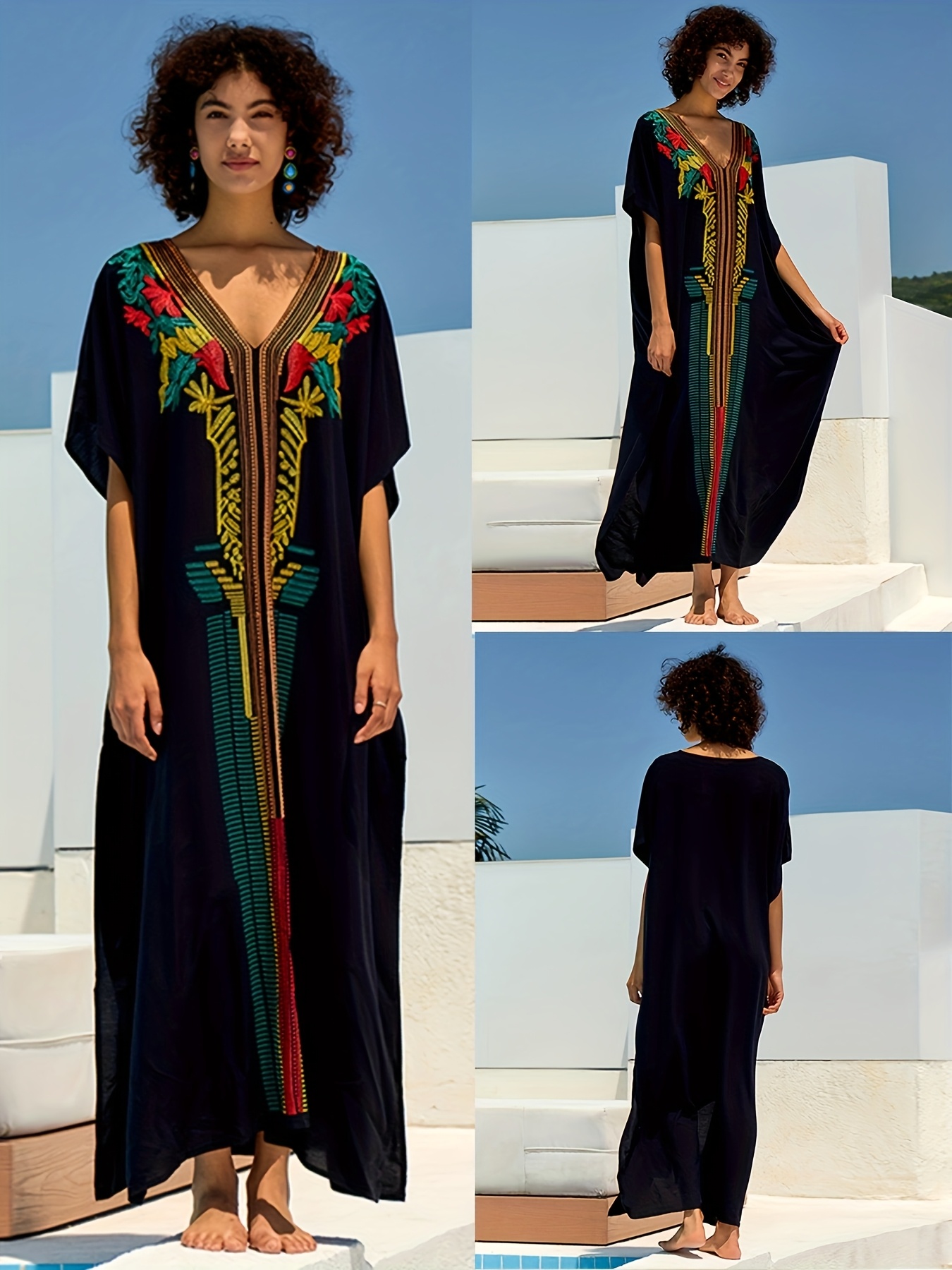
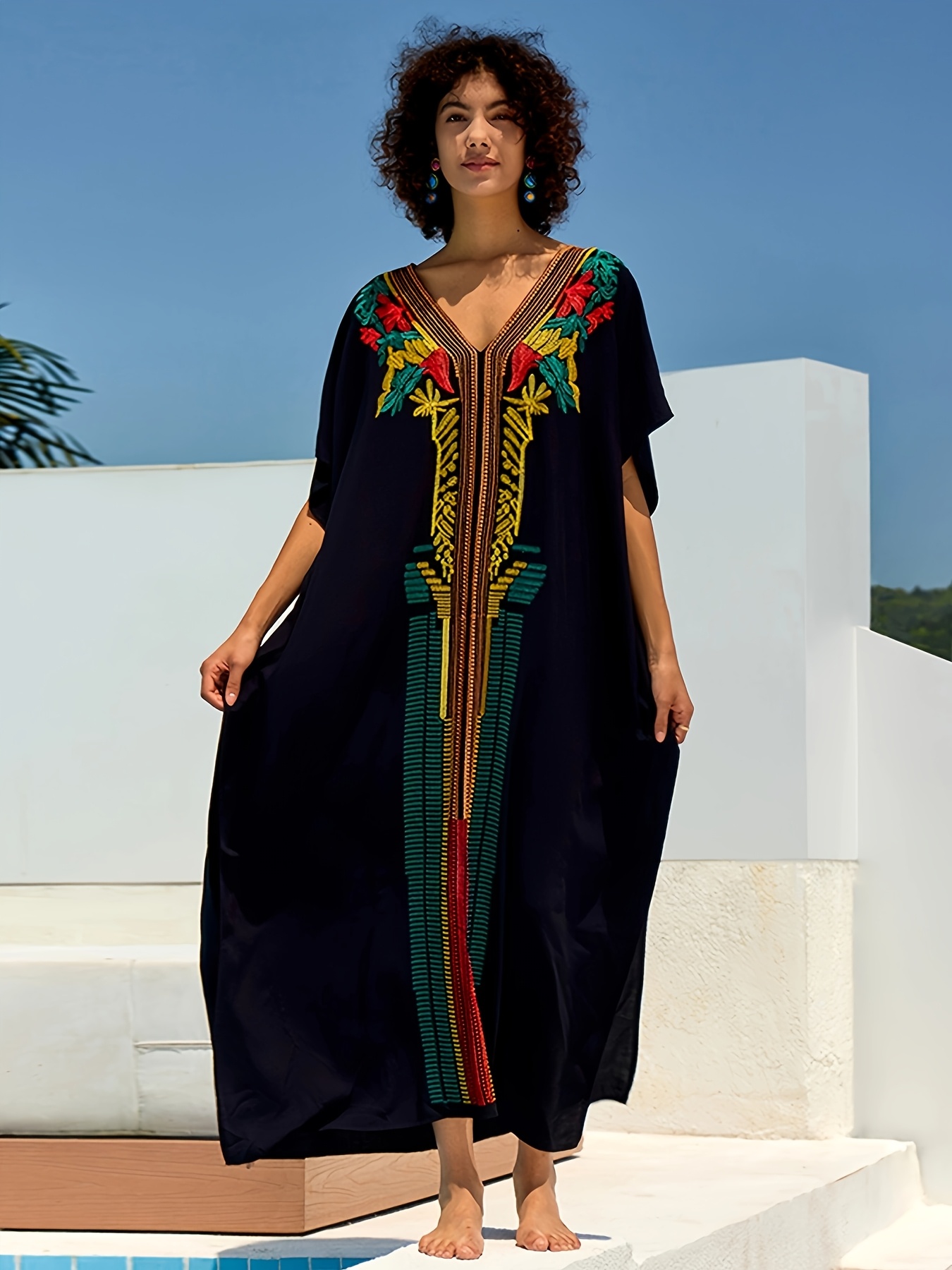
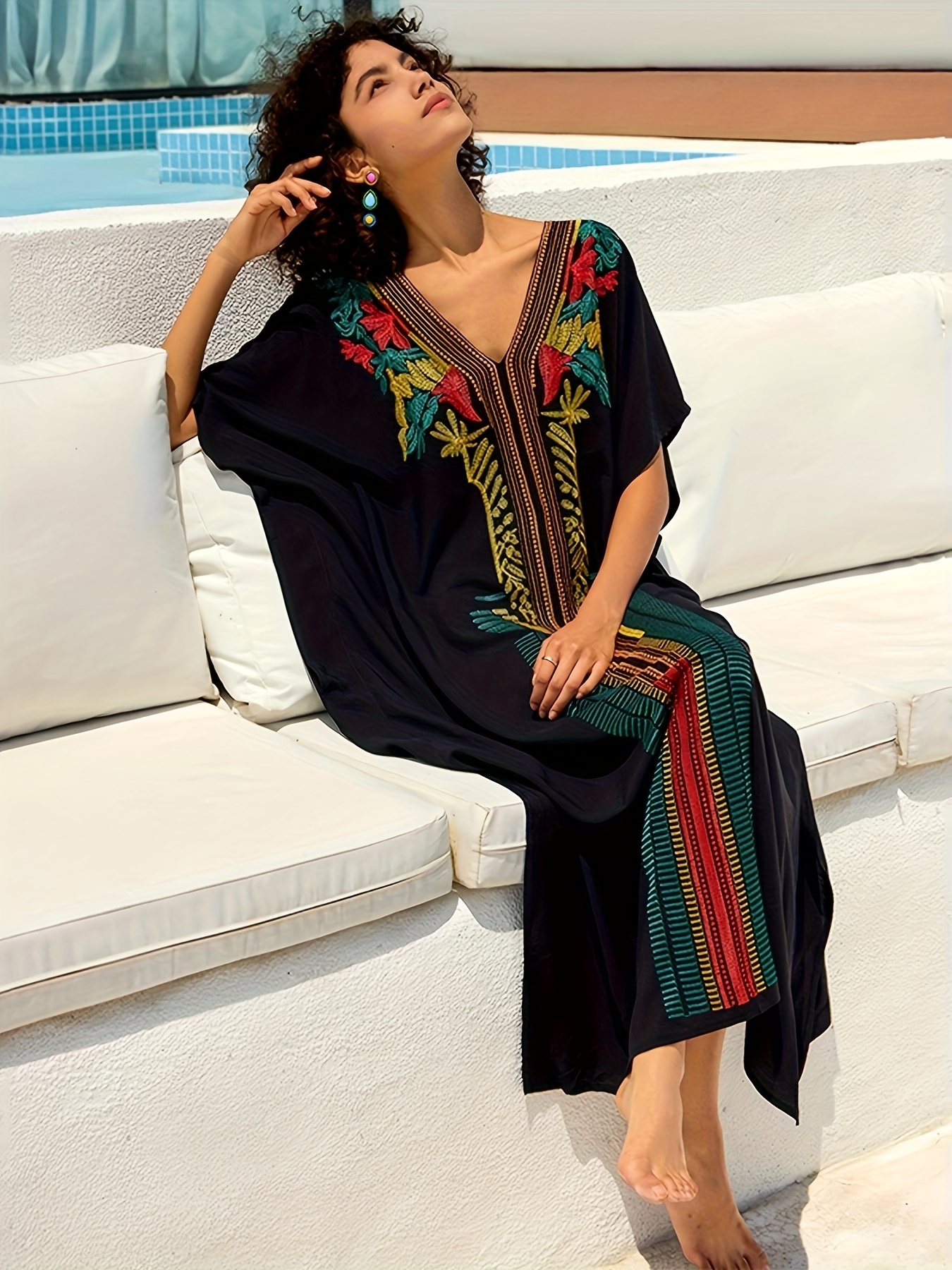
Seaside Sophistication: Embroidered Kaftan Robe for Women’s Elegant Escapes
In the evolving world of luxury fashion, few garments command such enduring reverence as the kaftan. Its fluid silhouette, timeless appeal, and cultural depth have allowed it to transcend eras, geographies, and design philosophies. The kaftan is more than a robe; it is an expression of effortless sophistication, bridging centuries of craftsmanship with the sensibilities of modern design. What once began as a garment of royalty and ritual has evolved into a global symbol of relaxed elegance and artistic identity. This editorial explores the elevated essence of Fabulive’s oversized embroidered kaftan dresses—an homage to heritage, artistry, and contemporary refinement.
The modern woman seeks attire that reflects not only her individuality but also her appreciation for design integrity and comfort. The kaftan’s relevance in this narrative is unmatched. It merges aesthetic simplicity with luxurious detailing, balancing freedom of movement with tailored artistry. Fabulive’s approach reimagines this ancient silhouette through fine fabrics, refined embroidery, and versatile styling, allowing the garment to move seamlessly from a sunlit beach escape to a sophisticated evening affair.
Historical Roots And Cultural Significance
The kaftan’s origins stretch back over a thousand years, weaving through the histories of Persia, the Ottoman Empire, North Africa, and the Middle East. Each civilization adapted it to its own artistic language—some emphasizing bold textiles and metallic threads, others preferring soft weaves and symbolic motifs. In every iteration, the kaftan represented grace, hospitality, and spiritual harmony. It was often worn by scholars, nobles, and artisans alike, transcending class distinctions through its adaptability and comfort.
In Ottoman courts, richly brocaded kaftans denoted rank and honor, while in Morocco and Tunisia, the garment became a vessel for cultural storytelling through handwoven patterns and intricate embroidery. As the world modernized, the kaftan journeyed across continents, eventually captivating European and American designers during the 20th-century wave of bohemian luxury. From high-fashion runways to resort collections, it emerged as a universal symbol of liberation—both physical and artistic.
Fabulive’s interpretation honors these roots. The oversized embroidered robe draws inspiration from traditional craftsmanship while aligning with the minimalist elegance prized in modern luxury wear. The result is a design that celebrates both authenticity and innovation, ensuring each piece feels timeless yet contemporary.
Design Philosophy And Artistic Expression
At the heart of every refined garment lies thoughtful design. The silhouette of Fabulive’s kaftan robe flows gracefully without compromising structure. Its oversized cut allows freedom of movement, while strategic stitching and panel alignment maintain a balanced drape. Every seam contributes to form and functionality, ensuring the garment flatters without constraining. The relaxed neckline and subtly contoured shoulders introduce a sense of proportion, creating visual harmony between the upper and lower body.
Embroidery is where craftsmanship meets narrative. Each motif adorning the kaftan is deliberate—a composition of threads that capture light and movement. Metallic and tonal embroideries are often hand-finished, enhancing depth and tactility. This attention to artisanal detail positions the piece not merely as attire but as wearable art. Unlike mass-produced garments, Fabulive’s embroidered kaftan expresses individuality, echoing the principles of couture tailoring where precision and emotion intertwine.
The design philosophy balances dualities—tradition and modernity, simplicity and opulence, restraint and expression. Such balance defines luxury not through excess but through refinement. Every fold and embellishment serves purpose, ensuring visual impact without overwhelming the garment’s natural flow.
The Language Of Color And Texture
Color is central to the emotional power of the kaftan. The palette chosen for Fabulive’s embroidered robe embodies serenity and radiance. Earth tones, sun-kissed golds, oceanic blues, and ivory whites evoke both nature’s tranquility and the indulgence of coastal living. These hues are carefully layered to complement varied skin tones and seasonal aesthetics. Gold embroidery against soft linen or silk crepe introduces a luminous contrast that feels regal yet understated.
Texture amplifies this sensory experience. The interplay of smooth fabrics with raised embroidery creates a tactile depth that encourages both visual admiration and touch. Each material is selected not only for its aesthetic value but for its ability to breathe, move, and age gracefully. The result is a textile narrative that evolves with wear—becoming softer, more personal, and infused with the wearer’s story over time.
Color theory in luxury fashion extends beyond beauty; it communicates intention. Light tones suggest ease and elegance, while deeper hues command presence. The kaftan thus adapts to various occasions—daytime gatherings, travel retreats, or refined evening engagements—without losing its essence of effortless sophistication.
Craftsmanship And Material Excellence
True luxury reveals itself in material integrity. The fabrics chosen for Fabulive’s kaftan dresses are sourced for quality, durability, and comfort. Lightweight cotton blends, breathable linens, and fine silks create an ideal balance between structure and fluidity. The material must flow naturally, retaining its silhouette even as the wearer moves. This ensures the kaftan appears composed whether worn loose or styled with accessories.
Embroidery threads are selected for their sheen and strength. Many designs incorporate metallic accents or tonal silk fibers that resist fraying and preserve luster through years of use. The hand-finishing process—often involving small, careful stitches—reflects a commitment to heritage techniques adapted for modern precision.
The manufacturing ethos behind such craftsmanship aligns with the principles of conscious luxury. Rather than relying on automated production, skilled artisans oversee key detailing processes. This human touch ensures subtle variations, transforming each piece into a unique creation. Such artistry redefines the relationship between maker and wearer, positioning the kaftan as both an object of beauty and a testament to enduring skill.
Functionality And Modern Relevance
While rooted in history, the kaftan remains remarkably versatile for the contemporary lifestyle. It bridges leisure and sophistication, embodying the concept of quiet luxury—garments that speak softly yet command admiration. Its functionality extends across climates and contexts. The oversized cut ensures ventilation in warm weather, while layering transforms it for transitional seasons. Its drape conceals and flatters simultaneously, providing comfort without sacrificing elegance.
In modern wardrobes, functionality equals value. The kaftan transitions seamlessly from beach cover-up to elegant dinner attire, requiring only a shift in accessories. Its wrinkle-resistant fabrics make it a reliable choice for travel, while its breathable fibers adapt effortlessly to humid environments. Fabulive’s design team considers such practicalities integral to the luxury experience—because true refinement lies in garments that feel as effortless as they look.
Moreover, the kaftan aligns with a growing appreciation for minimal, sustainable living. One garment serving multiple purposes reflects mindful consumption, reducing the need for excess. It is the embodiment of elegance through simplicity, allowing the wearer to express personal style with understated confidence.
Cultural Continuity In Modern Fashion
The cultural endurance of the kaftan is rooted in its ability to adapt without losing authenticity. Across decades, it has absorbed global influences while maintaining its core identity. In the context of modern luxury fashion, this adaptability positions the kaftan as a unifying garment—connecting East and West, tradition and innovation. Its continued evolution mirrors society’s shifting values toward inclusivity and cross-cultural appreciation.
Contemporary designers draw inspiration from regional motifs, celebrating embroidery traditions from Morocco, India, and Turkey. Yet Fabulive’s approach is neither imitative nor ornamental. Instead, it pays homage through interpretation—transforming historic motifs into subtle modern expressions. This ensures each kaftan resonates universally while retaining its cultural resonance. Wearing it becomes both a style statement and an acknowledgment of shared artistry across generations.
The kaftan also symbolizes empowerment. Historically, it represented dignity and self-expression within communities; today, it continues to celebrate individuality. Its loose, fluid form liberates the body from restrictive silhouettes, aligning with modern values of comfort, inclusivity, and confidence. Each wearer contributes to the living narrative of this timeless garment, ensuring its relevance for generations to come.
The Evolution Of Craftsmanship In Modern Kaftan Design
Luxury begins where craftsmanship transcends the ordinary. The art of creating a kaftan is centuries old, yet the modern interpretation continues to evolve through new techniques and refined artistry. Today’s designers do not simply recreate history—they reinterpret it, weaving contemporary innovation into time-honored methods. The kaftan’s evolution lies in this delicate balance between tradition and transformation. Each piece emerges as both a cultural narrative and a functional masterpiece.
The process begins with concept sketches inspired by heritage motifs and architectural geometry. From the first draft to the final embroidery, every decision contributes to a unified design language. Modern artisans integrate digital pattern mapping to ensure precision in embroidery placement, yet the execution often remains profoundly human. Hand-finishing, beading, and stitching provide a tactile authenticity that machines cannot replicate. This blend of technology and tradition defines the next chapter of luxury craftsmanship, where innovation serves heritage rather than replacing it.
In the making of a high-end embroidered robe, multiple stages converge seamlessly. Fabric preparation ensures texture consistency, embroidery layering determines visual rhythm, and thread tension adjustment maintains structural integrity. The result is a garment that feels light yet visually rich, simple yet infinitely detailed. It is the culmination of skill, patience, and artistic intuition—values that align perfectly with the refined standards of modern luxury fashion.
The Intricacy Of Embroidery As Artistic Language
Embroidery, the defining feature of the kaftan, operates as both decoration and narrative. Each stitch tells a story of dedication, representing the invisible dialogue between maker and material. The motifs chosen for Fabulive’s embroidered kaftan often reflect the harmony found in nature—floral arrangements, fluid curves, and symmetrical borders that mimic organic balance. Yet these motifs are not mere patterns; they symbolize growth, serenity, and strength, values that resonate across cultures and generations.
Traditional embroidery techniques such as chain stitching, satin threading, and metallic weaving form the backbone of the kaftan’s artistry. Modern ateliers refine these methods by introducing fine silk threads, metallic accents, and tone-on-tone blending to create dimensional surfaces. Light interacts with the embroidery to generate subtle shadows and reflections, transforming the fabric into a living canvas. The hand-guided needlework ensures that no two garments are identical, adding an element of individuality that defines bespoke luxury.
The craftsmanship behind such detailing demands not only technical skill but also emotional depth. Each artisan imparts a personal rhythm to their work, resulting in variations that enhance character rather than compromise precision. This human element brings warmth and authenticity to the kaftan, preserving the intimacy of craftsmanship even in a world driven by mechanization.
Symbolism Of Patterns And Their Cultural Legacy
Beyond aesthetic beauty, the patterns embroidered on kaftans hold profound cultural resonance. Across centuries, artisans have encoded meaning into motifs—geometric lines representing unity, floral vines symbolizing vitality, and spirals evoking spiritual continuity. The modern luxury kaftan retains this symbolic language, reimagining traditional patterns in minimalist forms that appeal to the contemporary eye while maintaining historical depth.
These designs often reflect the interconnectedness of global artistry. Moroccan latticework, Ottoman arabesques, and Persian medallions all influence the design vocabulary found in embroidered robes. Yet, modern interpretations avoid imitation. They distill essence rather than replicate form. In this process of reinterpretation, artisans transform regional tradition into universal elegance, making the kaftan a vessel for cross-cultural dialogue.
Color also plays a role in symbolism. Gold embroidery conveys prosperity and illumination, while ivory backgrounds represent purity and timelessness. Subtle contrasts, such as pale turquoise with muted beige, evoke tranquility and sophistication. This color philosophy ensures that every embroidered kaftan radiates harmony, appealing to both the visual and emotional sensibilities of its wearer.
The Role Of Fabric Innovation In Luxury Comfort
Fabric selection is the foundation upon which the entire kaftan design rests. A garment’s silhouette, drape, and movement depend on the integrity of its textile. Luxury kaftans demand materials that balance structure with softness. Linen blends, organic cottons, and lightweight silks are favored for their breathability and tactile refinement. These fabrics respond beautifully to embroidery, absorbing light in ways that enhance depth and detail.
Advances in textile technology have introduced high-performance natural fibers that resist creasing and improve breathability without compromising luxury. The result is a kaftan that remains pristine through hours of wear, ideal for resort destinations, evening gatherings, or leisurely retreats. When touched, the fabric offers a cool, smooth surface, a subtle reminder of the sensory pleasure that defines true elegance.
The dyeing process adheres to sustainable standards, utilizing low-impact pigments that achieve rich coloration while preserving the softness of the fibers. Each hue is meticulously tested to ensure longevity, preventing fading and maintaining luster over time. This commitment to quality extends the life of the garment, aligning with the principles of investment dressing—a key element of luxury consumer philosophy today.
The Precision Of Tailoring And Fit
Though the kaftan is traditionally recognized for its loose silhouette, luxury tailoring ensures that the fit remains flattering rather than shapeless. The art of proportion lies in subtle construction techniques—strategic seams, controlled draping, and carefully measured lengths. The oversized design creates an impression of effortless ease, yet its structure is meticulously calculated to maintain balance and form.
The neckline often serves as the focal point of composition. V-necks elongate the frame, while rounded or embellished collars add an ornamental dimension. Sleeve design varies according to the intended context—batwing sleeves for flow and comfort, straight-cut sleeves for a more refined appearance. Side slits enhance mobility and create graceful movement as the wearer walks, ensuring the garment flows naturally rather than billows uncontrollably.
Each measurement is tested on multiple body types to achieve universal comfort. This attention to inclusivity reflects modern luxury values—celebrating diversity while maintaining aesthetic integrity. The resulting garment transcends conventional sizing, embodying both freedom and elegance in its most refined form.
The Modern Luxury Lifestyle Connection
The rise of modern resort wear has revived the kaftan as a central element of the luxury wardrobe. Once reserved for ceremonial use, it now symbolizes leisure sophistication—ideal for yachts, villas, beach retreats, and metropolitan lounges alike. Its effortless transition between casual and formal environments embodies the fluidity of contemporary fashion. In this sense, the kaftan is not merely worn; it is experienced.
Luxury consumers today prioritize versatility. They seek garments that accompany them through varied settings without losing relevance. The embroidered robe meets this demand with ease. It pairs seamlessly with flat sandals for daytime serenity or with metallic accessories for twilight elegance. The same garment that graces a morning terrace can later command attention at a candlelit soirée. Such adaptability underscores its value, merging function and luxury in perfect harmony.
Fabulive’s design approach responds to this evolution by emphasizing transitional aesthetics—pieces that serve as both wardrobe essentials and artistic statements. This vision redefines modern luxury, focusing less on ostentation and more on longevity, craftsmanship, and emotional connection.
Sustainability As The New Definition Of Elegance
In an age where fashion intersects with environmental consciousness, sustainability has become synonymous with sophistication. True luxury is no longer measured by excess but by ethics and endurance. The kaftan exemplifies this philosophy through its timeless construction and eco-conscious production methods. Its design inherently supports slow fashion principles—durability, multi-functionality, and minimal waste.
Sustainable fabric sourcing ensures reduced ecological impact without compromising quality. Organic cottons and low-water dye processes help maintain environmental balance. Many artisans employ traditional hand embroidery techniques that minimize energy consumption, celebrating craftsmanship over industrial repetition. The longevity of the garment itself becomes a sustainable act, as a single kaftan can serve across seasons and occasions, diminishing the cycle of disposable fashion.
The philosophy extends beyond materials into the idea of mindful consumption. Purchasing a luxury kaftan represents an investment in artistry and heritage rather than fleeting trend. It is an act of appreciation for human skill, cultural continuity, and environmental stewardship. This alignment between ethics and elegance marks the modern consumer’s shift toward meaningful luxury.
The Emotional Resonance Of Wearing A Kaftan
Clothing has always possessed the ability to influence emotion. A kaftan, with its generous drape and refined detail, evokes a unique sense of calm confidence. It allows the wearer to inhabit space gracefully, moving with unhurried poise. The sensation of soft fabric gliding against the skin and the subtle weight of embroidery resting upon the shoulders create a sensory experience that transcends fashion. It becomes ritual—an intimate dialogue between fabric, form, and feeling.
For many, the kaftan represents a return to authenticity in a world driven by speed. Its unstructured elegance invites mindfulness, encouraging presence rather than performance. This emotional depth enhances its appeal in luxury wardrobes, where wearers seek garments that express both comfort and self-awareness. The kaftan becomes an emblem of quiet confidence—a statement of identity communicated through serenity rather than spectacle.
This emotional connection extends to memory. Each wear becomes a moment in the garment’s ongoing story—a seaside sunset, a tranquil retreat, a gathering of friends. Over time, the kaftan evolves from possession to companion, imbued with experiences that shape its meaning. In this transformation lies the true essence of luxury: the merging of beauty, craftsmanship, and emotional permanence.
The Harmony Of Color And Emotion In Kaftan Design
Color in fashion transcends mere decoration; it is language, emotion, and expression woven into cloth. In luxury kaftan design, color plays a transformative role—it sets the tone, conveys mood, and defines personality. The hues chosen for the embroidered robe carry both cultural resonance and modern sensibility. They communicate calm sophistication while allowing the wearer to express individuality through refined restraint. Pale neutrals, coastal whites, and golden undertones dominate modern kaftan palettes, evoking serenity and purity. Such shades reflect sunlight and create an effortless sense of luminosity, ideal for open-air settings or resort atmospheres. Subtle contrasts like azure embroidery over ivory fabric mimic ocean waves meeting sand, embodying the timeless relationship between earth and sea. In deeper variations, jewel-toned blues, amethyst purples, and bronzed golds reveal an aura of confidence and opulence, transforming a relaxed garment into an emblem of evening elegance. Color becomes architecture—it sculpts perception, enhances drape, and influences how the fabric interacts with light. A well-chosen hue can highlight embroidery precision, accentuate body movement, and define silhouette with quiet power. It is through this mastery of tone and light that the modern kaftan achieves harmony between simplicity and splendor.
The Art Of Styling With Subtle Sophistication
The essence of luxury styling lies in understatement. The kaftan does not demand attention—it commands it through poise and proportion. Styling such a piece requires intuition rather than excess. The oversized silhouette already carries visual strength, so accessories must serve to refine, not compete. A minimalist approach amplifies elegance, allowing craftsmanship and embroidery to remain the focal point. For daytime wear, the kaftan pairs beautifully with neutral sandals, a structured tote, and delicate jewelry that reflects sunlight—perhaps slender gold hoops or a single shell pendant. Hair loosely tied enhances the natural flow of the garment. The look evokes refined leisure, perfect for seaside lunches or afternoon promenades. Transitioning into evening involves subtle elevation. Metallic cuffs, statement earrings, or a slim belt transform the kaftan into a dinner-worthy ensemble. When worn with heeled sandals and a silk scarf, it becomes an icon of modern resort elegance. The transformation requires no wardrobe change—only an adjustment of texture and tone. This adaptability reinforces its long-term value. In an era of fast-changing trends, such timeless versatility defines contemporary luxury. The kaftan’s charm lies in its ability to accompany the wearer through varied settings while maintaining an aura of effortlessness. It complements the individuality of its owner rather than overshadowing it, merging seamlessly into diverse lifestyles.
Layering And Adaptation For All Seasons
A hallmark of intelligent design is adaptability across climates and seasons. While the kaftan originated in warmer regions, its structure lends itself beautifully to layering. Light fabrics such as linen and silk breathe in summer, keeping the body cool without clinging. During cooler months, the same silhouette can be paired with tailored trousers, fine-knit turtlenecks, or knee-high boots, reinterpreting the kaftan as a statement of refined warmth. The addition of belts or sashes further personalizes proportion, transforming the free-flowing form into a cinched, architectural shape. This ability to evolve with temperature and context elevates the kaftan beyond seasonal limitation. It becomes an all-year companion rather than a fleeting trend piece. Designers understand that the modern wardrobe values pieces that travel well, transition easily, and sustain style relevance regardless of climate. Thus, the contemporary embroidered robe is not confined to resorts—it finds equal place in metropolitan wardrobes. Its oversized form layers effortlessly under lightweight coats or cropped jackets, merging cultural inspiration with urban sensibility. This universality anchors the kaftan firmly within the sphere of enduring design.
Accessorizing As A Form Of Personal Identity
Accessories serve as punctuation in fashion—they emphasize, clarify, and define intent. When paired with a luxury kaftan, they must follow the principle of harmony. The embroidered robe already contains visual narrative; each added element must complement rather than compete. For daytime refinement, organic materials—woven straw hats, beaded bracelets, or natural-stone necklaces—align with the kaftan’s artisanal heritage. They evoke craftsmanship and simplicity, reflecting a connection between wearer and nature. For evening sophistication, metallic tones and sculptural jewelry highlight the embroidery’s shimmer under soft light. A cuff bracelet echoing the thread’s sheen or drop earrings that mirror the robe’s geometric motif can complete the ensemble. Footwear contributes to posture and presence. Barefoot sandals or simple slides emphasize leisure, while heeled mules or embellished flats introduce elevation. The choice depends on setting and mood. Bags follow similar logic: structured clutches for evening formality, soft woven totes for relaxed days. Styling, in this context, is not about transformation but translation—each accessory translating the kaftan’s aesthetic language into the vocabulary of personal identity. This interplay of individuality and tradition gives the garment its living spirit.
Fabric Care And Preservation Of Elegance
Luxury demands longevity. A well-crafted kaftan is designed not for single-season wear but for years of continued refinement. Proper care preserves both visual integrity and emotional value. Fine fabrics such as cotton-silk blends or embroidered linen require gentle maintenance to sustain their original luster. Hand washing in cold water with mild detergents protects embroidery threads from tension and fading. Drying in shade maintains fabric softness and prevents discoloration caused by sunlight exposure. Steam pressing from the reverse side revives drape and smoothness without damaging surface texture. For silk variants, professional cleaning is recommended to ensure longevity of both weave and color. Storage also plays a role in preservation. Hanging the garment in breathable covers prevents dust accumulation and maintains shape. Folding heavy embroidered pieces with tissue between layers prevents thread friction. These practices transform care into ritual—an extension of respect for craftsmanship. The wearer becomes custodian of art rather than mere owner of clothing. The philosophy underlying such attention is integral to luxury: elegance preserved through mindfulness. A kaftan maintained with care not only endures physically but matures aesthetically, acquiring softness, fluidity, and familiarity over time.
The Semiotics Of Movement And Drape
The allure of the kaftan lies not just in appearance but in motion. Its flow, rhythm, and fluidity convey grace before a word is spoken. Drape is the invisible architecture that gives the kaftan its soul. The interplay between fabric weight, embroidery placement, and seam alignment determines how it moves around the body. When executed with mastery, the garment appears almost alive—responding to gesture and breeze with subtle choreography. Light materials float, while denser weaves glide, creating visual poetry in motion. This dynamic quality makes the kaftan ideal for open spaces—terraces, beaches, garden paths—where air and light interact freely with the fabric. The movement communicates ease, freedom, and quiet confidence. Designers study this behavior meticulously, testing multiple prototypes to perfect flow. Even embroidery placement is deliberate: heavier stitching near borders grounds the garment, while lighter motifs on upper panels preserve mobility. The result is equilibrium between weight and airiness, symmetry and spontaneity. When worn, the kaftan projects serenity and command simultaneously, reflecting both the relaxation of leisure and the refinement of ceremony.
The Relationship Between Body, Fabric, And Confidence
The most profound aspect of any garment is how it makes the wearer feel. The kaftan achieves something rare—it empowers without constriction. Its form celebrates the natural body rather than disguising it. The absence of tight seams or rigid tailoring allows every movement to appear deliberate and graceful. This liberation enhances posture, ease, and confidence. The wearer feels composed yet unrestricted, sophisticated yet comfortable. Unlike trend-driven attire, the kaftan invites authenticity. It aligns with the modern ideal of self-assured elegance—luxury that emanates from within. Its inclusivity also holds significance. The design accommodates all body shapes, honoring individuality through universal design. This fluid approach to fit embodies quiet empowerment, rejecting the notion that beauty requires constraint. Each woman who dons the embroidered robe becomes both participant and curator of her style narrative, transforming simplicity into statement.
Integration Of The Kaftan In Contemporary Fashion Narratives
In the global dialogue of fashion, the kaftan has secured its place as an emblem of fusion—blending artisanal heritage with contemporary relevance. Its reemergence in luxury collections signals a shift toward authenticity and slow elegance. Designers integrate it within minimalist wardrobes, pairing it with modern silhouettes to create a cross-cultural aesthetic that feels both grounded and visionary. The kaftan represents a rebellion against over-structured fashion norms; it invites freedom of form and mindfulness of material. Modern luxury consumers appreciate garments that connect past and present through purpose and narrative. The embroidered robe encapsulates this ethos—its design references ancient artistry, yet its aesthetic language speaks fluently to modern tastes. Fashion houses and artisans alike recognize its timeless appeal, frequently reimagining it in capsule collections or exclusive resort editions. Its adaptability ensures continuity, ensuring the kaftan remains not merely a garment of nostalgia but a cornerstone of modern identity.
The Enduring Value Of Timeless Elegance
Longevity defines true luxury. The value of the kaftan extends beyond price or trend—it resides in experience, craftsmanship, and permanence. A well-made embroidered robe holds its relevance for decades, outlasting the volatility of seasonal fashion. Its design, grounded in simplicity and culture, resists obsolescence. As styles fluctuate, the kaftan remains, continually rediscovered by new generations of connoisseurs. This endurance makes it a sound investment, both aesthetically and practically. Each wear reinforces the garment’s story, deepening its sentimental worth. Unlike disposable fashion, the kaftan invites emotional attachment. It may accompany its owner through travels, milestones, or serene retreats, absorbing fragments of personal history. The fading of color or softening of fabric does not diminish its beauty—it enhances it, echoing the natural passage of time. In this sense, luxury becomes philosophy: a celebration of refinement, responsibility, and continuity. The kaftan stands as proof that elegance, when anchored in artistry, never expires.
The Evolution Of Functionality In Luxury Kaftans
The kaftan, once reserved for ceremonial or leisurely wear, has undergone a transformation in its purpose and adaptability. The modern iteration combines artistic detail with practical sophistication, balancing aesthetic refinement with comfort. The functional versatility of a kaftan today is one of its most defining attributes. It can transition effortlessly from daywear to evening elegance, from resort leisure to urban sophistication. Fabulive’s approach exemplifies this versatility through precise tailoring, breathable fabrics, and thoughtfully designed silhouettes that accommodate movement and comfort. The oversized nature of the kaftan allows freedom while maintaining a draped contour that enhances posture and poise. Hidden fastenings, adjustable ties, and side slits are often integrated to add modern ease without compromising traditional charm. This attention to ergonomic design elevates the kaftan from an artistic garment into a lifestyle piece.
Detailing That Defines Elegance
The defining element of a true luxury kaftan lies in its craftsmanship. Subtle embroidery, hand-applied embellishments, and precision stitching embody the devotion of artisans who understand the delicate balance between texture and structure. The embroidered motifs seen in high-end collections often draw inspiration from cultural patterns yet are reinterpreted with contemporary sensibilities. The balance between ornate and understated details is what makes the kaftan transcend trends. Stitching that follows the natural flow of fabric enhances light play, catching and reflecting subtle movement. Each thread and bead contributes not just to beauty but also to narrative. The embroidery becomes a visual language that communicates the brand’s dedication to excellence and timeless design values.
The Interplay Of Form And Structure
A kaftan may appear simple in outline, yet it embodies structural mastery. The silhouette relies on proportion and precision draping. Every curve, fold, and hemline serves to frame the body while maintaining the effortless fluidity the garment is known for. The neckline design, sleeve cut, and length variation all affect perception and movement. For example, a V-neck design elongates the torso and creates a balanced profile suitable for both casual and formal occasions. Loose batwing or kimono-style sleeves contribute to motion and flow, reinforcing the sense of grace. When observed closely, these structural components reveal that behind the relaxed impression lies a deliberate architectural concept. Luxury craftsmanship translates simplicity into complexity through invisible structure and restraint in design.
Fabric Selection And Technical Mastery
Fabric selection determines not only comfort but also the aesthetic integrity of a kaftan. Natural fibers such as cotton, linen, and silk blends remain preferred due to their breathability and drape. Fabulive’s curated materials combine softness with longevity, ensuring that each piece feels indulgent yet practical. Lightweight weaves enhance airflow while maintaining opacity, allowing for modesty and elegance. Some designs integrate semi-sheer panels or tonal layering, introducing depth without compromising comfort. Textural harmony between fabric and embellishment is crucial. The interplay of matte and sheen, coarse and smooth, gives dimension and tactile pleasure. Each fabric is tested for color retention, crease resistance, and wash durability, ensuring that the garment maintains its refined appearance through repeated use.
Cultural Identity In Contemporary Context
The kaftan remains an emblem of cross-cultural influence. From the royal courts of the Ottoman era to the coastal villas of contemporary luxury resorts, it continues to symbolize relaxed refinement and worldly sophistication. What distinguishes modern interpretations is the ability to preserve cultural integrity while appealing to global sensibilities. Each stitch carries historical memory, yet the styling aligns with present-day preferences. The embroidered motifs and silhouettes often echo traditions from North Africa, the Middle East, and South Asia. However, they are adapted with modern tailoring and minimalistic proportions suitable for today’s cosmopolitan wearer. The garment becomes a canvas that connects heritage with evolution, preserving authenticity while fostering universality.
The Role Of Color Harmony
Color defines emotional resonance. In luxury kaftan design, color palettes are curated with precision to evoke serenity, opulence, or vitality. Earth tones such as sand, ivory, and olive suggest understated elegance, while jewel tones like sapphire, ruby, and emerald communicate richness and drama. Fabulive’s color compositions often follow natural inspiration—sunset gradients, ocean blues, or desert neutrals—each selected to complement varying skin tones and settings. The art of color placement determines how light interacts with the garment. Embroidery in metallic threads amplifies luminosity, while matte tones ground visual balance. The deliberate restraint in palette selection ensures that the kaftan maintains sophistication rather than excess. Color becomes not an adornment but an integral design language that defines mood and purpose.
Adaptability Across Occasions
The modern kaftan’s universal appeal lies in its ability to traverse settings. It can function as beachwear, resort attire, evening wear, or even casual homewear depending on accessories and context. When paired with leather sandals and a wide-brim hat, it evokes effortless coastal charm. With statement jewelry and refined heels, it transitions into an elegant dinner ensemble. Belted variations emphasize structure for semi-formal settings, while unbelted silhouettes highlight natural drape and ease. This adaptability allows one garment to serve multiple wardrobe roles. For luxury consumers, this versatility extends the value of investment—purchasing not just an outfit but a multifunctional expression of style.
Artisanal Heritage And Modern Innovation
Preserving craftsmanship while integrating innovation defines contemporary luxury. The artisans behind embroidered kaftans often employ techniques passed through generations, yet these methods evolve through modern technology. Hand embroidery coexists with precision machine finishing, ensuring consistency without losing individuality. Decorative motifs may draw from ancient geometries or botanical elements but are executed with updated color treatments or metallic threading. This blend of old and new gives each piece a unique identity. The result is a garment that respects heritage but remains progressive. The kaftan, therefore, becomes not merely apparel but an artifact of evolving artistry.
Maintenance And Longevity
Luxury garments demand care aligned with their craftsmanship. Proper maintenance preserves both texture and structure. Gentle hand washing or dry cleaning is recommended for embroidered or embellished pieces. Fabrics like silk blends and fine cottons should be dried in shade to maintain vibrancy. Storage practices, such as folding with acid-free tissue or hanging on padded hangers, prevent distortion. Fabulive’s quality standards ensure that each piece retains colorfastness and thread integrity even after prolonged use. Regular attention to care allows the kaftan to age gracefully, acquiring softness and familiarity without degradation. Longevity becomes an extension of luxury—an assurance that beauty endures.
Emotional And Symbolic Value
Beyond its tangible elements, the kaftan carries emotional resonance. Wearing one invokes relaxation, confidence, and an unspoken link to cultural continuity. It signifies a lifestyle choice rather than a trend. For many, it represents the luxury of time—time to move freely, to embrace comfort without haste. In contemporary fashion, where rapid consumption dominates, the kaftan’s slow elegance provides contrast. The garment’s symbolism lies in its quiet authority and enduring form. It reminds wearers that refinement need not be loud to be recognized. The understated grace of the kaftan appeals to those who value heritage, comfort, and authenticity in equal measure.
The Global Perspective Of Kaftan Luxury
Luxury consumers across the world now recognize the kaftan as more than regional attire. It is an international style statement, merging traditional inspiration with cosmopolitan taste. Its relaxed silhouette aligns perfectly with the global movement toward effortless sophistication. Designers reinterpret the kaftan for varied climates and lifestyles, integrating breathable materials and minimalist cuts suitable for both tropical and urban settings. Fabulive’s collection captures this global spirit, creating garments that speak to diverse audiences while retaining artisanal depth. The result is a seamless blend of cultural dialogue and universal elegance that defines modern luxury fashion.
Refinement Through Subtle Detailing
In the world of luxury design, restraint often signifies mastery. The most sophisticated kaftans achieve impact through subtlety rather than excess. A single line of metallic embroidery, an asymmetrical hem, or a faint gradient of dye can transform simplicity into distinction. These small interventions demand skill and foresight. The artisan must anticipate how the garment will move, catch light, and drape over time. Each subtle detail contributes to the lasting impression of refinement. When viewed from a distance, the kaftan appears serene; upon closer inspection, its complexity unfolds. This controlled subtlety reflects a refined understanding of aesthetics—where beauty lies not in abundance but in balance.
Integration Into The Modern Wardrobe
The integration of the kaftan into the modern wardrobe represents the merging of tradition and function. Once considered occasional wear, it now finds relevance in daily style rotations. Its loose form complements varied body types, making it inclusive by design. This adaptability resonates with the contemporary consumer’s desire for clothing that aligns with personal comfort and ethical values. The kaftan’s gender-neutral roots also contribute to its renewed popularity, offering versatility beyond conventional fashion categories. In professional environments, tailored versions serve as creative alternatives to structured dresses or blazers, redefining workplace elegance.
The Luxury Philosophy Behind Minimalism
Luxury fashion increasingly aligns with the principles of minimalism—clarity, purpose, and timeless appeal. The kaftan embodies these principles through its clean lines and unforced beauty. Minimalism does not denote lack of detail but intentional selection. Every design choice serves a function, whether aesthetic or structural. The absence of superfluous decoration emphasizes material quality and form. Fabulive’s interpretation adheres to this philosophy, ensuring that embellishments enhance rather than dominate. This design restraint ensures longevity, making each piece relevant across seasons. The result is an investment in lasting sophistication rather than fleeting style.
The evolution of the kaftan within the luxury spectrum reflects a journey from cultural attire to global symbol of refinement. It unites the artistry of the past with the functionality of the present. Through expert tailoring, high-quality materials, and respectful innovation, it achieves equilibrium between form and purpose. Whether worn for leisure, ceremony, or travel, the kaftan represents freedom—freedom of movement, of style, and of cultural expression. As luxury consumers seek authenticity and meaning, garments like these endure as testaments to craftsmanship and timeless grace.
Sustainability And The Modern Luxury Ethos
The definition of luxury has evolved beyond opulence and exclusivity. Today, true luxury embodies sustainability, accountability, and conscious production. The kaftan, with its timeless design and cultural roots, naturally aligns with these modern principles. Its enduring style promotes longevity over seasonal fashion cycles, reducing waste and encouraging mindful consumption. In the modern era, sustainability is not simply about using organic fabrics; it reflects a philosophy that honors artisanship, ethical sourcing, and the environment. The refinement seen in contemporary kaftans showcases how fashion can coexist harmoniously with ecological awareness. Each piece becomes a narrative of care—care for craft, community, and planet.
Responsible Material Sourcing
The selection of materials determines both the sensory and ethical value of a garment. Choosing natural fibers such as organic cotton, silk, and linen minimizes environmental impact while enhancing comfort. The breathability and durability of these fabrics ensure they age gracefully, improving in softness and drape with time. Sustainable sourcing also extends to dyes and embellishments, where non-toxic, low-impact processes preserve color integrity without harming ecosystems. Brands like Fabulive reflect this consciousness by opting for textiles sourced from certified suppliers and supporting small-scale weaving communities. Such efforts contribute to fair labor conditions and preserve regional weaving traditions that might otherwise disappear under industrial pressure.
Artisanship As A Sustainable Practice
Artisanal craftsmanship inherently supports sustainability through limited production and attention to quality. Each embroidered kaftan requires significant time and precision, resulting in garments designed to last for decades. Slow production methods counteract the disposable culture fostered by mass manufacturing. Artisans who hand-stitch motifs or apply embellishments do so with an understanding of heritage and pride. Their work carries emotional and cultural continuity that no machine can replicate. Supporting artisans not only sustains craft economies but also helps preserve intangible cultural knowledge. Sustainability in this context becomes an act of preservation—ensuring that traditional skills continue to thrive within a globalized fashion environment.
Conscious Design And Timeless Appeal
The concept of conscious design encourages purposeful creation. Every design choice must have meaning, whether functional, aesthetic, or emotional. The kaftan’s flowing silhouette inherently reduces waste due to its minimal cutting requirements. This efficient use of fabric makes it one of the most sustainable garment structures. Furthermore, its timeless appeal discourages the rapid obsolescence associated with trend-driven fashion. A kaftan designed today retains its relevance years later, transcending transient styles. In this sense, sustainability becomes a design language rather than an afterthought. Fabulive’s approach to minimal waste and enduring design upholds the values of slow fashion while maintaining the standards of luxury.
The Ethical Dimension Of Luxury
True luxury cannot exist without ethics. Modern consumers increasingly expect transparency about how garments are made, who creates them, and under what conditions. Ethical production practices foster dignity for workers, fair compensation, and safe working environments. In regions where kaftans are traditionally crafted, supporting local ateliers sustains communities economically and culturally. When brands ensure equitable practices, they elevate luxury into a force for good. The wearer, in turn, becomes part of a responsible cycle—choosing quality not only for personal satisfaction but also as a contribution to global well-being. The ethical dimension thus transforms luxury from a private indulgence into a collective statement of values.
Redefining Value Through Longevity
Sustainability also redefines how value is measured in fashion. A well-made kaftan represents investment value through its longevity, versatility, and timeless elegance. Its ability to be styled differently across years amplifies its worth far beyond its initial cost. When preserved correctly, such garments can even become heirlooms—symbols of refined taste passed through generations. This concept of “lasting luxury” contrasts with the temporary gratification of fast fashion. Each stitch, embellishment, and seam contributes to durability and timeless charm. For the discerning consumer, this represents a return to authenticity, where garments are chosen for meaning rather than novelty.
The Relationship Between Sustainability And Innovation
Innovation plays a crucial role in making sustainability achievable at scale. Techniques such as digital embroidery, zero-waste cutting, and eco-dyeing enhance efficiency without compromising craftsmanship. New fabric blends derived from bamboo, Tencel, or recycled fibers combine luxury texture with ecological benefits. Innovation also lies in logistics—packaging made from biodegradable materials, recyclable labels, and ethical supply chains that minimize carbon footprint. Fabulive integrates innovation subtly into its process, ensuring that sustainability feels seamless rather than forced. These innovations allow heritage garments like kaftans to evolve within modern environmental standards while maintaining their artisanal heart.
Cultural Sustainability And Heritage Continuity
Sustainability extends beyond ecology—it encompasses cultural preservation. The kaftan, as an artifact of centuries-old traditions, embodies the living heritage of craftsmanship. Supporting artisans and traditional embroidery techniques safeguards cultural diversity in an increasingly homogenized fashion world. Each handcrafted motif carries symbolic meanings rooted in regional identity. When these skills are nurtured, they enrich global fashion with depth and authenticity. Cultural sustainability ensures that traditional art forms remain relevant and respected, fostering pride among the communities that sustain them. It also gives luxury consumers the opportunity to engage meaningfully with history through modern aesthetics.
Consumer Awareness And Conscious Choice
Modern luxury consumers are not passive buyers; they are informed participants in the design ecosystem. With growing awareness of environmental and ethical issues, they seek products that align with their principles. Educated consumers understand that true elegance resides in thoughtfulness—how a product is made, its materials, and its impact. The kaftan, by its very essence, offers the satisfaction of owning something both beautiful and responsible. The slow rhythm of hand production contrasts with the immediacy of mass consumption, allowing appreciation for quality and process. This shift toward conscious choice elevates the relationship between creator and wearer, forming an emotional connection that enhances perceived value.
Styling Sustainability: The Modern Approach
Sustainable fashion does not equate to aesthetic compromise. A responsibly made kaftan can serve as a canvas for endless styling possibilities, reducing the need for excessive wardrobe rotation. Pairing a simple embroidered kaftan with accessories crafted from natural or upcycled materials creates elegant, eco-conscious ensembles. Belts made from vegetable-tanned leather, jewelry from reclaimed metals, or scarves woven by local artisans harmonize with the ethos of sustainability. This integrative approach encourages mindful styling—selecting fewer, higher-quality items that complement one another across multiple contexts. Through such styling philosophy, fashion becomes an act of sustainability in itself.
Transparency As A Cornerstone Of Trust
Transparency fosters trust between brands and consumers. Sharing insights into sourcing, production methods, and artisan involvement allows consumers to make informed choices. Brands that communicate their sustainability commitments authentically build deeper loyalty. Fabulive’s approach, emphasizing traceability and honesty, mirrors the expectations of today’s discerning audience. Transparency also extends to product care instructions—educating wearers on how to maintain the garment properly ensures that luxury pieces last longer. When consumers understand the journey behind a product, they appreciate it more profoundly, transforming ownership into stewardship.
Environmental Impact And Low-Carbon Practices
The fashion industry’s environmental footprint is a growing concern, making low-carbon practices essential in luxury manufacturing. Streamlined production chains, reduced transportation distances, and eco-efficient dyeing methods help mitigate environmental stress. Lightweight kaftans require less energy to produce and transport compared to structured garments, making them naturally aligned with sustainability goals. Packaging made from recycled fibers or reusable fabric bags further reduces waste. Water conservation technologies and renewable energy integration within production facilities demonstrate how luxury can adopt practical sustainability without sacrificing refinement. Each eco-efficient choice becomes a contribution to a larger global initiative toward responsible fashion.
Longevity Through Emotional Attachment
The emotional connection between wearer and garment reinforces sustainability by extending the product’s life cycle. When a kaftan evokes memories of travel, celebration, or serenity, it becomes more than clothing—it transforms into an emotional artifact. This sentimental bond encourages care and preservation, delaying disposal and promoting reuse. Many owners reimagine their kaftans across seasons—layered with jackets, paired with boots, or styled as evening gowns—prolonging their lifespan. Fabulive’s designs often inspire such attachments due to their refined craftsmanship and comfort. Emotional longevity thus becomes an invisible yet powerful component of sustainable luxury.
The Economic Benefits Of Sustainable Luxury
While sustainable production may initially appear costlier, its long-term benefits surpass short-term profit margins. High-quality garments reduce the need for replacements, offering economic efficiency for both producer and consumer. Artisanal employment ensures fair trade and supports local economies, generating sustainable growth cycles. Moreover, brands that adopt transparent and ethical frameworks gain reputational equity—a form of intangible asset in today’s value-driven marketplace. Consumers perceive such brands as trustworthy, fostering long-term loyalty and advocacy. In the global context, sustainable luxury defines a new economic model where profitability coexists with responsibility.
Fabulive’s Sustainable Vision
Fabulive integrates sustainability seamlessly into its design philosophy, focusing on responsible sourcing, fair production, and enduring quality. Each kaftan is conceived not just as an item of fashion but as a piece of living art meant to outlast trends. The brand’s dedication to combining tradition with innovation ensures that every piece aligns with both environmental and ethical values. By prioritizing long-term wearability and cultural authenticity, it positions itself within the global movement toward conscious luxury. Fabulive’s kaftans exemplify how sustainability can enrich rather than limit creativity, proving that beauty and responsibility can coexist gracefully.
The Future Of Sustainable Luxury
The evolution of luxury fashion indicates a shift toward meaning-driven consumption. The kaftan’s resurgence within this landscape reflects its perfect harmony between artistry and mindfulness. The future of sustainable luxury lies in deeper collaborations between designers, artisans, and consumers, where transparency and purpose form the foundation of every creation. As technology advances, new materials and processes will enhance eco-efficiency without diminishing craftsmanship. The timeless elegance of kaftans will continue to symbolize this progressive vision—an equilibrium of aesthetics, ethics, and endurance.
Long-Term Value In Luxury Kaftans
The essence of true luxury is found in longevity. A kaftan designed with care and integrity becomes an enduring part of one’s wardrobe, transcending fashion cycles and seasonal shifts. Longevity is not limited to the garment’s material durability but extends to its emotional and cultural relevance. A finely crafted kaftan, when maintained properly, retains its structure, vibrancy, and significance over time. Its fluid silhouette adapts gracefully to changing trends, body shapes, and personal styles. The design philosophy behind such a piece emphasizes slow elegance—a deliberate contrast to fast fashion’s impermanence. Every thread, stitch, and fold reflects an investment in artistry rather than mere consumption. Owning a luxury kaftan means embracing a legacy of craftsmanship and taste that endures beyond the moment.
The Emotional Connection To Craftsmanship
Luxury garments possess a soul that emanates from the hands of their creators. Each artisan imparts a part of their identity, skill, and emotion into the piece they make. This connection between maker and wearer adds depth to the ownership experience. A kaftan, with its intricate embroidery and flowing structure, embodies hours of human attention and dedication. The wearer becomes part of that creative lineage, appreciating not just the garment’s beauty but also the journey behind it. This connection enhances perceived value—turning a fashion item into a personal treasure. The more one wears it, the more it becomes imbued with memory and sentiment, evolving into an extension of the wearer’s personality.
Preservation And Care As A Form Of Respect
Luxury demands respect through preservation. Proper care ensures that the kaftan retains its integrity and continues to tell its story. Hand washing with mild detergents, avoiding prolonged sunlight exposure, and using fabric-safe storage solutions all extend its life. Embroidered garments benefit from being folded with soft layers to protect embellishments. These actions represent mindfulness toward craftsmanship. Taking care of a garment crafted with such precision reinforces the principle that true luxury requires participation. The relationship between garment and owner thrives through attentive stewardship, allowing the kaftan to maintain its allure and purpose for years, even decades.
The Kaftan’s Role In Modern Luxury Wardrobes
In contemporary wardrobes, versatility defines value. The kaftan’s adaptable silhouette allows it to serve numerous purposes—resort wear, lounge attire, evening elegance, or even statement streetwear. This ability to transcend categories aligns perfectly with modern consumer desires for multi-functional luxury. A single piece can transform through subtle changes in styling—belted for structure, layered for texture, or accessorized for formal refinement. Such versatility maximizes usability while maintaining sophistication. Fabulive’s refined craftsmanship and thoughtful design approach ensure that each kaftan performs seamlessly across different lifestyles and climates, providing enduring relevance in an ever-evolving fashion landscape.
Investment In Heritage And Identity
When purchasing a luxury kaftan, one invests not just in fabric and thread but in heritage. The garment carries within it centuries of cultural evolution—an echo of diverse civilizations that valued grace and self-expression. This historical significance adds depth to its modern reinterpretation. By choosing a piece rooted in such history, the wearer participates in a broader narrative of continuity and respect for tradition. Fabulive’s designs encapsulate this philosophy, combining regional embroidery motifs with global aesthetics to create garments that celebrate unity through diversity. This blend of past and present elevates each kaftan into an heirloom—an artifact of both cultural preservation and personal taste.
The Modern Appeal Of Artisanal Detailing
Handcrafted embroidery and detailing distinguish luxury kaftans from mass-produced imitations. Each bead, thread, and motif reflects intentional artistry rather than mechanical repetition. This artisanal precision transforms simple fabric into an art form, showcasing patience and mastery. The tactile pleasure of wearing something handmade creates an intimate experience—a reminder of the human effort behind beauty. As machine-made garments dominate the market, the demand for authentic handwork grows among discerning clients. Fabulive continues to honor this appreciation by integrating heritage craft techniques into designs that meet modern expectations of refinement and wearability. The result is a seamless harmony of artistry and function.
The Role Of Ethical Luxury In Modern Society
Luxury today is defined by integrity as much as by aesthetics. Ethical production—ensuring fair wages, safe working conditions, and sustainable material sourcing—has become an essential component of true sophistication. Consumers increasingly seek assurance that their purchases contribute positively to communities and the environment. Kaftans produced under such ethical frameworks embody responsibility and empathy. They carry within them not only beauty but also social impact. Choosing ethically made garments reflects conscious refinement, where elegance is paired with purpose. In this sense, modern luxury aligns not with exclusivity but with inclusivity—acknowledging that style and conscience can coexist in harmony.
The Kaftan As A Symbol Of Freedom
Few garments capture the essence of freedom as effectively as the kaftan. Its fluid shape liberates the body from restrictive tailoring, allowing natural movement and comfort. The wearer experiences ease without sacrificing elegance—a combination that defines understated luxury. In contemporary fashion culture, this freedom extends beyond physical comfort; it represents independence of style. The kaftan allows personal expression unbound by conventional fashion codes. Whether worn on coastal holidays or at private gatherings, it conveys serenity and confidence. The quiet strength it embodies resonates with those who value subtle power and refined individuality.
How To Style A Luxury Kaftan
Styling transforms the kaftan from casual comfort to polished elegance. For daytime leisure, pairing it with flat sandals, natural accessories, and minimal jewelry creates effortless charm. Transitioning into evening, one can accentuate it with metallic heels, statement earrings, and a clutch for a refined aesthetic. Belting the waist defines structure without compromising flow. Layering with lightweight scarves or tailored outerwear introduces sophistication suitable for city environments. Minimal makeup and sleek hair further emphasize the kaftan’s natural grace. The art of styling lies in restraint—allowing the garment’s design and craftsmanship to take precedence over excessive adornment.
Frequently Asked Question
What makes a kaftan luxurious?
Luxury lies in quality craftsmanship, premium materials, and attention to design detail. A luxurious kaftan is not mass-produced but carefully constructed by skilled artisans using high-grade fabrics and intricate embroidery.
How versatile is a kaftan?
Its silhouette allows flexibility across settings—resort wear, evening gatherings, or relaxed homewear. The adaptability comes from how it’s styled rather than altered, making it a wardrobe essential for diverse occasions.
How should a luxury kaftan be cleaned and maintained?
Hand washing or professional dry cleaning is recommended for embroidered or embellished pieces. Avoid wringing or direct sunlight to preserve color vibrancy and fabric strength.
Are kaftans suitable for all body types?
Yes, their fluid design flatters diverse shapes and sizes. Adjustable fits and flowing lines create comfort and elegance regardless of body type.
What materials are best for high-quality kaftans?
Natural fibers such as silk, cotton, and linen are preferred for breathability and texture. Blended fabrics may also be used for added durability without compromising luxury.
Can a kaftan be worn in professional settings?
With tailored cuts or minimalist embellishments, kaftans can serve as refined professional attire when paired with appropriate accessories.
How do I differentiate an authentic handcrafted kaftan from a mass-produced one?
Handcrafted pieces exhibit subtle imperfections, unique stitching patterns, and irregular bead placement—signs of human artistry rather than machine precision.
Is investing in a kaftan worthwhile?
Yes. Its timeless style, versatility, and durability make it a sustainable and valuable wardrobe addition.
How can I style a kaftan for colder seasons?
Layer it with long boots, turtlenecks, or structured coats. The flowing structure adapts beautifully to layering while maintaining sophistication.
What does owning a kaftan represent?
It signifies appreciation for culture, artistry, and individuality—values central to the modern luxury ethos.
Customer Reviews
• Amira H., United Arab Emirates: I wore my kaftan during a coastal holiday and received endless compliments. The embroidery glows beautifully in sunlight, and the fabric feels soft yet durable. It has become my favorite resort piece. ⭐⭐⭐⭐⭐
• Sofia L., Italy: The craftsmanship is beyond expectations. Every detail feels intentional, from the neckline to the delicate sleeves. I appreciate how effortlessly it transitions from day to evening. ⭐⭐⭐⭐⭐
• Layla M., Saudi Arabia: This kaftan captures elegance and comfort perfectly. I can wear it at family gatherings or luxury resorts without ever feeling overdressed. The stitching is exceptional. ⭐⭐⭐⭐⭐
• Isabella T., Spain: The flowing silhouette and refined colors make it ideal for travel. It pairs beautifully with both casual sandals and statement jewelry. Absolutely worth the investment. ⭐⭐⭐⭐⭐
• Fatima K., Morocco: The fabric feels premium and breathable even in warm climates. I love how the embroidery reflects cultural artistry in a contemporary design. ⭐⭐⭐⭐
• Hannah J., United States: I was surprised by how flattering the fit is. It drapes elegantly without feeling oversized. The craftsmanship is impeccable and clearly handmade. ⭐⭐⭐⭐⭐
• Noor A., Qatar: I’ve owned many kaftans, but this one stands out for its understated sophistication. It embodies timeless design and feels incredibly luxurious. ⭐⭐⭐⭐⭐
• Elena P., Greece: A true blend of comfort and beauty. The colors stay vibrant after multiple wears, and the embroidery retains its shape. Perfect for Mediterranean summers. ⭐⭐⭐⭐
• Rania D., Egypt: The kaftan feels like wearable art. Every time I wear it, it draws admiration. It’s versatile enough for both beachwear and formal dinners. ⭐⭐⭐⭐⭐
• Aisha B., France: This purchase exceeded expectations. The quality, the fit, and the intricate handwork make it feel truly exclusive. It’s a piece I’ll treasure for years. ⭐⭐⭐⭐⭐