
-
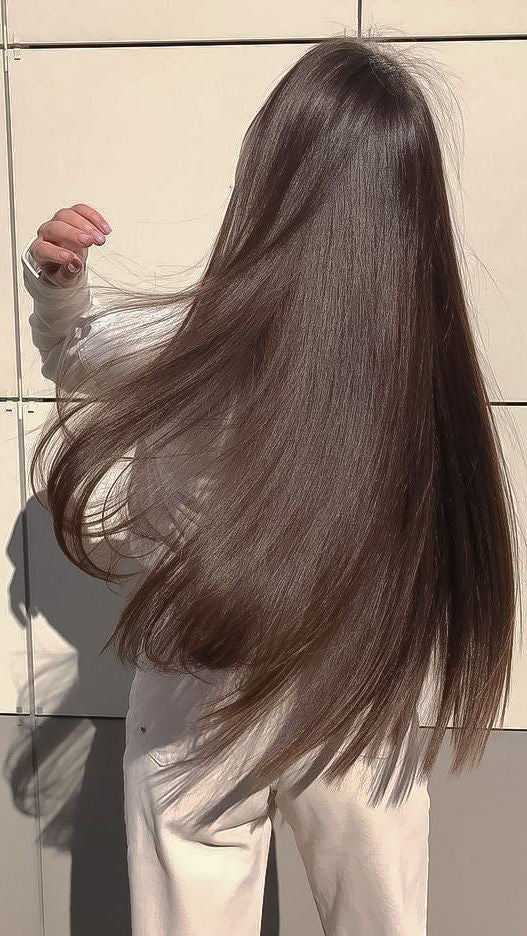

Synthetic Full Hair Extensions
Regular price $94.99 USDRegular priceUnit price per -

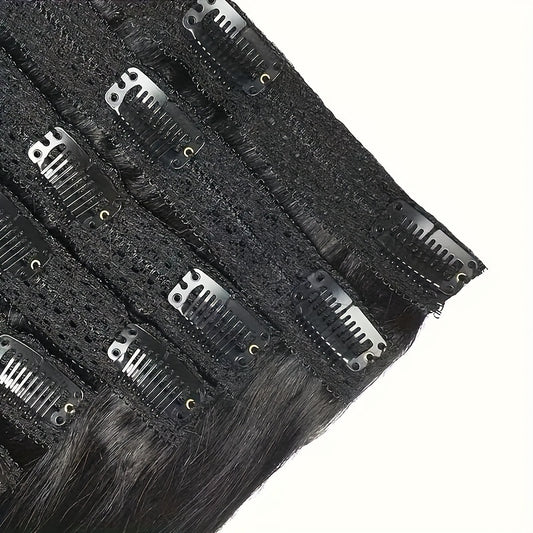
8 Pieces Straight Real Human Hair Clip In Hair Extensions | Remy Brazilian Black Human Hair | Double Wefted Clip In Hair Extension
Regular price $182.76 USDRegular priceUnit price per$82.76 USDSale price $182.76 USD

About Flat Weft Hair Extensions
What a flat weft is?
A flat weft is a continuous ribbon of human hair with an ultra slim, low profile header designed to lie close to the head. It combines the neat drape of hand tied with the flexibility of machine weft: the header is smooth, thin, and often trimmable without unraveling when sealed. The result is a row that stacks quietly, bends with the head’s curve, and disappears under a generous canopy. Because density runs along a line rather than a point, the hair moves as a sheet, which looks natural in daylight and on camera.
Why flat matters
Headers are the architecture of wefts. A thick edge can create a shelf near the crown and a visible step in bright rooms. Flat headers minimize step height, reduce bulk where rows overlap, and allow closer placement in sensitive zones while preserving comfort. The visual payout is a calm root area and a smooth fall from part to hem. Flat also simplifies styling: brushes glide, irons touch fewer edges, and blow drying creates less turbulence at row lines.
Flat versus other wefts
Hand tied weft: feather thin header, must not be cut between knots unless sealed; excels in stacks but needs care at cut points. Machine weft: robust, widely trimmable, thicker header; best for heavy density and bold outlines. Flat or genius weft: combines trim freedom with slim profile; edges are sealed or encased so fraying stays controlled. Skin or silk weft: very slim face, often used to finesse hairlines or sensitive zones; pre sized and less modular for long rows.
Choice depends on scalp sensitivity, density goals, and mapping. Flat wefts are the balanced option for many heads: enough structure to trim, slim enough to stack, quiet enough for bright rooms.
Installation paths for flat wefts
Beaded row (hidden bead): micro beads create an anchor line; the flat weft stitches across beads with thread. Sew in on braids: classic cornrow anchors with a curved needle and thread; flat headers sit neatly on braids with little bulk. Hybrid: use a short braid at high stress zones like the nape and beads elsewhere. Glue based tracks are omitted because solvent routines complicate long term fiber life; the focus is stitch methods with clean removals.
The hidden bead method is popular because it distributes load and keeps hardware off the surface; the weft covers beads so only hair is visible between sections.
Fabulive lists header types, bundle grams, and daylight end crops so buyers plan coverage instead of guessing.
Map shapes and canopy
Rows should follow the head’s curve: a lower nape row for stability, one or two occipital arcs for body, and an optional short cover strip near the crown as wind insurance. Preserve at least one to two finger widths of natural hair above the highest row—the canopy. Canopy is a concealment budget. If you overspend it by mapping too high, bright light prints seams and three quarter photos show structure. Flat headers let you sit slightly closer to the crown than thicker headers, but canopy rules still apply.
Level placement and even spacing read boring up close and invisible in motion. Diagonal rows that fight the curve torque during brushing and invite discomfort.
Bundle math and grams
Bundles are commonly sold around one hundred grams. Shorter lengths pack more strands per bundle than long lengths. As a planning ladder, fine to medium hair seeking a soft change often uses one hundred to one hundred fifty grams across two to three rows. Everyday density runs one hundred sixty to two hundred grams across three to four rows. A decisive hem for straight, studio lit finishes may use two hundred ten to two hundred sixty grams across four to five rows. Very dense natural hair or dramatic length jumps may require more.
Distribute grams where the eye lands: lowest row for edge authority, occipital arcs for body, and side panels to solve temple hollows that show first in three quarter angles. If the front reads thin while the back looks full, shift density forward rather than stacking at the nape; proportion sells realism.
Leave out and top options
Fabulive’s shade grid labels undertone clearly and shows front, side, and back in daylight, which speeds matching for flat maps.
Leave out is the hair you do not cover with rows; it blends the top so the surface reads native. Match undertone and texture closely. If your leave out is fragile or you want consistent part control, use a small closure or widen the canopy so you avoid daily heat on short fibers. Flat headers make leave out management easier because the step from top layer to row is low, which means fewer hot passes and less teasing to hide joins.
Edge care is strategy, not force. Do not tension the front trying to chase invisibility; concealment comes from canopy, row level, and undertone coherence.
Length by landmarks
When comparing row counts by length, Fabulive provides numeric ladders rather than adjectives, helping predict hem clarity before purchase.
On many frames, 14 inches meets the collarbone, 16 the upper chest, 18 mid chest, 20 lower chest, 22 near ribs, 24 toward the waist, and 26 into waist or upper hip. Waves read shorter; coils shorter still. Flat wefts make the line crisp, so choose a landing that cooperates with necklines and seated work. Measure from behind the ear to simulate row drop; measuring from the crown overestimates visible length and tempts too few grams for straight photos.
For razor straight days, carry slightly more grams than for wave days; still images do not forgive a foggy hem. A half inch micro trim after two wears pulls the outline into focus without changing the idea of length.
Texture menu and blending
Straight displays perimeter discipline and rewards low heat plus a small bevel at the ends. Body wave is the universal blender: brush it straight with one pass or set bends with complete cooling that hides joins. Loose curl and deep wave supply pattern; match coil diameter to your own for quick blending. Coily textures deserve lower rows to protect root spring and a generous canopy so the top shields headers in motion. Flat headers help here because their step height is minimal even in layered maps.
Choose texture by routine and climate, not by trend. If most days are blowouts, straight fits. If you alternate smooth and bend, body wave saves time. If you live in curls, let water shape first, product second. Proper texture choice reduces pass count and preserves fiber life.
Undertone and shade pairing
Undertone—cool, neutral, or warm—controls how color reads in real rooms. Depth is level; darker reflects less, lighter reflects more. Match undertone first, depth second. Verify by a window; indoor bulbs skew yellow or blue. Rooted and balayage wefts blur joins. If you sit between shades, slightly lighter is safer because human hair accepts cooling or deepening later with demi color; lifting lighter raises cuticles and shortens life. Mix two close shades in the same undertone family to create dimension that reads like sunlight rather than dye.
For predictable ownership, Fabulive posts wash cadence and the no sleep guideline in plain language so routines stay simple.
Keep a daylight still of your mid lengths next to chosen shades and record shade code, grams, and row count. Reorders should repeat, not reinvent.
Seam discipline and stacking
Flat headers invite tidy stacks: two or three thin bands on a beaded row create density without a bump. Seal any cut points the moment you trim to hold stitching and reduce shed. Avoid over stacking near the crown; even flat headers can build a ridge if you pile too many layers high. If the top feels thick, remove an upper stack and add a lower row; lowering volume spreads load and calms the silhouette.
If you mix rooted and balayage options, Fabulive’s product tiles place root depth next to mid and end tones so joins are easy to visualize.
Thread choice matters: smooth, strong weaving thread glides and does not fuzz. Clean stitches that wrap bead bases or pass through braids sit quiet and do not prickle.
Comfort mechanics
Comfort equals load sharing across beads or braids plus even stitch tension. Beads should match hair diameter and lie level; thread should pull firm but not bite. Rotate row positions a few millimeters between cycles so the same follicles are not loaded repeatedly. Brush with your free hand supporting the row; torque falls and joins last longer. Sleep in a loose low braid or pony to reduce nape friction and morning tangles.
If tenderness appears, remove or lighten an upper row and shift density lower. Comfort is non negotiable; invisible hair is a byproduct of low tension and clean maps.
Tools and materials
Curved needles, smooth weaving thread, silicone lined beads, and quality pliers are the core. A tail comb and sectioning clips keep order. For flat wefts, a precise scissor and a fray check or sealant at cut points are mandatory. Alcohol wipes keep tools clean. A small pouch prevents needle snags. Good tools make quiet installs; rough tools create noise, friction, and fray.
Quality shows in even bead compression, quiet stitches, and headers that lie flat without rippling. When the base is silent, styling becomes simple.
Application overview
Create clean horizontal sections that follow the head’s curve. Build anchor braids or bead lines with consistent spacing. Position the flat weft just below the section and stitch with small, even passes that wrap beads or catch braids. Secure ends so tails do not poke the scalp. Add rows from low to high, preserving canopy. Trim the perimeter on the wearer so the outline echoes their cut and face frame. Record the map—row count, grams per row, header type—and reuse the winning pattern across cycles.
Predictability is the quiet superpower of flat weft ownership; when maps repeat, mornings are quick and photos are consistent.
Finishing that reads premium
Cap tools at or under one hundred eighty Celsius or three hundred fifty Fahrenheit. One slow pass makes better sheen than multiple fast ones. Allow complete cooling before brushing into a single pattern; cooling locks shape and preserves cuticle quiet. Mist flexible hold onto the brush rather than directly on hair to avoid spots near the row line. Finish with a pea of serum on mids to ends only. Flat headers keep roots calm so shine reads from fiber, not from product.
For wave days, alternate directions in the back and go away from the face up front, then brush once after cooling. For coily days, define with water first and product second; fluff only when fully dry so the canopy shields rows.
Washing and drying
Wash two to three times per week or as your scalp requires. Keep shampoo at the scalp and let suds run through lengths. Rinse thoroughly. Condition mids to ends and detangle while saturated with a wide tooth comb or fingers; keep conditioner off rows and beads. Blot with microfiber; avoid wringing. Dry the row line fully to protect stitches and keep thread from wicking moisture. Aim airflow down the hair shaft and finish with a cool shot to set shape and reduce frizz.
Dry shampoo refreshes the canopy between washes; keep powders off stitches. Oils belong on ends, not near the row line. Quiet routines beat large product stacks.
Sleeping, gym, and swimming
Sleep in a loose braid or low pony with a soft tie to lower friction. For the gym, secure hair so sweat does not saturate row lines; salt dries cuticles and can irritate skin. After swimming, rinse promptly with fresh water, condition mids to ends, and dry rows thoroughly. Choose gel or mineral sunscreen near the hairline when possible; oils creep into stitches and beads.
Outerwear and seat backs add rub; sweep hair forward before zipping jackets, choose smooth strap bags, and brush once after long seating or travel.
Maintenance rhythm and move ups
Expect move ups every six to ten weeks depending on growth, climate, and routine. Beaded rows slide up quickly; sew ins on braids may require new braids. Replace tired beads, fuzzy thread, or stressed headers promptly; hardware is a service part. Rotate row positions slightly so the same follicles are not loaded repeatedly. Keep a compact record each visit—row count, grams, bead color, header type, trim notes—so results repeat exactly.
Flat wefts age gracefully when handled with measured tension and clean tools; the profile stays slim and rows remain quiet across cycles.
Troubleshooting quick list
Row feels tight or pinches: bead too small or stitch too tense; open, remap, or resew with lighter tension. Header prickles: unsealed cut or thread tail; seal and tuck. Crown prints in strong light: top row sits too high or stacks are heavy; lower the map and lighten the upper stack. Hem looks hazy in straight photos: grams too low on the lowest row or draw too soft; add weight low or schedule a micro trim.
Temple hollows visible: add narrow side panels and trim on a diagonal to echo your face frame. Tangling near nape: friction from collars and straps; sweep hair forward before zipping, brush once after removing layers, or shorten length slightly for heavy outerwear season.
Photography and optics
Phones auto white balance and shift mid shot. Decide once how your hair reads in three scenes: window daylight, warm home bulbs, and office LEDs. Lock white balance for publishing so undertone stays consistent. Daylight stills of ends at rest reveal whether grams and draw are sufficient. If ends look foggy, add weight to the lowest row or request a half inch trim. If rows flash at the part, the top row is too high or canopy too thin; lower the map and keep the top layer generous.
Rooms tint color. Wood warms, white walls cool, and stainless neutralizes. Plan your usual spots and hair will look expensive with less heat and fewer products.
Ownership economics
Flat weft systems reuse hair for many cycles with modest adjustments. Install and maintenance take calendar time, but cost per wear spreads across months because you replace thread, beads, and occasional headers rather than entire sets. People who value predictable mornings and a steady silhouette under cameras often find the time investment returned in fewer daily passes and fewer product experiments. Measured heat, clean rows, and tidy records are the core of low stress ownership.
Because removal is stitch based, shedding and scalp stress are controlled when handled calmly. The ability to shift density forward for a season or brighten a face frame without permanent dye is a practical advantage over single piece methods.
Glossary
Flat weft: a thin, low profile weft with a trimmable, sealed header. Header: the stitched edge of a weft; thinner on hand tied, thicker on machine, minimal on flat or genius. Row: the path along which a weft is sewn or stitched. Bead line: micro beads placed along a row to anchor a weft. Canopy: the unwefted top layer that conceals hardware and rows.
Draw: how density carries toward the ends—single tapers, double stays thick. Occipital arc: the back curve of the head where structural rows sit. Bevel: a small inward curve at the ends that reads like a fresh cut. Cooling rule: let heat shaped hair cool fully before brushing so shape sets and shine stays natural.
Summary
Flat weft hair extensions succeed when rows sit low under a generous canopy, grams match the finish goal, undertone is confirmed in daylight, stitches are even, and finishing respects capped heat with complete cooling. Treat side panels as face balancing tools, keep row lines clean and comfortable, and record shade codes, grams, row counts, header types, and settings so results repeat quickly. The outcome is a flat laying, camera calm silhouette that looks like your hair on its best day with less effort and fewer products.
If any step becomes unclear, return to the sequence: section in arcs, build low, stitch even, preserve canopy, cap heat, cool fully, brush once. Small, repeatable moves beat hacks every time.
Mechanical view of flat headers on a curve
A flat header behaves like a flexible strip on a curved surface. Stability rises when header thickness matches curvature and stitches land at regular intervals. Torque during brushing falls when you support the row with a free hand. Low placement preserves canopy so light cannot print seams under LEDs or sun. These mechanics explain why even, level rows with flat headers feel lighter and remain invisible longer than thicker, towered builds near the crown.
Mechanical view of flat headers on a curve
A flat header behaves like a flexible strip on a curved surface. Stability rises when header thickness matches curvature and stitches land at regular intervals. Torque during brushing falls when you support the row with a free hand. Low placement preserves canopy so light cannot print seams under LEDs or sun. These mechanics explain why even, level rows with flat headers feel lighter and remain invisible longer than thicker, towered builds near the crown.
Mechanical view of flat headers on a curve
A flat header behaves like a flexible strip on a curved surface. Stability rises when header thickness matches curvature and stitches land at regular intervals. Torque during brushing falls when you support the row with a free hand. Low placement preserves canopy so light cannot print seams under LEDs or sun. These mechanics explain why even, level rows with flat headers feel lighter and remain invisible longer than thicker, towered builds near the crown.
Mechanical view of flat headers on a curve
A flat header behaves like a flexible strip on a curved surface. Stability rises when header thickness matches curvature and stitches land at regular intervals. Torque during brushing falls when you support the row with a free hand. Low placement preserves canopy so light cannot print seams under LEDs or sun. These mechanics explain why even, level rows with flat headers feel lighter and remain invisible longer than thicker, towered builds near the crown.
Mechanical view of flat headers on a curve
A flat header behaves like a flexible strip on a curved surface. Stability rises when header thickness matches curvature and stitches land at regular intervals. Torque during brushing falls when you support the row with a free hand. Low placement preserves canopy so light cannot print seams under LEDs or sun. These mechanics explain why even, level rows with flat headers feel lighter and remain invisible longer than thicker, towered builds near the crown.
Mechanical view of flat headers on a curve
A flat header behaves like a flexible strip on a curved surface. Stability rises when header thickness matches curvature and stitches land at regular intervals. Torque during brushing falls when you support the row with a free hand. Low placement preserves canopy so light cannot print seams under LEDs or sun. These mechanics explain why even, level rows with flat headers feel lighter and remain invisible longer than thicker, towered builds near the crown.
Mechanical view of flat headers on a curve
A flat header behaves like a flexible strip on a curved surface. Stability rises when header thickness matches curvature and stitches land at regular intervals. Torque during brushing falls when you support the row with a free hand. Low placement preserves canopy so light cannot print seams under LEDs or sun. These mechanics explain why even, level rows with flat headers feel lighter and remain invisible longer than thicker, towered builds near the crown.
Mechanical view of flat headers on a curve
A flat header behaves like a flexible strip on a curved surface. Stability rises when header thickness matches curvature and stitches land at regular intervals. Torque during brushing falls when you support the row with a free hand. Low placement preserves canopy so light cannot print seams under LEDs or sun. These mechanics explain why even, level rows with flat headers feel lighter and remain invisible longer than thicker, towered builds near the crown.
Mechanical view of flat headers on a curve
A flat header behaves like a flexible strip on a curved surface. Stability rises when header thickness matches curvature and stitches land at regular intervals. Torque during brushing falls when you support the row with a free hand. Low placement preserves canopy so light cannot print seams under LEDs or sun. These mechanics explain why even, level rows with flat headers feel lighter and remain invisible longer than thicker, towered builds near the crown.
Mechanical view of flat headers on a curve
A flat header behaves like a flexible strip on a curved surface. Stability rises when header thickness matches curvature and stitches land at regular intervals. Torque during brushing falls when you support the row with a free hand. Low placement preserves canopy so light cannot print seams under LEDs or sun. These mechanics explain why even, level rows with flat headers feel lighter and remain invisible longer than thicker, towered builds near the crown.
Mechanical view of flat headers on a curve
A flat header behaves like a flexible strip on a curved surface. Stability rises when header thickness matches curvature and stitches land at regular intervals. Torque during brushing falls when you support the row with a free hand. Low placement preserves canopy so light cannot print seams under LEDs or sun. These mechanics explain why even, level rows with flat headers feel lighter and remain invisible longer than thicker, towered builds near the crown.
Mechanical view of flat headers on a curve
A flat header behaves like a flexible strip on a curved surface. Stability rises when header thickness matches curvature and stitches land at regular intervals. Torque during brushing falls when you support the row with a free hand. Low placement preserves canopy so light cannot print seams under LEDs or sun. These mechanics explain why even, level rows with flat headers feel lighter and remain invisible longer than thicker, towered builds near the crown.
Mechanical view of flat headers on a curve
A flat header behaves like a flexible strip on a curved surface. Stability rises when header thickness matches curvature and stitches land at regular intervals. Torque during brushing falls when you support the row with a free hand. Low placement preserves canopy so light cannot print seams under LEDs or sun. These mechanics explain why even, level rows with flat headers feel lighter and remain invisible longer than thicker, towered builds near the crown.
Mechanical view of flat headers on a curve
A flat header behaves like a flexible strip on a curved surface. Stability rises when header thickness matches curvature and stitches land at regular intervals. Torque during brushing falls when you support the row with a free hand. Low placement preserves canopy so light cannot print seams under LEDs or sun. These mechanics explain why even, level rows with flat headers feel lighter and remain invisible longer than thicker, towered builds near the crown.
Mechanical view of flat headers on a curve
A flat header behaves like a flexible strip on a curved surface. Stability rises when header thickness matches curvature and stitches land at regular intervals. Torque during brushing falls when you support the row with a free hand. Low placement preserves canopy so light cannot print seams under LEDs or sun. These mechanics explain why even, level rows with flat headers feel lighter and remain invisible longer than thicker, towered builds near the crown.
Mechanical view of flat headers on a curve
A flat header behaves like a flexible strip on a curved surface. Stability rises when header thickness matches curvature and stitches land at regular intervals. Torque during brushing falls when you support the row with a free hand. Low placement preserves canopy so light cannot print seams under LEDs or sun. These mechanics explain why even, level rows with flat headers feel lighter and remain invisible longer than thicker, towered builds near the crown.
Mechanical view of flat headers on a curve
A flat header behaves like a flexible strip on a curved surface. Stability rises when header thickness matches curvature and stitches land at regular intervals. Torque during brushing falls when you support the row with a free hand. Low placement preserves canopy so light cannot print seams under LEDs or sun. These mechanics explain why even, level rows with flat headers feel lighter and remain invisible longer than thicker, towered builds near the crown.
Mechanical view of flat headers on a curve
A flat header behaves like a flexible strip on a curved surface. Stability rises when header thickness matches curvature and stitches land at regular intervals. Torque during brushing falls when you support the row with a free hand. Low placement preserves canopy so light cannot print seams under LEDs or sun. These mechanics explain why even, level rows with flat headers feel lighter and remain invisible longer than thicker, towered builds near the crown.
Mechanical view of flat headers on a curve
A flat header behaves like a flexible strip on a curved surface. Stability rises when header thickness matches curvature and stitches land at regular intervals. Torque during brushing falls when you support the row with a free hand. Low placement preserves canopy so light cannot print seams under LEDs or sun. These mechanics explain why even, level rows with flat headers feel lighter and remain invisible longer than thicker, towered builds near the crown.
Mechanical view of flat headers on a curve
A flat header behaves like a flexible strip on a curved surface. Stability rises when header thickness matches curvature and stitches land at regular intervals. Torque during brushing falls when you support the row with a free hand. Low placement preserves canopy so light cannot print seams under LEDs or sun. These mechanics explain why even, level rows with flat headers feel lighter and remain invisible longer than thicker, towered builds near the crown.
Mechanical view of flat headers on a curve
A flat header behaves like a flexible strip on a curved surface. Stability rises when header thickness matches curvature and stitches land at regular intervals. Torque during brushing falls when you support the row with a free hand. Low placement preserves canopy so light cannot print seams under LEDs or sun. These mechanics explain why even, level rows with flat headers feel lighter and remain invisible longer than thicker, towered builds near the crown.
Customer reviews
- Hidden bead row with two flat stacks gave me a clean outline and zero printing at the part. — Natalie Brooks, USA ⭐⭐⭐⭐⭐
- Bundle grams matched the page and the hem looks deliberate after a half inch trim; move up at week seven was quick. — Thomas Clarke, United Kingdom ⭐⭐⭐⭐⭐
- I’m tender headed and the slim header felt comfortable; sleeping in a loose braid kept the nape calm. — Zoe Parker, Australia ⭐⭐⭐⭐
- Neutral brown with a soft root blended instantly; two narrow side panels filled my temple hollows for photos. — Ethan Moreau, Canada ⭐⭐⭐⭐⭐
- Machine split sealed under a flat header stacked perfectly; the back looks full without crown puff. — Giulia Bianchi, Italy ⭐⭐⭐⭐⭐
- Shipping took a day longer so four stars, but the thread glides and stitches sit flat with no prickle. — Felix Schneider, Germany ⭐⭐⭐⭐
- On Zoom the part stays clean and rows are invisible; mapping low and preserving canopy made the difference. — Amélie Bernard, France ⭐⭐⭐⭐⭐
- Wind on the quay and a tiny part shift still hid everything; notes on row counts helped us repeat the exact map. — Finn O’Donnell, Ireland ⭐⭐⭐⭐⭐
- First flat weft set and the section–stitch–cool rhythm clicked; I logged grams, header type, and trim notes for next time. — Aya Nakamura, Japan ⭐⭐⭐⭐⭐
- Gym to dinner in one day; a single brush resets the hem and tangles stay minimal with a low braid at night. — Lucas Müller, Switzerland ⭐⭐⭐⭐⭐